Should You Store Reusable Press-On Nails in a Humid Bathroom?
Diagnose bathroom-storage problems involving moisture, heat cycling, residue, contamination, and adhesive storage.
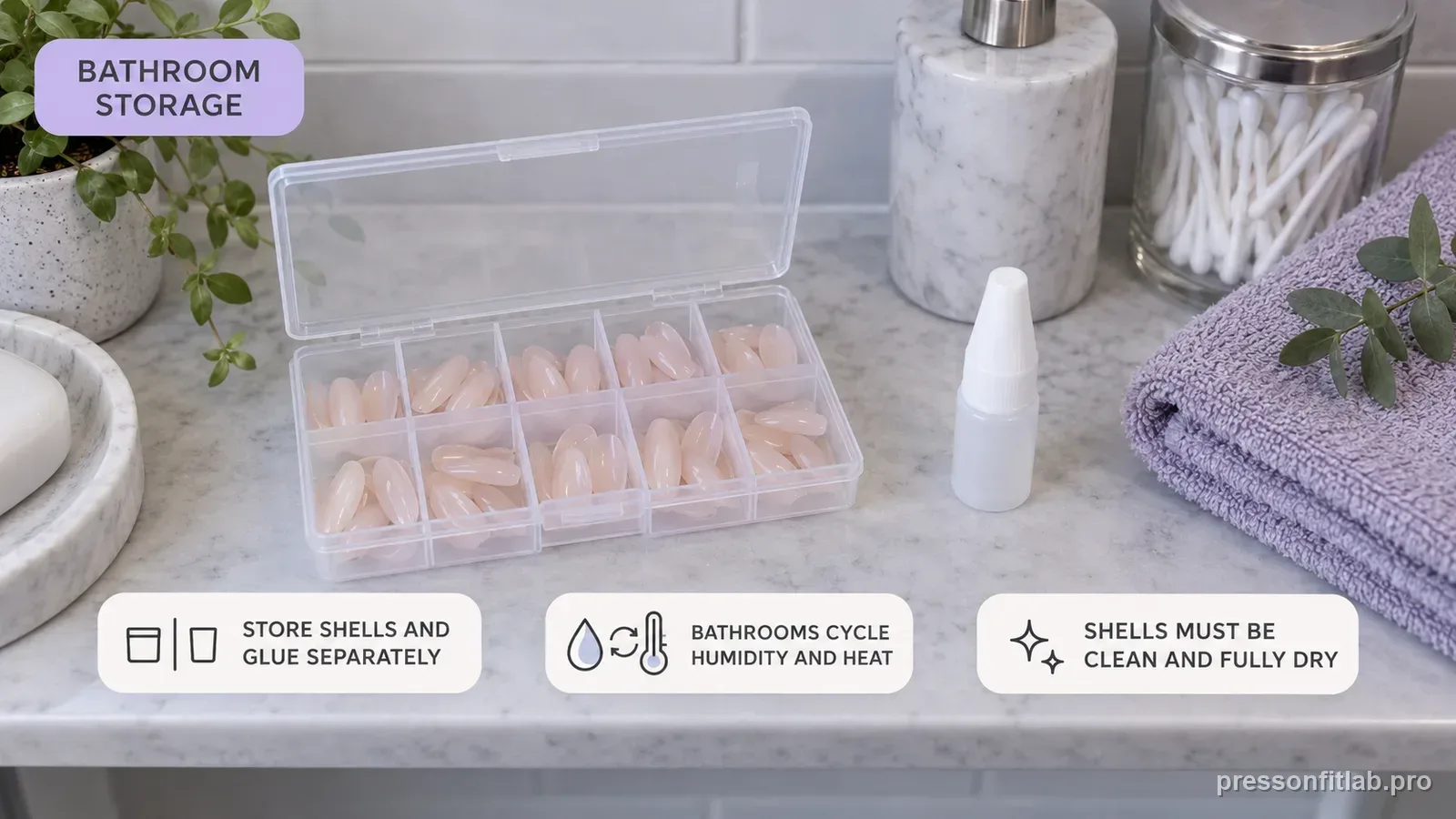
A humid bathroom is a poor default storage location for reusable press-ons and adhesive supplies. Reusable-shell guidance favors a clean, dry container, while cyanoacrylate shelf life and cure behavior are affected by temperature and humidity. Store cleaned, fully dry shells in a closed dry container away from repeated shower steam, and store nail glue according to its own manufacturer directions.
Check these first
- ✓ Does the storage area become steamy during showers?
- ✓ Are shells fully dry before the container is closed?
- ✓ Is old adhesive residue still tacky and collecting lint?
- ✓ Is the glue bottle stored in the same warm humid cabinet?
- ✓ Have reused shells become dirty, uneven, warped, or harder to fit?
Separate shell storage from glue storage
Reusable press-on shells and liquid adhesive have different storage needs. The shell mainly needs cleanliness, dryness, organization, and shape protection; the glue has chemistry-specific shelf-life instructions.
Treat storage as preservation of a future bonding surface. The underside should remain dry, clean, flat, and identifiable by finger. Glamnetic's current reuse guidance says to clean off residual adhesive and store reusable nails in their original kit away from dust. That supports the practical storage principle here: keep the future bonding surface protected and dry rather than leaving cleaned shells exposed for convenience.
Bathrooms repeatedly cycle humidity and temperature
Shower steam raises local humidity and warmth, then the room cools and dries. That repeated cycling offers no benefit to a future bonding surface.
Bathroom humidity is episodic: a hot shower raises moisture and temperature, then the room cools and dries. Repeating that cycle adds no benefit to reusable shells and can keep adhesive residue or trapped dust less predictable. A closed organizer in a consistently dry room removes this variable at essentially zero cost.
Store reusable shells clean and fully dry
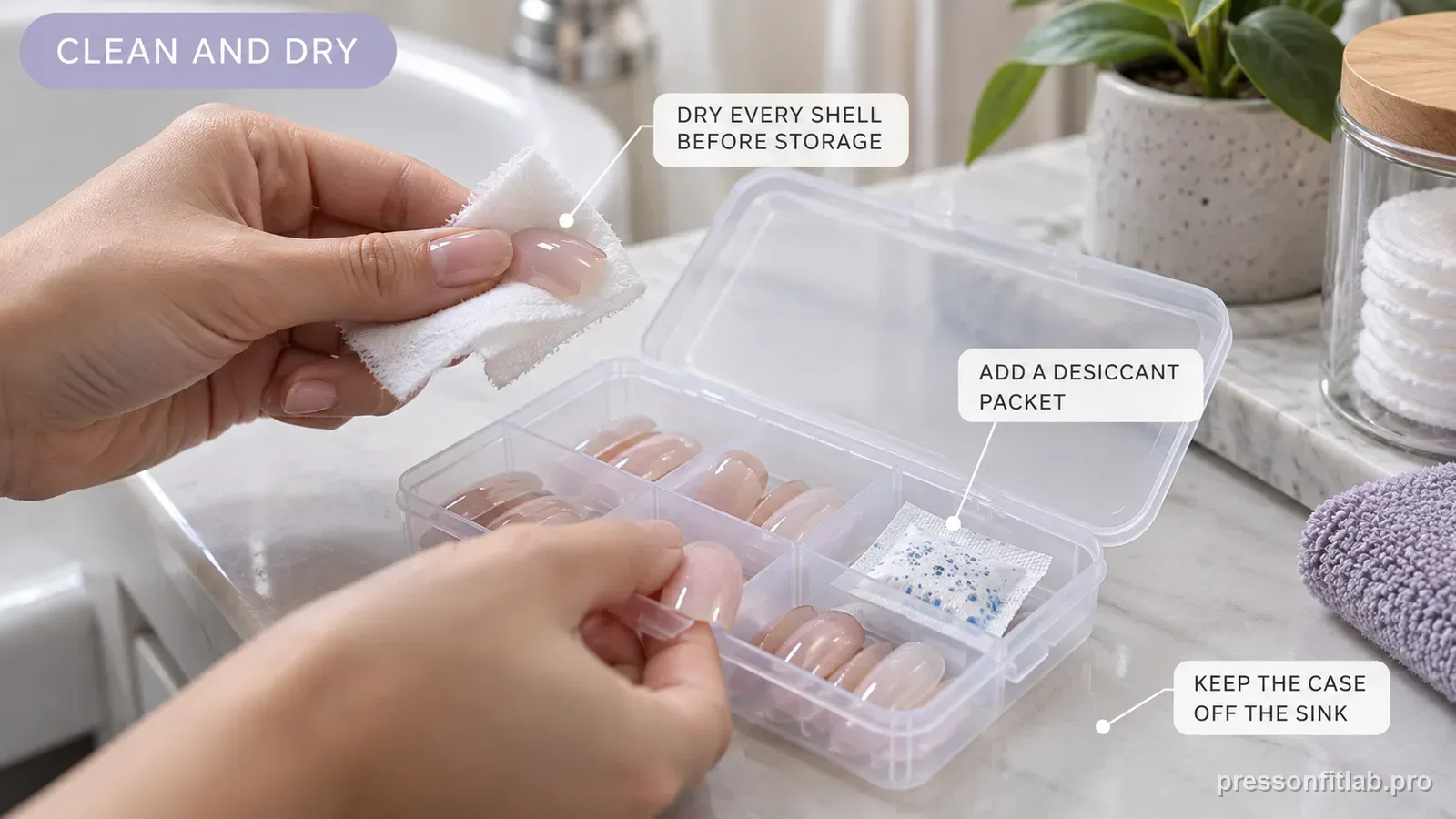
Glamnetic’s reuse guidance recommends a clean dry container and mentions silica gel as an optional moisture absorber. Do not close freshly washed shells into storage while water remains on the underside.
Opened cyanoacrylate is even more sensitive to storage conditions than the plastic shell. Permabond explains that moisture entering the package and ambient temperature/humidity affect usable life. A nail-glue label may specify different storage, so keep the bottle according to its own directions rather than storing it wherever the nail box happens to live.
Cyanoacrylate storage deserves separate attention
Permabond documents the influence of temperature and humidity on cyanoacrylate shelf life and cure. Follow the nail-glue label rather than assuming a steamy bathroom cabinet is chemically neutral.
Residue management matters because an uneven glue mound physically changes future fit. Before storage, decide whether the shell's reuse method allows glue removal now or later, then keep the underside from contacting lint and oils. A hard lump under one side can make a previously perfect shell rock during the next dry fit.
Bathroom contamination is not only water
Hair products, lotions, aerosols, powders, and general dust can settle on an open organizer. The underside of a reusable press-on should be treated as a future bonding surface, not merely the hidden side.
If a shell has visibly warped, cracked, whitened under stress, or no longer sits on a flat reference surface the way its matching mate does, retire it. Storage troubleshooting is not about proving humidity caused the deformation; it is about refusing to compensate for altered geometry with more adhesive.
Inspect geometry before every reuse
Before reapplication, check for cracks, warping, adhesive lumps, oily film, and edge damage. A shell that no longer sits flat should not be rescued by filling the gap with more glue.
Labeling right and left matters more after multiple uses because many shells become subtly customized through filing. A right index that was narrowed on one side may look nearly identical to its left counterpart in the box. Keeping positions separate prevents a storage mix-up from masquerading as a mysterious new fit problem.
Diagnostic table
| What you see | What it suggests | Next check |
|---|---|---|
| Shells feel damp after storage | Container/room retained moisture | Dry completely and move to a dry location |
| Underside collects lint/debris | Residual adhesive stayed exposed | Clean appropriately before storage |
| Glue performance changes after bathroom storage | Storage conditions may be unsuitable | Follow adhesive storage guidance and replace questionable product |
| Reused shell rocks | Warp or uneven residue changed geometry | Clean/refit; retire shell if it no longer sits flat |
| Clean shells become oily | Open storage contamination | Use a closed organizer away from sprays and lotions |
A controlled test plan
- 1
Clean a reusable set and let it dry completely.
- 2
Move it to a closed dry container outside the bathroom.
- 3
Store liquid glue separately according to its label.
- 4
At the next use, inspect underside cleanliness and dry-fit geometry first.
- 5
Compare wear before changing any additional variables.
What not to do
- Putting damp shells into a sealed box
- Leaving reusable press-ons exposed on a bathroom counter
- Storing opened glue in steam without checking instructions
- Filling a warped shell with extra adhesive
- Assuming a tidy-looking organizer is contaminant-free
Worked troubleshooting example
Lena kept reusable press-ons in an open bathroom tray. After several cycles she found lint embedded in residue and experienced inconsistent reapplication.
She cleaned the reusable shells, dried them fully, labeled their positions, and moved them to a closed dry drawer. The glue was stored separately according to its own instructions.
At the next application she could dry-fit and bond to a clean underside instead of compensating for contaminated residue with more adhesive.
Field notes
The bathroom issue is usually cumulative rather than dramatic. Dry storage simply removes a variable that provides no benefit.
The underside deserves the same cleanliness mindset as any other bonding surface because residue can change both fit and adhesion.
Frequently asked questions
Will one shower ruin stored press-ons?
Not necessarily. The recommendation is about avoiding repeated unnecessary humidity and contamination over time.
Should I use silica gel in the storage box?
Some reusable-press-on guidance suggests it as an optional moisture absorber; keep packets safely contained.
Should nail glue be refrigerated?
Storage depends on the specific adhesive and whether it is opened. Follow the nail-glue manufacturer rather than one universal rule.
Sources checked
Sources below are page-specific. We prioritize manufacturer directions for product-specific steps and use medical or dermatology guidance when a safety question requires it. Always follow the instructions for the exact adhesive or set you own.