Why Is My Nail Turning Yellow Under a Press-On?
Separate cosmetic surface staining from moisture-related discoloration and nail changes that should not be covered again.
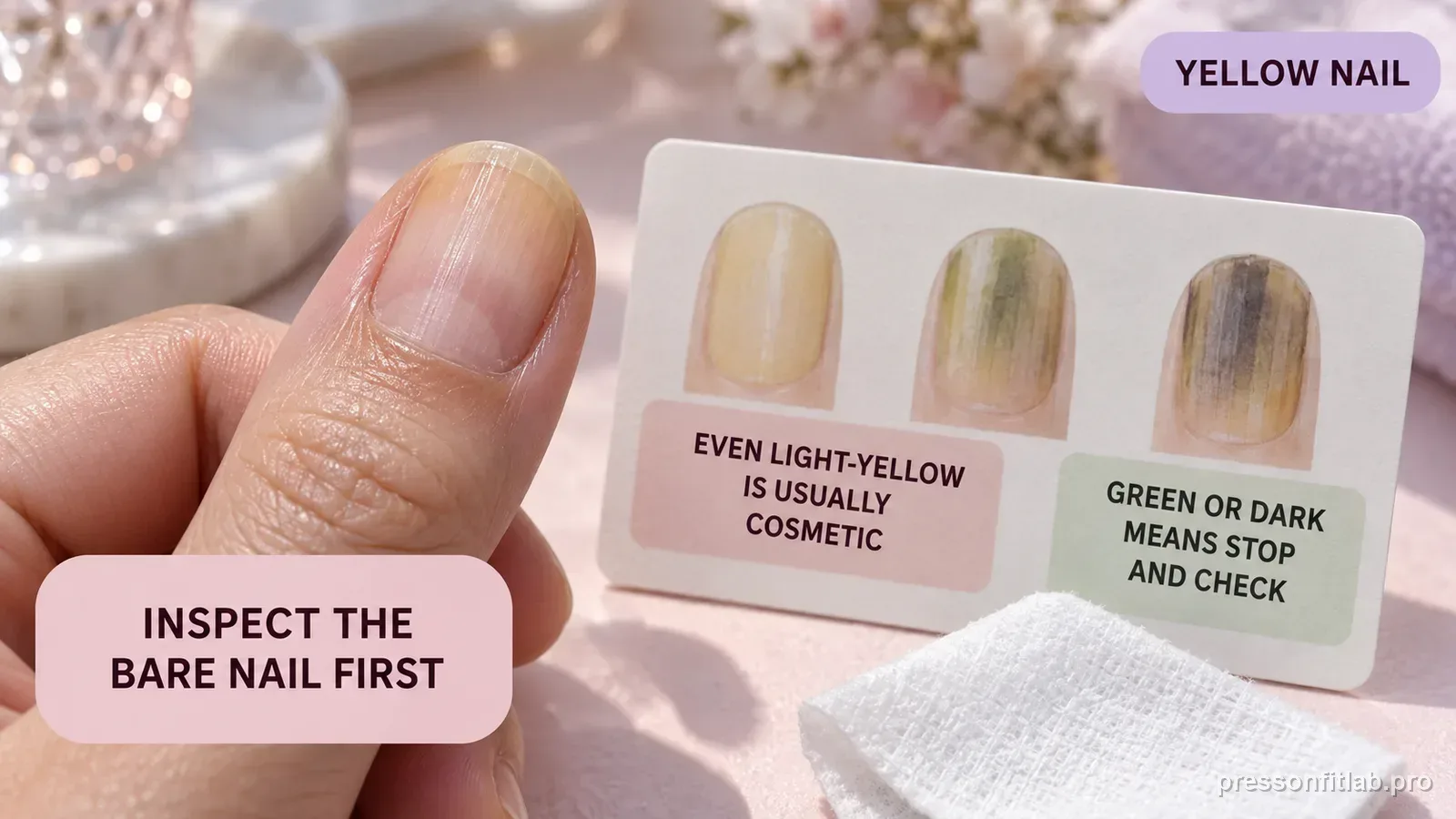
Yellow color after press-on removal is not automatically glue damage. First determine whether the change is a smooth superficial stain or is accompanied by thickening, crumbling, lifting, pain, odor, redness, drainage, green color, or progression. A stable cosmetic stain can be monitored as it grows out, but an abnormal or worsening nail should be left uncovered and assessed.
Check these first
- ✓ Is the yellow area smooth or is the plate thick, crumbly, soft, or lifted?
- ✓ Is the change limited to one nail or appearing on several?
- ✓ Was there a lifted edge that repeatedly admitted water?
- ✓ Is the color green, dark, or black rather than pale yellow?
- ✓ Is there pain, redness, swelling, odor, or drainage?
Inspect the bare nail before deciding
Remove the press-on gently, clear loose residue without scraping the plate thin, and inspect in neutral light. Color alone is less informative than color plus texture, attachment, pain, and progression.
Start by separating pigment from structure. A cosmetic stain usually follows the surface it contacted and the plate remains smooth. A nail-health problem is more concerning when color is paired with change in thickness, attachment, texture, odor, drainage, or surrounding skin. That combined pattern is more useful than debating whether the yellow looks warm, pale, or mustard-toned.
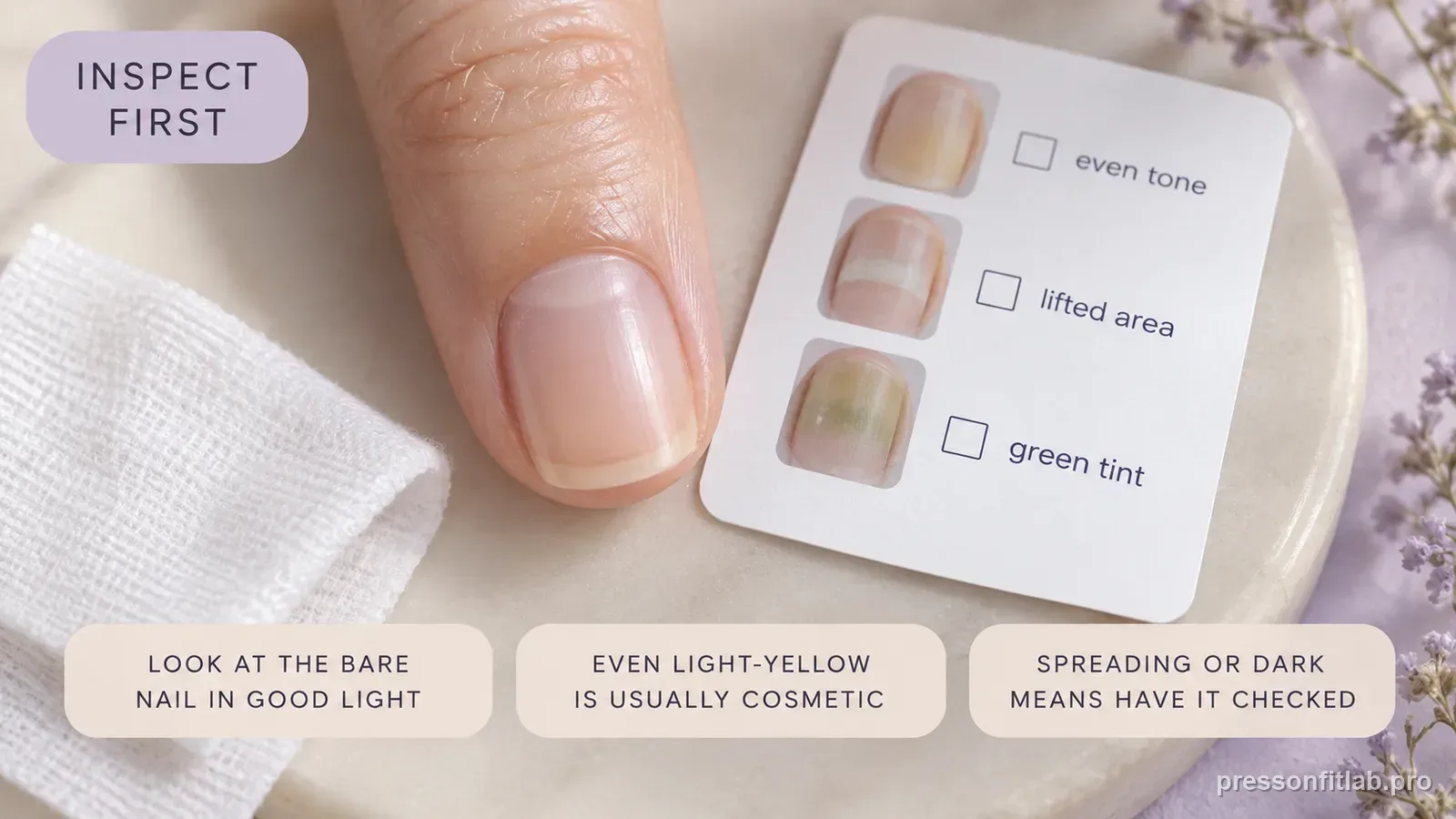
Cosmetic staining has a different pattern
Nail products can stain the plate yellow. A smooth, attached, painless nail with stable color presents a different picture from a thickened, friable, lifting, or inflamed nail. Avoid repeated buffing just to erase color.
AAD notes that nail polish can leave temporary yellow discoloration, which gives you a noninfectious comparison pattern: stable color, no tenderness, and gradual movement toward the free edge as the nail grows. That is very different from a change that spreads proximally, becomes crumbly, or develops under an increasingly separated nail plate.
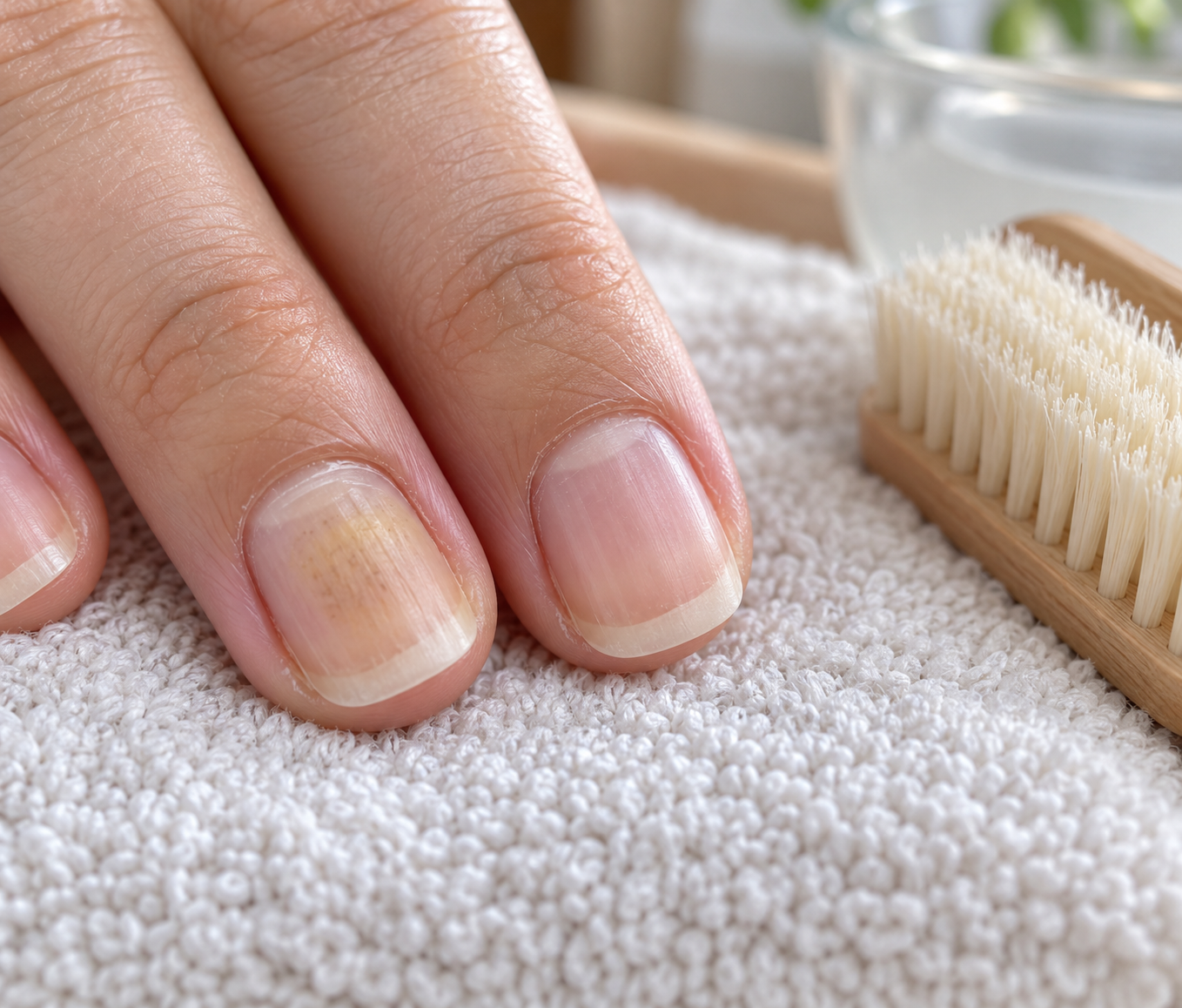
A lifted shell changes the moisture question
The relevant water exposure is not simply showering; it is water gaining access under a partially detached shell. If a gap stayed open for days and the nail changed color, remove the covering, dry the nail, and fix the original lifting cause before future wear.
Moisture itself does not prove infection, but a repeatedly wet pocket changes the risk context because organisms and debris have a protected space. If you find an open edge, treat that edge as failed even if the rest of the press-on still feels attached. Continuing to reseal only the visible gap can hide what is happening underneath.
Yellow can also accompany nail disease
Fungal nail infection may cause yellow or other discoloration together with thickening, crumbling, debris, or separation. Those findings cannot be diagnosed from color alone, so do not seal a progressively abnormal nail under another artificial shell.
Fungal nail disease is not diagnosed by yellow color alone. DermNet describes multiple possible appearances, including discoloration with subungual scaling, thickening, and separation. If those structural signs are present, another press-on would make monitoring harder and can delay getting the nail properly examined or tested.
Green or dark discoloration raises a different concern
Green, green-black, or spreading dark change—especially with separation, odor, pain, or drainage—belongs in a health-evaluation pathway rather than routine cosmetic troubleshooting.
Green or green-black deserves a separate branch because bacterial colonization can produce a distinct color pattern in separated nails. Do not scrape deeply to ‘clean it out’ or cover it with opaque polish. The useful action is to remove artificial coverage, keep the area observable, and seek professional assessment when the change is persistent or concerning.
Reapply only after the nail passes a basic health check
The nail should be intact, dry, comfortable, and free from unexplained progressive change before another set. If a mechanical gap allowed moisture in, correct size, curve, or replacement timing instead of immediately covering the same nail.
For future prevention, the mechanical question is how liquid first got access. Recurrent cuticle lifting points toward cuticle fit or placement; one lateral pocket points toward width or curve; center lifting suggests interior curvature mismatch. Solving that entry route is more useful than adding a blanket rule such as ‘never get press-ons wet.’
Do not diagnose color from a photo or cover it up
A surface stain from polish or product residue can look different from a nail that is thickening, crumbling, separating, painful, or changing over time. Color alone cannot identify the cause. Gently remove only what releases according to the product directions; do not scrape, aggressively buff, bleach, or reapply a tip simply to hide an unexplained change.
Leave the nail uncovered long enough to inspect its color, surface, and attachment. If discoloration persists, spreads, or appears with thickening, crumbling, separation, swelling, or pain, ask a clinician rather than treating it as a glue problem.
Diagnostic table
| What you see | What it suggests | Next check |
|---|---|---|
| Pale yellow, smooth, attached, painless | Possible surface staining | Leave uncovered briefly and monitor growth |
| Yellow plus thickening or crumbling | Possible nail disorder including fungal infection | Do not re-cover; seek appropriate assessment |
| Color beneath a previously lifted edge | Moisture and debris reached the underside | Remove, dry, inspect, and correct the lifting cause |
| Green or green-black change | Possible bacterial involvement | Leave uncovered and obtain medical evaluation |
| Redness, swelling, drainage, or significant pain | Inflammation or infection | Stop press-ons and seek care |
| Yellowing plus thickening, crumbling, separation or pain | Needs assessment; color alone cannot diagnose cause | Leave uncovered and ask a clinician rather than masking it |
A controlled test plan
- 1
Remove the shell without force and gently clear loose residue.
- 2
Photograph color, texture, attachment, and surrounding skin in consistent light.
- 3
Leave the nail uncovered and dry rather than immediately reapplying.
- 4
Compare over the next several days for stability versus progression.
- 5
Seek evaluation if color spreads or structural, painful, green, or inflammatory changes appear.
What not to do
- Assuming every yellow nail is glue staining
- Sealing discoloration under another press-on before inspection
- Buffing deeply until the color disappears
- Ignoring green, dark, painful, crumbling, or separating changes
- Leaving a partially lifted shell in place while water repeatedly enters
Worked troubleshooting example
Leah removed a ring-finger press-on after six days and found a pale yellow patch. She first assumed the glue had damaged her nail.
The nail was smooth, attached, painless, and not swollen; she also remembered wearing pigmented polish before the press-on. She left the nail uncovered instead of aggressively buffing it.
The patch remained stable and moved outward with growth. A green, crumbling, painful, or progressively lifting nail would have changed the plan to medical evaluation rather than another adhesive test.
Field notes
The most useful distinction is often whether the plate still behaves like a normal nail: smooth, firm, attached, and comfortable versus soft, thickened, lifted, friable, or painful.
A same-light photograph immediately after removal is more reliable than memory when deciding whether the change is actually progressing.
Frequently asked questions
Does yellow color automatically mean nail fungus?
No. Cosmetic staining and several nail conditions can produce yellow tones. Texture, attachment, progression, and clinical assessment matter.
Can I put another press-on over a yellow nail?
Not until you understand the change. Leaving it visible lets you see whether the nail is stable or worsening.
What if the nail is green rather than yellow?
Treat green or green-black discoloration as a different warning sign and avoid covering it while you seek appropriate assessment.
Sources checked
Sources below are page-specific. We prioritize manufacturer directions for product-specific steps and use medical or dermatology guidance when a safety question requires it. Always follow the instructions for the exact adhesive or set you own.