Can You Sleep Right After Applying Press-On Nails?
Learn when a freshly applied press-on set is ready for bed, what still needs to set, and why product directions matter more than an arbitrary overnight rule.
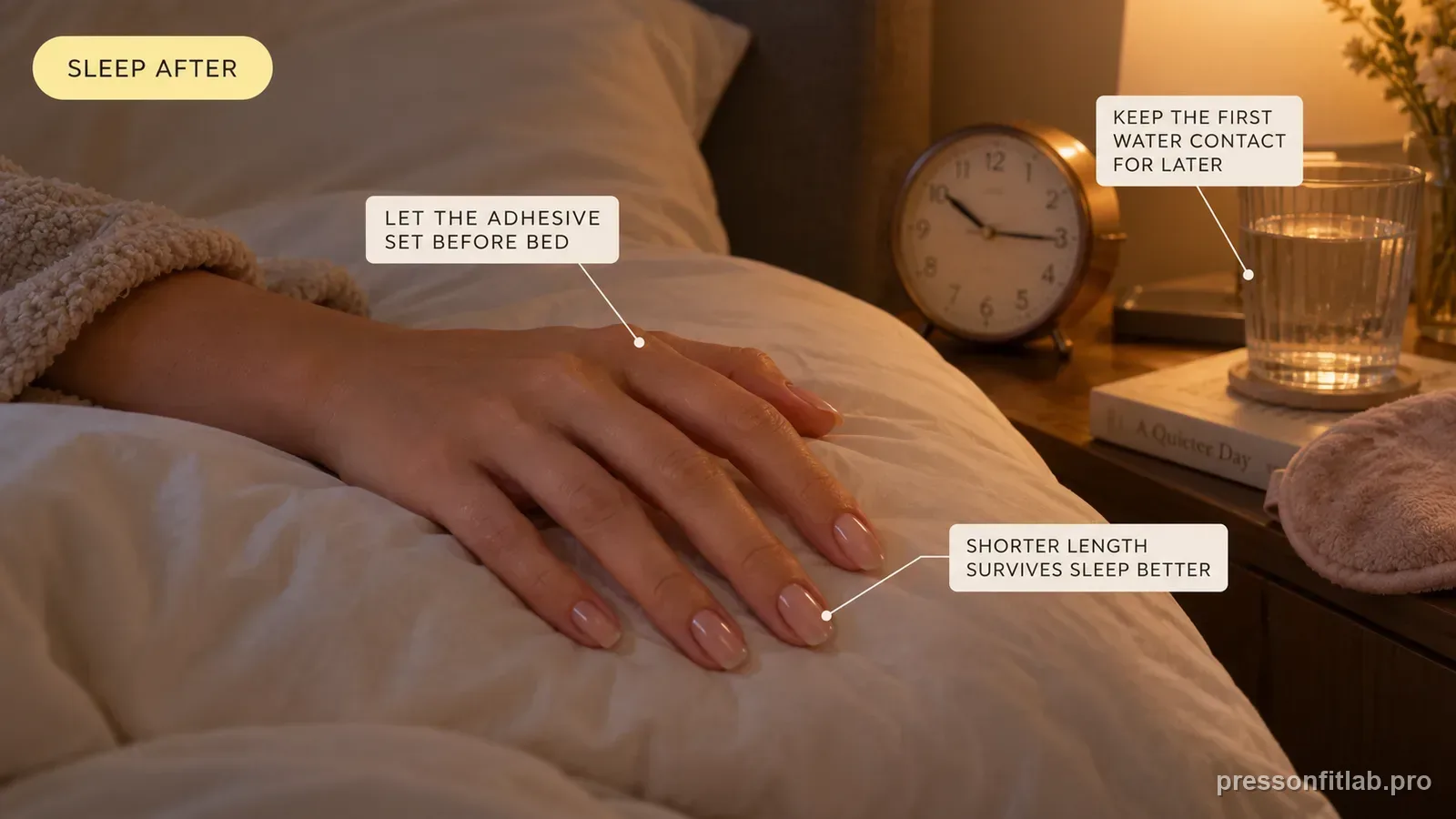
Usually, once the application is complete according to the exact product directions, the nails are aligned, and no wet adhesive remains on skin. Sleeping is not a special curing method. The useful part of an evening application is simply that you may have several low-water, low-impact hours afterward; follow the product's stated early-wear guidance first.
Check these first
- ✓ Did you complete the full hold/press step for your adhesive?
- ✓ Is any glue still wet on skin or around the cuticle edge?
- ✓ Does the manufacturer give a water-avoidance period after application?
- ✓ Are any nails crooked, rocking, or already lifting before bed?
Bedtime is convenient, not magical
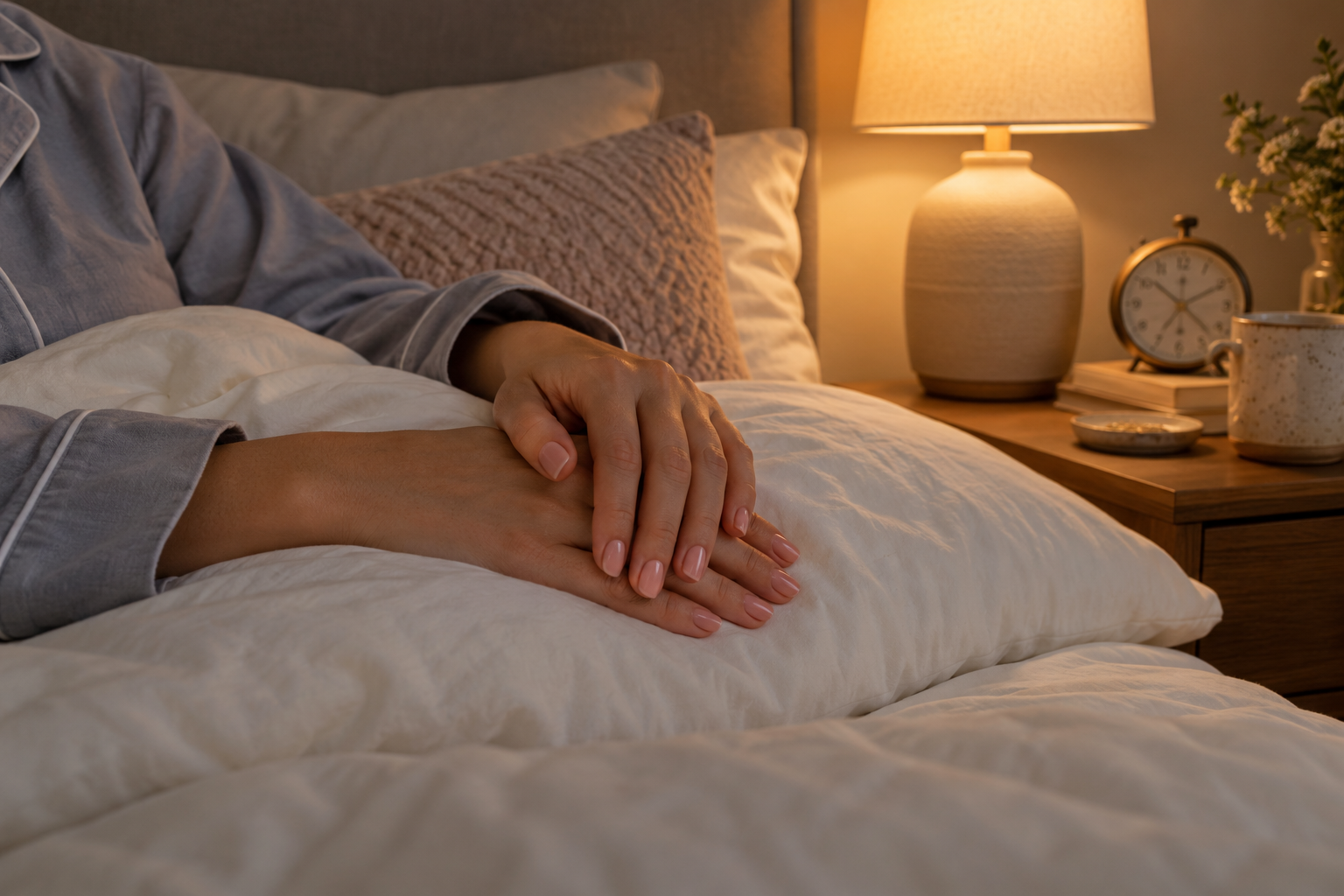
Applying press-ons at night can be practical because the next few hours often involve less dishwashing, showering, hand cream, and repetitive hand use. That quiet period may help you avoid disturbing a new bond. But sleep itself does not replace the application instructions, and a set that was poorly fitted at 10 p.m. will not become well fitted by morning.
Treat bedtime as a scheduling choice. Finish the application correctly, inspect all ten nails, and then use the low-activity window to keep water and leverage to a minimum. If your adhesive maker specifies a particular hold time or water-avoidance period, use that instruction rather than a generic “leave it overnight” rule.
Finish the adhesive step before you get into bed
Each nail should already be fully seated before you stop paying attention to it. Press the tip according to the product directions, check the sidewalls, and make sure the cuticle edge is on nail plate rather than skin. If liquid glue squeezed out, deal with it according to the product directions instead of leaving uncured adhesive where bedding or skin can contact it.
A nail that feels unstable while you are still awake needs troubleshooting now. Rocking, pinching, a visible air pocket, or a lifted edge is a fit or contact signal. Going to sleep with the problem simply makes it harder to remember where the original failure started.
The first water exposure matters more than the clock
Many press-on instructions tell users to avoid water for a period after application, but the exact timing is product specific. KISS, for example, gives a one-hour water-avoidance direction for one reusable Majestic system, while other systems publish different steps. That is why 'before bed' should not be converted into one universal number of hours.
If your normal nighttime routine includes a shower, hair washing, skin care oils, or heavy hand cream, do those tasks before applying the set. The useful sequence is dry routine first, press-ons second, then a quiet interval that matches the adhesive directions.
Protect long nails from sleep-time leverage
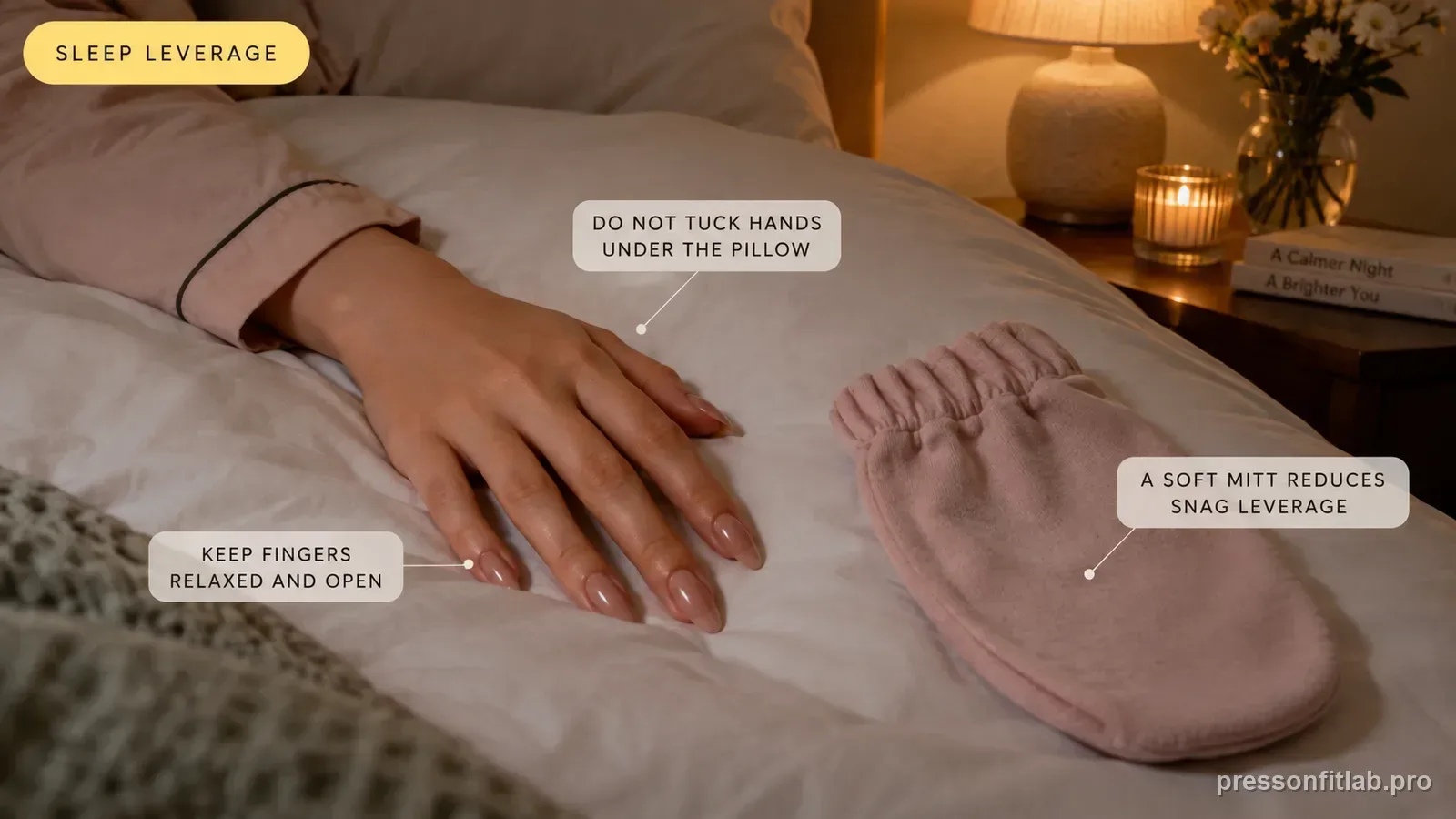
Most people can sleep normally in press-ons, but very long shapes can catch on blankets, fitted sheets, clothing, or hair. That is a mechanical issue rather than an adhesive-curing issue. If a nail keeps hooking fabric even when fully bonded, the length or free-edge shape may not match your everyday routine.
Before bed, inspect each perimeter under good light and use the opposite fingertip to feel for a rough or moving edge. A confirmed rough free edge can often be smoothed if the product allows filing, but a crack, sharp sidewall, or lifted corner should not be hidden under stronger glue. Solve the defect instead of testing it against bedding all night.
Morning check: look for a changed failure pattern
When you wake up, inspect the cuticle line and sidewalls before washing your hands. If several nails loosened without any water exposure, revisit fit, prep, and adhesive contact. If only one long nail moved, consider whether it caught on fabric or was already mis-sized.
A successful overnight application should feel boring: comfortable nails, no pinching, no visible gap, and no need to press them back down. If pain, irritation, or a health concern appears, remove the cosmetic set rather than treating overnight wear as a test you must finish.
Use the product label, not a universal bedtime timer
There is no single wait time that fits every glue, adhesive tab, or pre-glued set. Follow the package directions for setting and for the first water exposure; a bedtime routine does not make an adhesive cure faster. If you apply just before sleep, keep hands from pressing hard into bedding and avoid snagging long free edges.
If the label gives no water interval, do not invent an exact number of hours. Finish chores first when convenient, let the adhesive settle as directed, and treat any new lift or soreness in the morning as a reason to inspect rather than press the edge down repeatedly.
Diagnostic table
| What you see | What it suggests | Next check |
|---|---|---|
| Set feels secure before bed | Normal completed application | Follow the product’s early-wear precautions and leave it alone |
| Wet glue remains on skin | Application is not finished cleanly | Follow product cleanup guidance before sleep |
| Several nails lift overnight | Fit/prep/contact issue more likely than water | Recheck dry fit and application sequence |
| One long nail catches sheets | Mechanical leverage | Shorten/replace with a practical length if the product allows |
| Pain or strong pinching develops | Not a normal “curing” sensation | Remove rather than waiting until morning |
| Package gives a first-water interval | The interval is product-specific | Follow the label; bedtime does not replace set time |
A controlled test plan
- 1
Complete your normal shower, hand washing, and skin-care routine before the set goes on.
- 2
Dry-fit and apply one nail at a time using the exact adhesive directions.
- 3
Before bed, photograph any edge that looks questionable so you can compare it in the morning.
- 4
On waking, inspect the nails before prolonged water exposure and note whether failure is one-finger or full-set.
- 5
Change only the variable indicated by that pattern on the next application.
What not to do
- Using sleep as a substitute for the manufacturer’s hold time.
- Going to bed with liquid glue on skin or an obviously crooked nail.
- Adding extra glue to an edge that is already lifting without removing and diagnosing the failure.
- Assuming every adhesive needs the same number of water-free hours.
Worked troubleshooting example
Example: you finish a shower at 8:30 p.m., dry your hands, wait until your nail plates are completely dry, and apply a glue-on set using the brand directions. All nails sit flush and no adhesive is on skin. You go to bed after the instructed press step and avoid adding cuticle oil afterward.
In the morning, nine nails are unchanged but the right index has a small side lift. Because the problem is finger-specific, inspect that index for width, curve, and the way it may have caught on bedding rather than changing the adhesive routine for all ten nails.
If the next index tip dry-fits better and stays secure, you have learned that the overnight schedule was not the root problem—the original fit was.
Field notes
Evening application is best thought of as logistics: it can create an easy low-activity window, especially for people who shower and do chores earlier in the evening. The timing advantage disappears if the application itself is rushed because you are tired.
If overnight failures happen repeatedly, record whether they affect all ten nails or only the same fingers. That distinction is more diagnostic than simply concluding that “bedtime application does not work.”
Frequently asked questions
Is it better to apply press-ons before bed?
It can be convenient because you may have fewer water-heavy or high-impact activities afterward, but it is not inherently better. Correct fit and the product directions matter first.
How long should I wait before sleeping after nail glue?
Use the adhesive manufacturer’s directions. Once the application and hold step are complete and no wet glue remains on skin, there is no universal extra sleep waiting time that applies across products.
Should I shower before or after applying press-ons at night?
If your product warns against early water exposure, shower first, dry thoroughly, then apply the set so the adhesive gets an undisturbed period afterward.
Sources checked
Sources below are page-specific. We prioritize manufacturer directions for product-specific steps and use medical or dermatology guidance when a safety question requires it. Always follow the instructions for the exact adhesive or set you own.