Press-On Nails Fall Off Overnight? Use the Timing as a Clue
Press-ons that fail during the first night often point to early bond or fit problems. Use the failure pattern to check sizing, contact, prep, and timing.
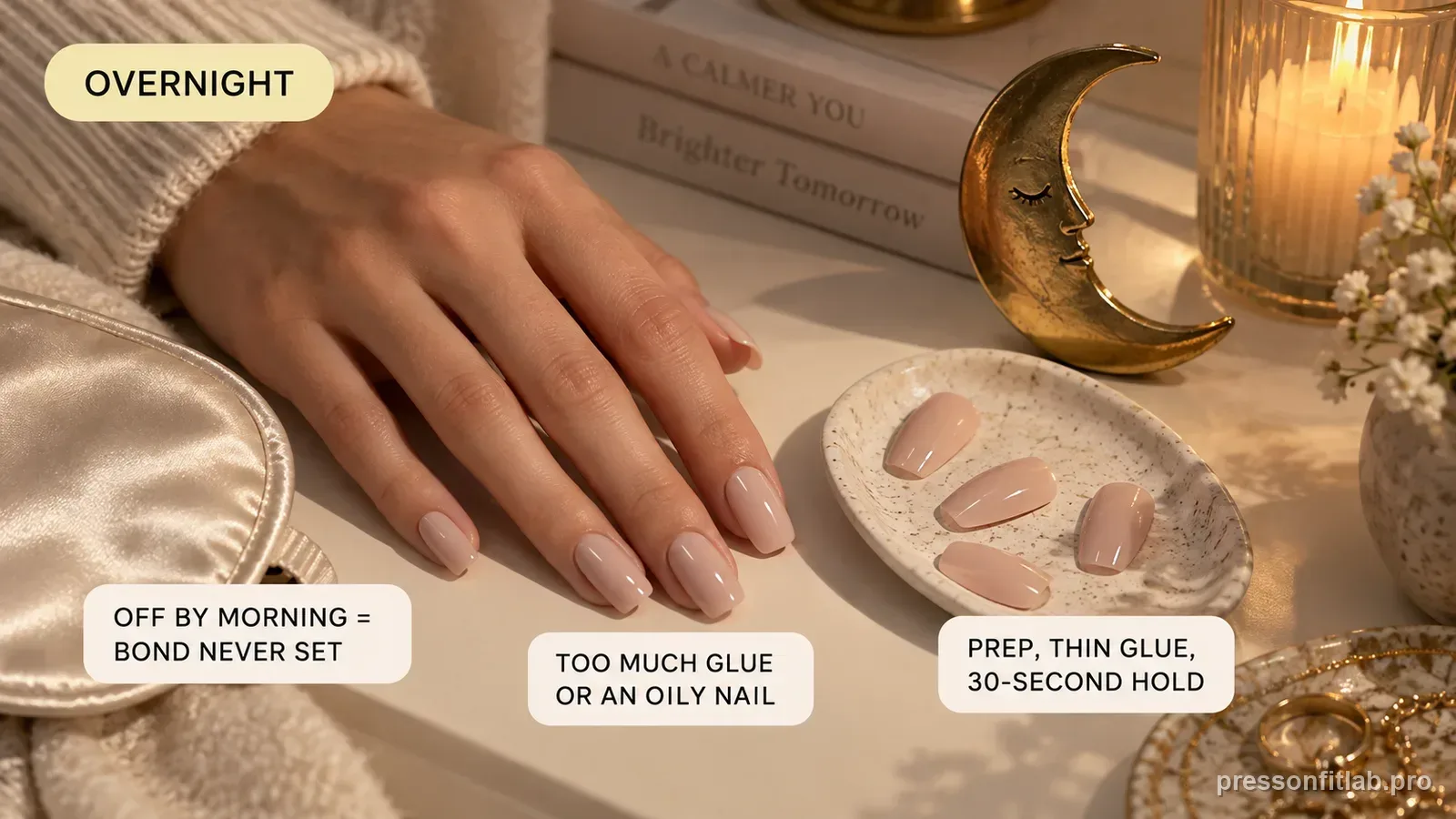
If press-ons fall off the first night, do not assume sleep itself is the cause. Very early failure makes fit, clean/dry prep, incomplete contact, or insufficient set conditions more useful suspects. Compare which nails failed and where they first lifted.
Check these first
- ✓ Were the nails applied immediately before bed?
- ✓ Which fingers failed and which stayed on?
- ✓ Was there a visible gap before application?
- ✓ Did the product directions require a specific set period?
Overnight is a time window, not a diagnosis
Sleeping adds blanket friction and incidental pressure, but a well-fitted nail should not depend on keeping your hands motionless. A failure within hours often means the bond never had a strong, uniform starting condition.
Treat the short wear time as evidence to review the application sequence rather than as proof that you “sleep too rough.”
Look for a pattern across fingers
If the same thumb and index finger fall off, those nails may be taking more stress or may be poorly sized. If six or eight nails release, a shared prep or adhesive issue becomes more plausible.
Photograph the set before bed and after waking if you are troubleshooting. The first visible lift location is more useful than simply counting fallen nails.
Application timing can matter
If your product gives a set or water-exposure window, applying moments before washing up, applying lotion, or going straight to bed may make it harder to follow those directions carefully.
A calmer application window also reduces rushed sizing errors. Fit all ten tips first so you are not searching for sizes while glue is open.
Check bedding snags versus true pop-offs
A rough cuticle edge can catch a blanket and lever the nail upward even if the bond is otherwise decent. Hair- or fabric-catching before bedtime is a sign to inspect the perimeter.
If the edge is smooth but the whole nail releases cleanly, review contact and prep. Different failure shapes call for different fixes.
Run one controlled retry
On the next set, change only the most likely variable. For example, keep the same adhesive but correct the thumb fit, or keep the same tips but follow a more deliberate clean/dry prep.
When every variable changes at once, a successful retry teaches you very little.
Inspect the evidence before re-gluing anything
When you wake up, keep the failed nails in finger order and look at both surfaces. Note whether adhesive stayed mostly on the natural nail, mostly inside the press-on, or separated irregularly. Also record whether the first opening is at the cuticle, sidewall, free edge, or across the whole piece. Those details are more useful than the label 'fell off overnight.'
If several nails show the same failure location, test a shared variable first. If one finger has a distinct pattern, separate it from the whole-hand problem. Re-gluing immediately without recording the failure can erase the evidence you need for the next controlled attempt.
Separate a bedding snag from a weak bond
A fabric snag usually leaves a local clue: a raised cuticle or side edge that catches before the nail releases. A whole-set prep or contact issue is more likely when several nails loosen without a common snag point. Check pillowcases and blankets only after you have inspected whether an edge was already elevated.
For the retry, change one cause at a time. Fix the raised edge on the snagging finger, but keep the successful full-set prep routine unchanged; or improve the shared prep process while keeping the same fitted tips. That separation makes the morning result interpretable.
Use the second night as a controlled checkpoint
If the corrected set stays secure through the first night, do not assume the problem is solved forever; use the second night to see whether the same finger or edge begins to fail again. A repeat at the same location suggests a persistent local fit or leverage issue, while a one-time whole-set improvement supports the application change you made.
Keep the retry simple enough that the result remains interpretable. Changing adhesive brand, nail length, tip profile, prep, and bedtime routine together can produce a better outcome without telling you which change mattered.
Keep a baseline photo before bed
A quick photo of the cuticle and side edges immediately after application gives you something to compare with the morning failure. If an edge was already elevated, the overnight period did not create the geometry; it revealed it. If the perimeter was flush and several nails separate cleanly by morning, shared prep or contact deserves a closer review.
The photo does not need to be decorative. One clear close-up can preserve evidence that is otherwise lost once the nail pops off or is re-glued.
Diagnostic table
| What you see | What it suggests | Next check |
|---|---|---|
| Many nails fail within hours | Shared prep/contact | Review the whole application sequence. |
| Same 1–2 nails fail | Local fit/leverage | Fit those fingers separately. |
| Fabric catches first | Raised edge | Inspect cuticle/sidewall fit. |
| Applied minutes before bed | Rushed set conditions | Choose a calmer application window. |
A controlled test plan
- 1
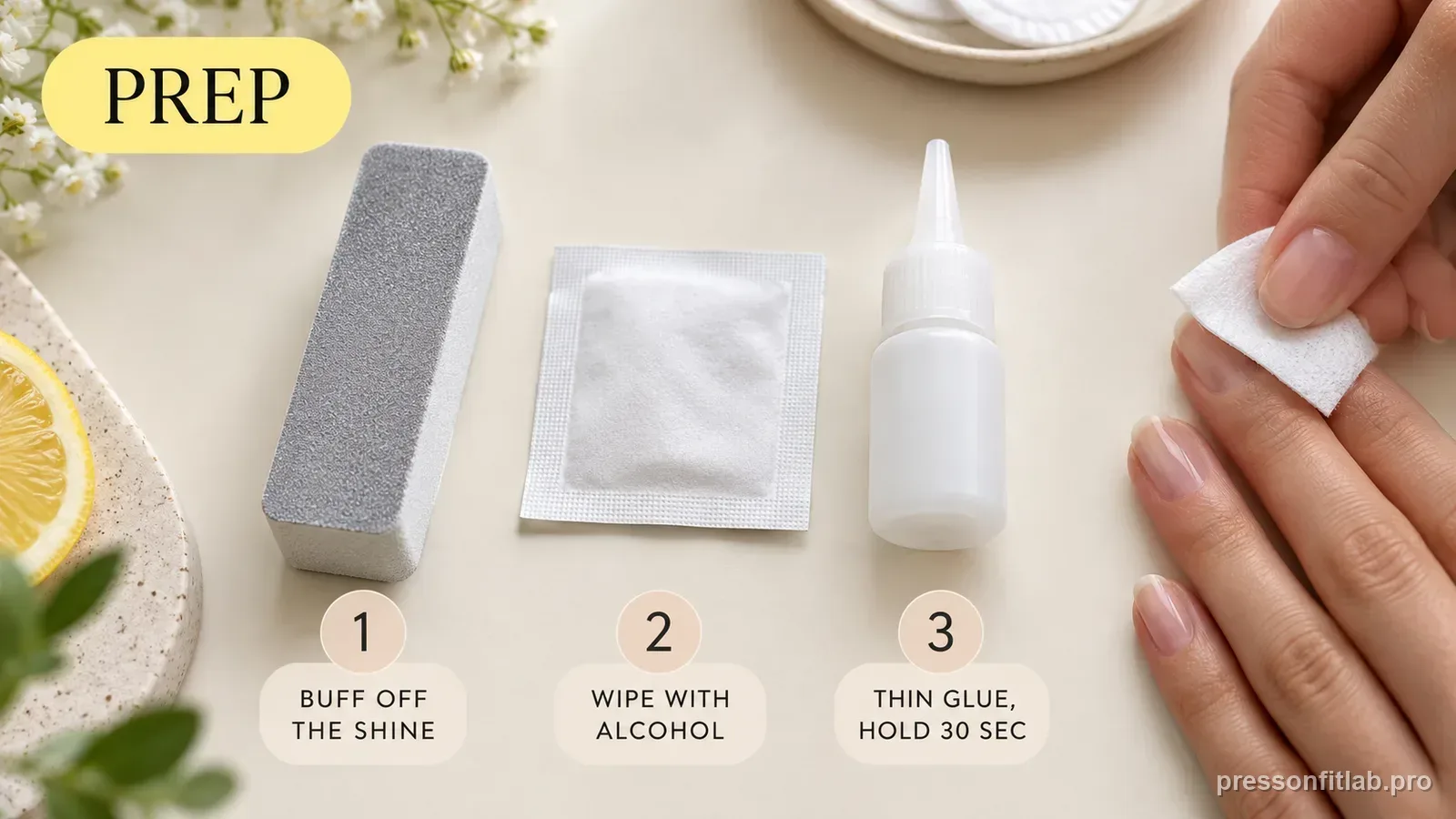
Fit all ten before opening adhesive.
- 2
Apply when you can follow set directions.
- 3
Inspect perimeter before bed.
- 4
Compare which nails fail by morning.
- 5
Change one suspected variable next time.
What not to do
- Assuming sleep alone caused the failure.
- Changing glue, size, prep, and length all at once.
- Ignoring a fabric-catching edge.
Worked troubleshooting example
Example: four nails are loose by morning after a brand-new application, while the same ring finger is the only one caught in bedding. Because several fingers failed in the same short window, you review the shared application sequence before blaming sleep or one snag event.
On the controlled retry you finish sizing and filing before opening adhesive, clean each nail according to the product directions, and apply one finger at a time. The set now stays secure overnight except for the ring finger that still catches fabric.
That isolates two separate issues: a system-level application weakness improved, while one local raised edge remains. You can now refit the ring finger without changing the successful routine for the other nine nails.
Field notes
Overnight failure is useful because it happens before many days of wear complicate the story. Early failures deserve a basic fit-and-contact audit first.
A controlled retry is more informative than a “stronger everything” retry. One changed variable gives you a clearer answer.
Frequently asked questions
Why do my press-ons fall off while I sleep?
Early overnight failure often reflects fit, prep, or incomplete contact that was already marginal before sleep.
Should I apply press-ons in the morning instead?
Apply when you have enough time to fit, prep, and follow the product’s set instructions without rushing. The clock time itself is less important.
Can bedding pull press-ons off?
A raised or rough edge can snag fabric and increase leverage, so inspect the perimeter if nails fail overnight.
Sources checked
Sources below are page-specific. We prioritize manufacturer directions for product-specific steps and use medical or dermatology guidance when a safety question requires it. Always follow the instructions for the exact adhesive or set you own.