Why One Press-On Nail Keeps Popping Off
Fix a single repeat-failure finger by checking that nail’s individual size, curve, prep, placement, and daily workload.
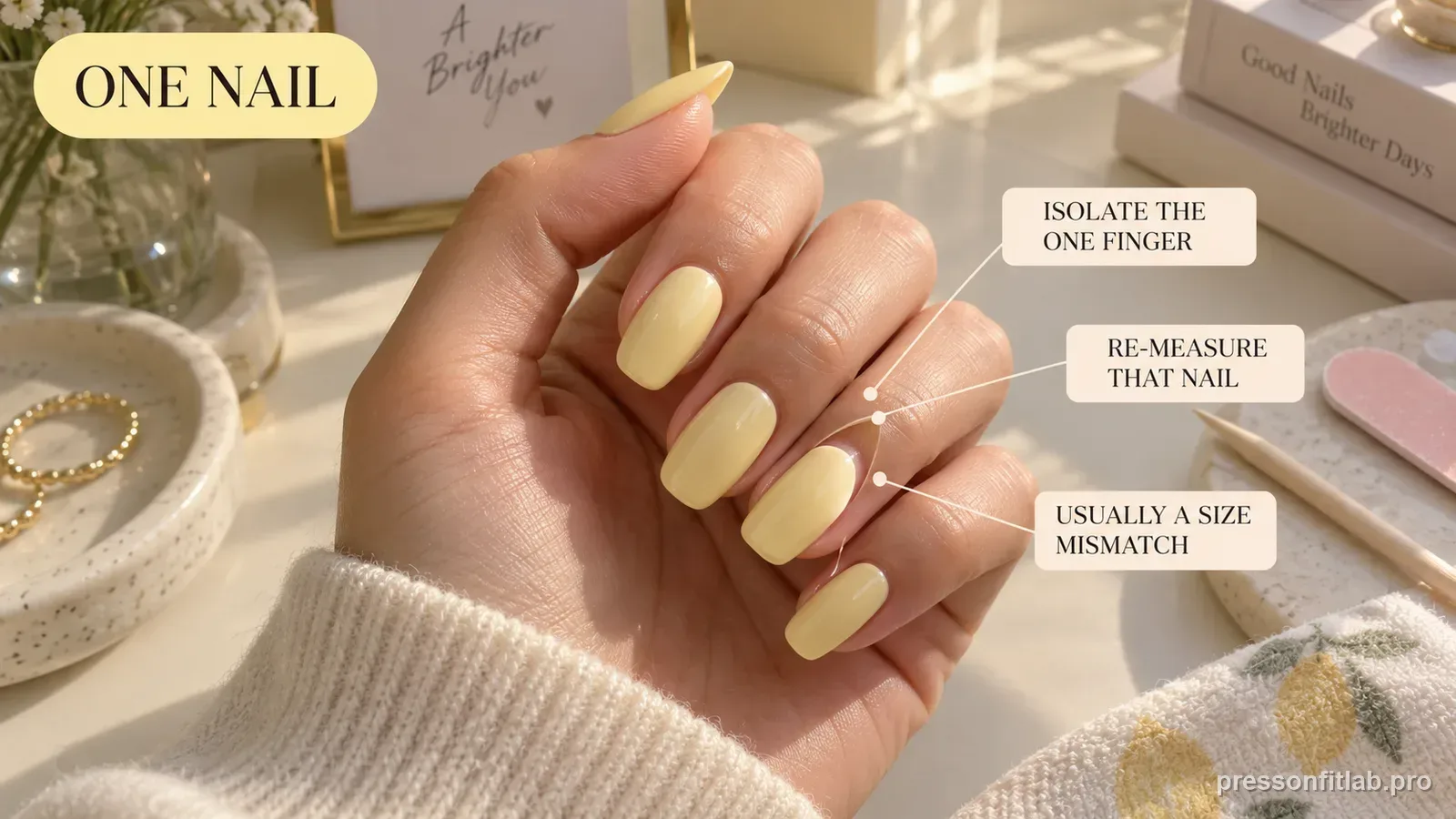
When the same single press-on keeps popping off while the others stay on, the problem is usually local to that finger: a different width, a different curve, incomplete prep, or extra leverage. Refit that nail instead of changing the whole manicure.
Check these first
- ✓ Re-measure that finger.
- ✓ Try the neighboring tip size.
- ✓ Compare its curve with the other hand.
- ✓ Notice how that finger is used during the day.
A single failure is useful information
If nine nails remain secure, your overall prep and adhesive are probably not completely wrong. Focus on what is unique about the failing finger.
Natural nails are not identical. One index finger can be flatter, one thumb can be wider, and one nail can have a different cuticle shape.
Refit the nail from scratch
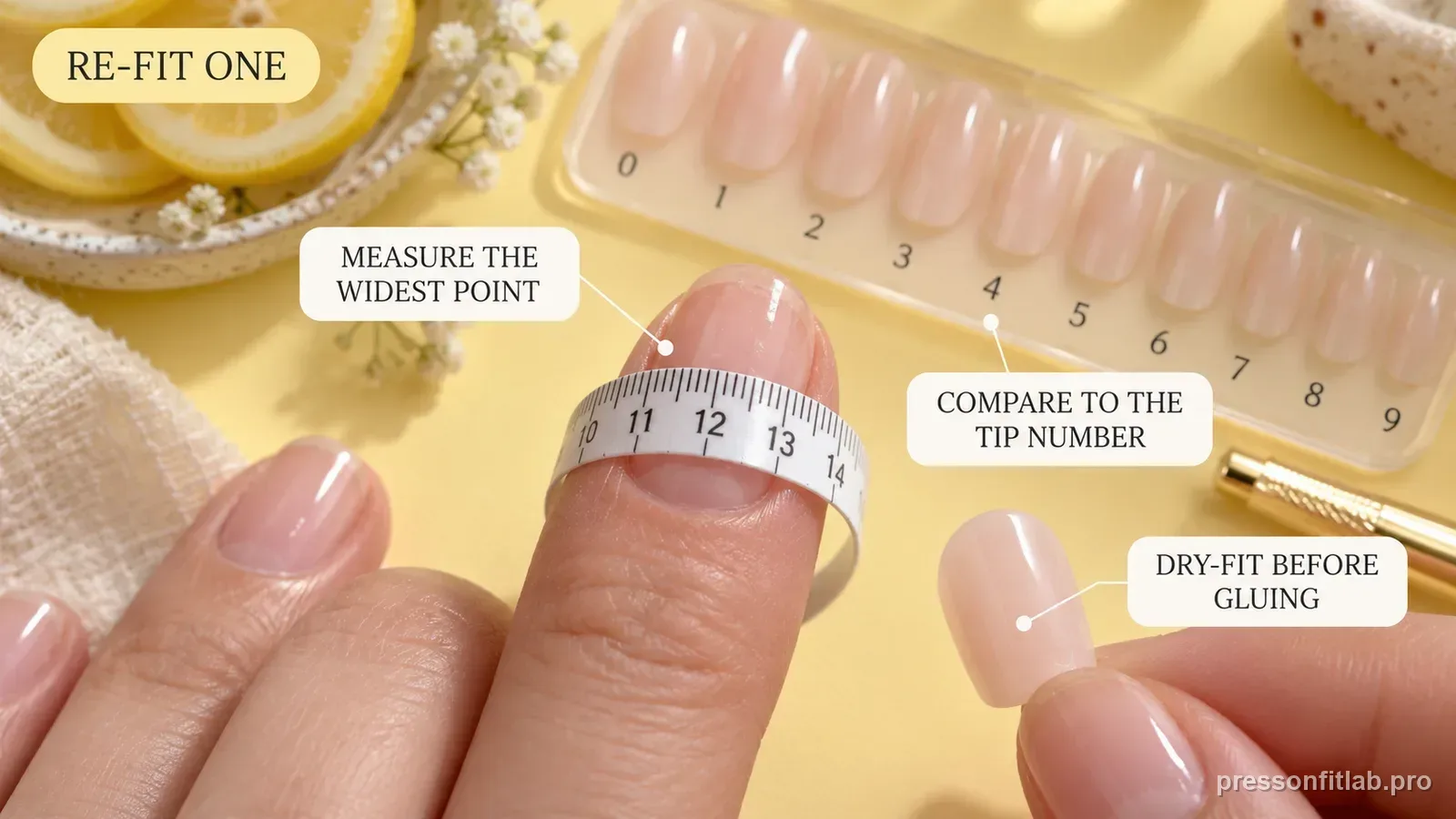
Remove old adhesive from the reusable tip if applicable and dry-fit again. Test the current tip plus neighboring physically wider and narrower candidates. Check sidewall coverage and rocking.
Do not assume the size you selected originally must be correct because it looked similar to the opposite hand.
Check the daily workload
Index fingers and thumbs do more prying, pressing, opening, and tapping than other fingers. A long press-on on a high-use finger experiences stronger leverage.
If the fit is good but failure continues, try a shorter tip on that finger or adjust how you use the edge during the test period.
Change one variable at a time
First test fit. Then prep. Then adhesive amount or placement. If you change all of them at once, you will not know what solved the issue.
A simple one-finger test can save you from redoing an entire set repeatedly.
Build a one-finger failure log
For two or three wears, record that finger’s tip size, curve note, nail length, first lift location, and the task happening near failure. A tiny log can reveal that the same side edge opens first, or that every failure follows a high-leverage task such as opening packaging.
Use the pattern to choose the next single change. If the same location repeats, inspect fit, placement, and contact at that location first; if the same task repeats while the dry fit is stable, leverage or length becomes a stronger suspect. This is more efficient than rebuilding the whole manicure around one difficult finger.
Keep the other nine nails as your control group
When one finger is the repeat offender, the rest of the hand is useful evidence. If nine nails succeed with the same prep and adhesive, do not rebuild the entire routine first. Preserve those successful variables while changing only the difficult finger’s size, curve, length, or daily-use pattern. That turns the manicure into a practical control group instead of ten simultaneous experiments.
Diagnostic table
| What you see | What it suggests | Next check |
|---|---|---|
| Same finger fails every set | Local fit or routine stress | Measure and profile that nail independently. |
| Failure follows the same tip size | Chosen mold is marginal | Try the neighboring size or different curve. |
| Nail fails during one repeated task | Repeated leverage may be contributing | Shorten that finger or change how the task is done while keeping fit/prep constant. |
| Nail pops but glue remains mostly on tip | Natural-nail contact may have been weak | Review prep on that specific finger. |
| Nail pops after being repaired multiple times | Bond surface is contaminated/uneven | Reset with a clean reapplication rather than stacking repairs. |
A controlled test plan
- 1
Write down which finger fails and exactly where the first lift starts.
- 2
Compare its millimeter width with the corresponding finger on the other hand.
- 3
Dry-fit neighboring physically wider and narrower candidates to test whether the current tip is truly best.
- 4
Observe the high-load tasks that finger performs during a normal day.
- 5
Make one targeted change on the next wear test and compare the result.
What not to do
- Rebuilding the whole manicure routine because one finger failed.
- Assuming matching fingers on opposite hands need the same size.
- Using more glue without checking whether the tip rocks or pinches.
- Ignoring a recurring snag or edge lift until the nail fully pops.
Worked troubleshooting example
Example: every nail lasts well except the left index, which repeatedly pops off near the free edge. You re-measure it and discover its width is fine, but you also notice you use that finger to pry open packaging and scrape labels several times a day.
For the next set you keep the same tip width and adhesive but shorten only that index slightly and stop using the nail edge as a tool. The index now stays on with the rest of the set, so leverage—not a whole-hand prep problem—was the useful variable to change first.
If it had still failed, your next test would be a different profile or neighboring size on that one finger. A repeat offender deserves a finger-specific record rather than repeated full-set resets.
Field notes
A single repeat offender is useful because the other nine nails act like controls. If the same prep and adhesive work elsewhere, investigate what is unique about that finger before blaming the product.
Many people unconsciously use one index nail or thumbnail as a tool. If fit is already correct, reducing length or changing the task can lower leverage without changing the entire set.
Frequently asked questions
Why does only one press-on nail fall off?
That finger may have a different width, curve, prep condition, or daily workload than the others.
Should both thumbs use the same press-on size?
Not automatically. Measure and fit each thumb separately.
Can I use a different adhesive method on one finger?
Yes, if the product instructions allow it, but correct the fit first so you are not masking a sizing problem.
Sources checked
Sources below are page-specific. We prioritize manufacturer directions for product-specific steps and use medical or dermatology guidance when a safety question requires it. Always follow the instructions for the exact adhesive or set you own.