Why Do Extra-Long Press-On Nails Lift Even When the Fit Looks Correct?
Diagnose XL press-on failures as leverage and impact problems instead of repeatedly changing glue or preparation.
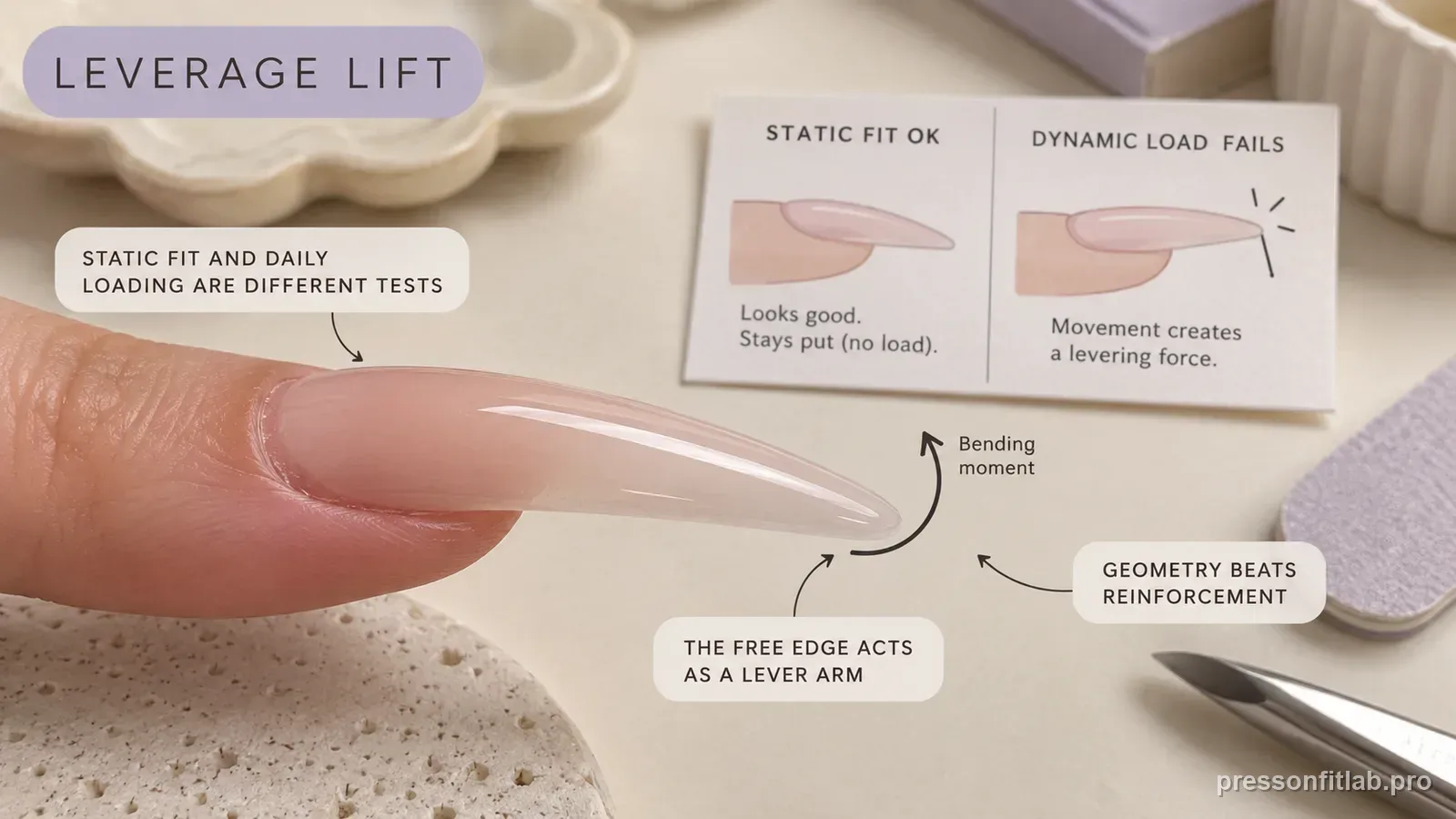
Extra-long press-ons can lift despite good static fit because the portion beyond the fingertip acts as a lever. Force farther from the bonded area creates more torque and peeling stress at the cuticle or sidewalls. If failures follow catches or impacts, shorten one test nail before changing glue chemistry.
Check these first
- ✓ Do failures follow a snag, tap, or free-edge impact?
- ✓ Does lift begin opposite the direction of the impact?
- ✓ Is the bonded natural plate short compared with the extension?
- ✓ Do shorter sets last longer with the same prep?
- ✓ Does the XL shell sit neutrally before glue?
Static fit and dynamic loading are different tests
Dry fitting proves only that the shell matches at rest. It does not show what happens when an extra-long free edge is pushed, pulled, or twisted repeatedly during daily use.
You can visualize the lever without equations: hold a ruler close to its end and tap beside your fingers, then tap far from your grip. The farther force is applied from the supported region, the larger the turning effect. An XL free edge creates the same qualitative problem for the adhesive interface when it is knocked or caught.
The free edge behaves like a lever arm
As the point of applied force moves farther from the bonded base, the moment at that base increases. A small catch at an XL tip can therefore create a much larger peeling load than the same contact on a short nail.
Peel loading is especially important. Adhesives can tolerate compression or shear differently from an edge being progressively peeled away. A long nail that is pushed downward at the tip can lift the proximal edge, while a side catch can peel one lateral margin. Record that first lift location because it identifies how the lever was loaded.
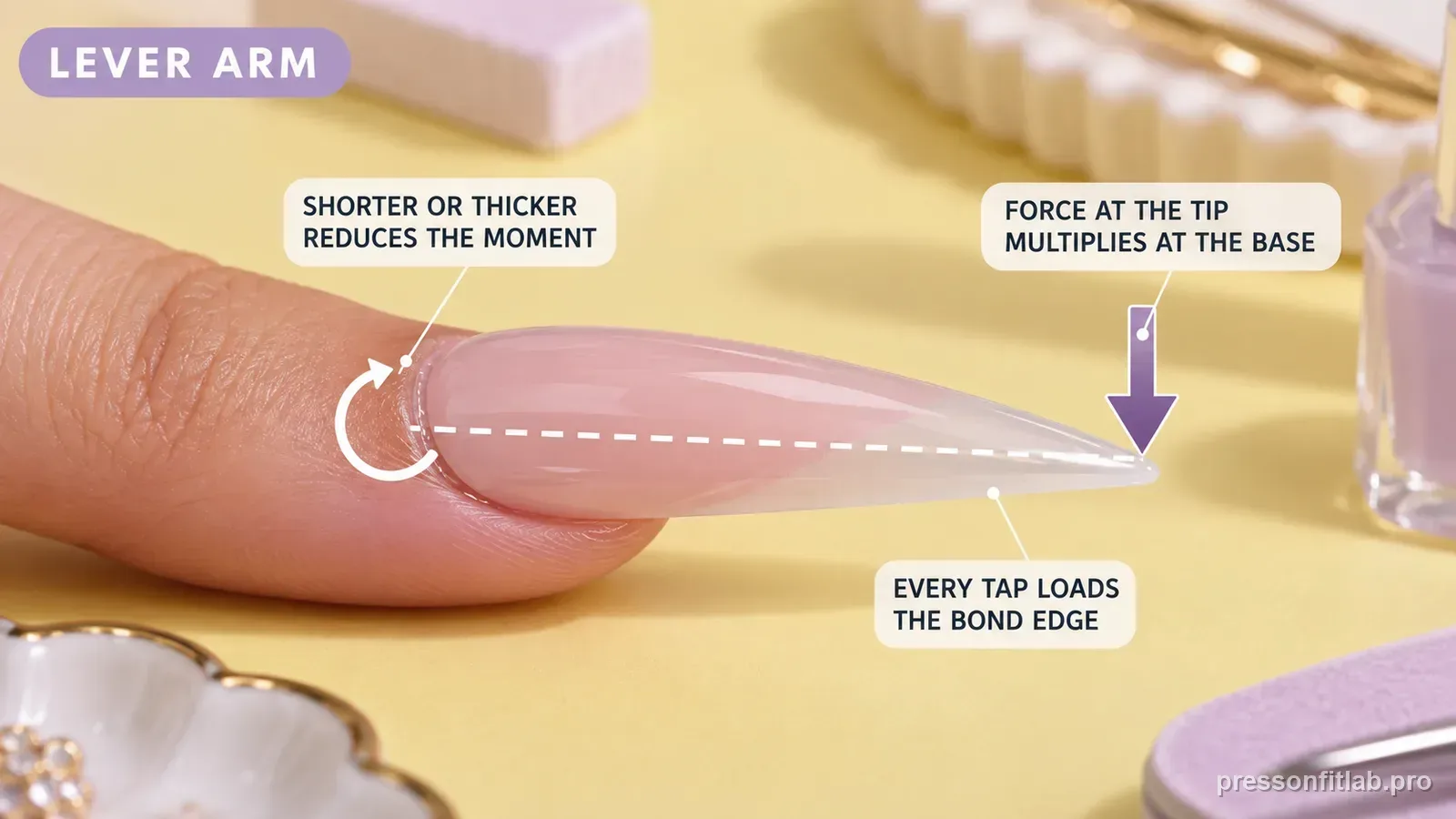
Short nail beds make the ratio more extreme
When a long artificial shell sits on a short natural plate, the bonded footprint is limited while the unsupported extension is large. Precision of curve and sidewall contact becomes more important, not less.
Do not conflate shell strength with bond strength. A thick, rigid XL press-on may resist bending very well, yet that rigidity can transmit more of an impact to the adhesive rather than dissipating it through shell flex. A flexible shell may behave differently even at the same length, so material stiffness is a separate variable from dimensions.
Impact pattern is better evidence than days of wear
Record what happened immediately before the first lift. Cuticle lift after the free edge was pushed down is different from a sidewall that was open from application day.
The natural nail's bonded length also matters. If an XL tip sits on a short plate, the contact footprint has less fore-aft distance to resist rotation. This is one reason users with short beds may find the same commercial length mechanically more demanding than someone with a long nail plate.
Shape changes where impacts happen
A broad squared free edge may catch surfaces that a tapered tip clears, while a pointed tip can concentrate force at a smaller contact point. Compare similar lengths before attributing the effect to shape.
A useful compromise test is not necessarily ‘go short forever.’ Reduce the highest-failure finger from XL to long or medium while preserving shape and prep. If failures disappear, you have evidence that your personal leverage threshold lies somewhere between those lengths and can tune style around it.
Reinforcement cannot rescue bad geometry
An XL shell still needs full neutral contact. More adhesive cannot reliably overcome a rocking curve, skin overlap, or a large void that stores tension.
Repeated impacts deserve a nail-health branch too. If the natural nail becomes painful, lifts from the bed, or shows bruising after an XL catch, remove the cosmetic system and assess the injury rather than immediately reattaching the shell. A stronger bond is not desirable if it merely transfers more force into the natural nail.
Diagnostic table
| What you see | What it suggests | Next check |
|---|---|---|
| Cuticle lifts after tip impact | Lever force transferred to proximal bond | Shorten extension or reduce impact exposure |
| Only XL sets fail while short sets hold | Length-related torque likely | Run a controlled shorter-length test |
| Sidewall open immediately after application | Static fit problem | Correct width or curve first |
| Failures follow pockets/bags/bedding snags | Free edge repeatedly catches | Reduce length or choose less catch-prone geometry |
| Glue squeezes out but nail still lifts | More adhesive is not correcting leverage | Return to fit and load diagnosis |
A controlled test plan
- 1
Choose the finger that fails most often and verify neutral dry fit.
- 2
Apply the same prep and glue but shorten only that artificial nail.
- 3
Record snags and impacts during normal use.
- 4
Compare the shortened test with unchanged XL nails.
- 5
If the shorter nail survives, treat leverage as the main variable before altering chemistry.
What not to do
- Adding more glue as the first response to impact lifting
- Ignoring extension-to-bonded-base ratio
- Testing XL length on a shell that already rocks
- Using the free edge as a tool to pry or open objects
- Changing several variables after one failure
Worked troubleshooting example
Emi had a well-fitting extra-long coffin set but her index and middle nails repeatedly lifted near the cuticle after reaching into a tight handbag.
On the next set she kept prep, glue, and shell family unchanged but shortened only the index nail to medium length.
The shortened index remained attached while the long middle lifted after another snag, isolating leverage rather than surface preparation as the dominant variable.
Field notes
Long-nail failures are often called glue failures because the final event is adhesive separation. The more useful clue is the load that preceded separation and the edge where lifting began.
One shortened control nail can isolate leverage faster than changing adhesive across all ten fingers.
Frequently asked questions
Do extra-long press-ons always need stronger glue?
No. Stronger adhesive does not remove lever length, curve mismatch, or repeated impacts.
Which finger should I shorten first?
Use the one that fails most consistently because it gives the clearest comparison.
Can a perfectly fitted long press-on still pop off?
Yes. Fit controls initial contact; mechanical loading determines what that bond experiences afterward.
Sources checked
Sources below are page-specific. We prioritize manufacturer directions for product-specific steps and use medical or dermatology guidance when a safety question requires it. Always follow the instructions for the exact adhesive or set you own.