Coffin vs. Almond Press-Ons: Why Can the Same Size Wear Differently?
Compare coffin and almond shell geometry, free-edge width, sidewall taper, and leverage on the same nail bed.
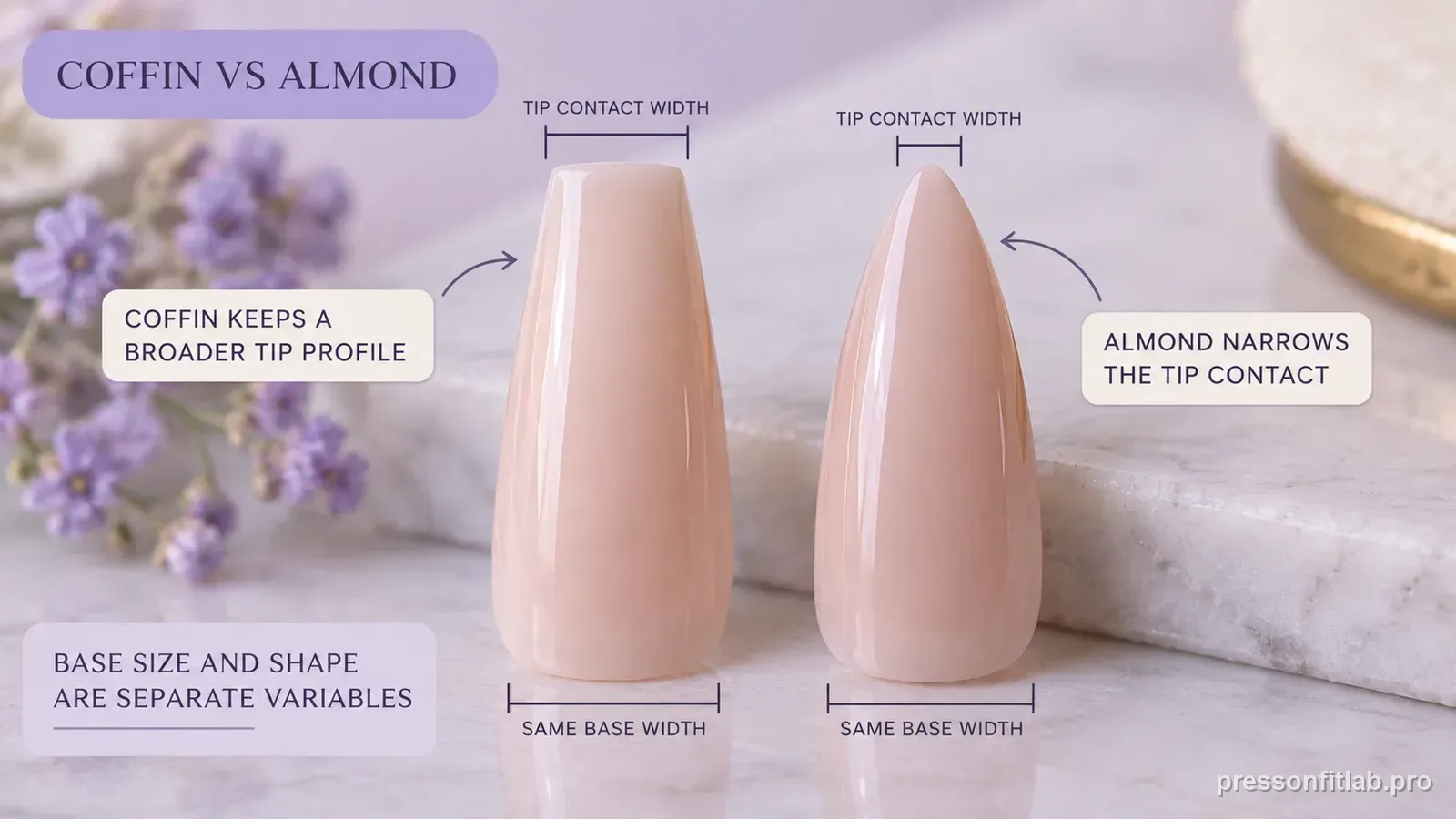
A coffin and an almond press-on with the same nominal base size can wear differently because the distal geometry is different. Coffin retains more width before ending in a squared free edge, while almond tapers toward a narrower rounded point. Control base fit and length first, then use snag and impact patterns to decide whether shape is contributing.
Check these first
- ✓ Do both shapes actually share comparable cuticle and sidewall fit?
- ✓ Does the coffin edge hit objects that the almond clears?
- ✓ Does either shell rock before adhesive is applied?
- ✓ Are you comparing similar lengths as well as similar base sizes?
- ✓ Does failure begin from static sidewall lift or only after a free-edge impact?
Base size and finished shape are separate variables
A number within a product line does not guarantee two different shape molds have identical interior curve, taper, apex, or overall length. Dry-fit each shape independently.
Use the same-finger thought experiment: if coffin and almond shells have equally good base fit and equal length, the remaining difference is how material is distributed toward the free edge. Gelish describes almond tips as having tapered edges versus straighter sidewalls, confirming that commercial molds intentionally change distal geometry rather than merely the painted silhouette.
Coffin retains a broader distal profile
Coffin or ballerina nails taper but finish with a relatively broad squared edge. That distal width can contact desks, pockets, bags, steering wheels, or other surfaces across a larger area.
The broader squared coffin tip presents a larger edge to some obstacles. That can increase the chance of catching fabric seams or striking a flat surface, but it should not be turned into a universal claim that coffin is weaker. A shorter coffin may experience less leverage than a much longer almond despite its wider distal end.
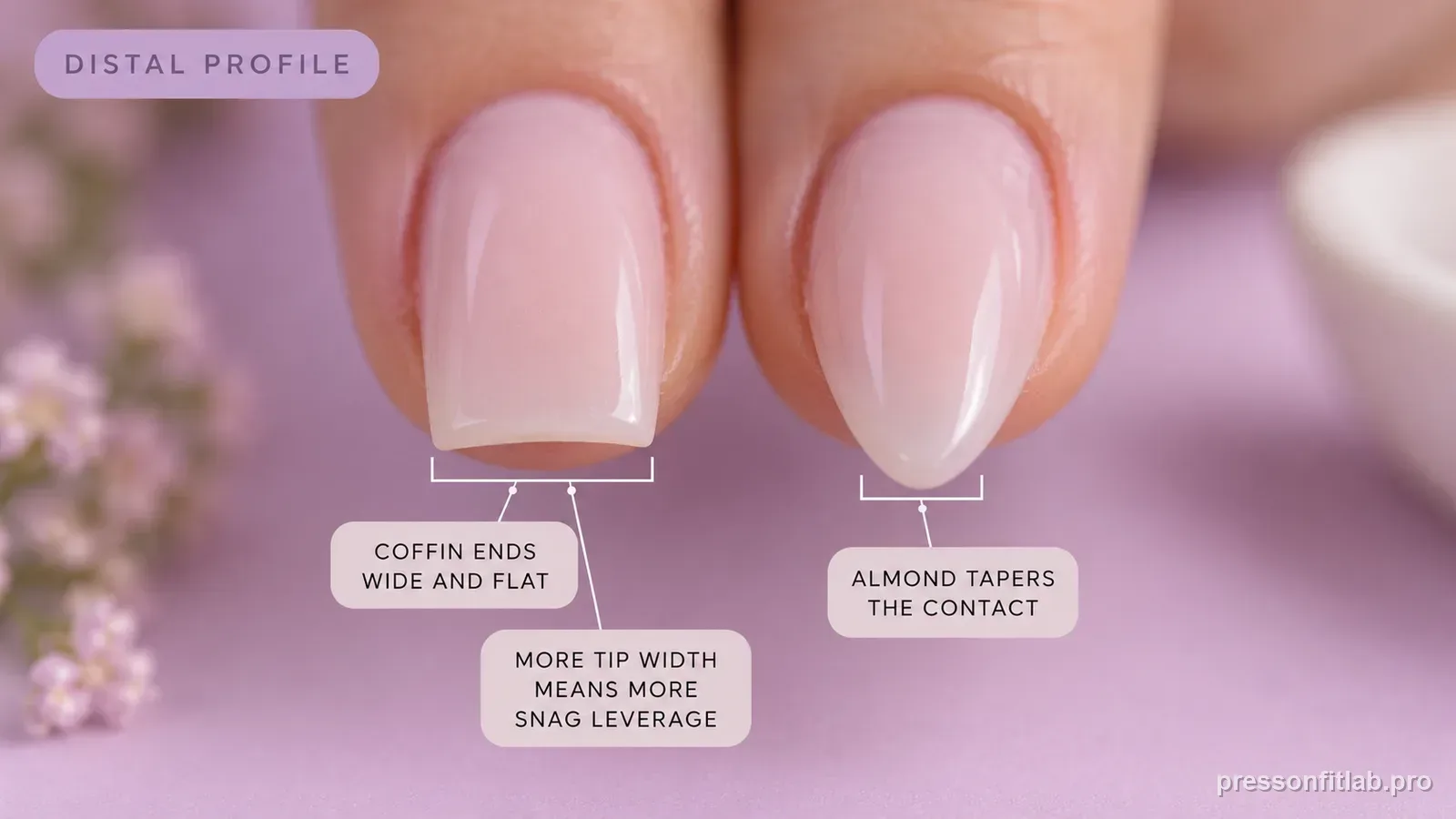
Almond narrows the distal contact
Almond tapers toward a rounded tip. It may clear some obstacles more easily, but it can also concentrate force at a smaller tip. Neither silhouette is universally stronger.
Almond's narrower tip can clear some objects but can concentrate contact into a smaller distal area. If that point repeatedly strikes a key, string, or hard surface, the user can still get impact-related lifting. Shape changes the contact path; it does not repeal length and force.
Sidewall taper changes the visual transition
Coffin often carries straighter sidewalls farther forward, whereas almond tapers earlier. That affects appearance above the nail bed even when the bonded base is equally sound.
Base geometry must be rechecked because size numbers are not standardized across molds. One brand's size 5 almond can have a different cuticle arc or interior curvature from its size 5 coffin. A clean comparison requires both shells to pass the same sidewall, cuticle, and rocking checks before wear begins.
Length has to be controlled in a fair comparison
A long almond and medium coffin differ in lever length as well as silhouette. Compare similar lengths if you want to know whether free-edge shape is actually the variable.
Axis alignment is another hidden variable. A coffin's straight distal edges make sideways rotation easy to notice, while almond can visually disguise a slightly crooked placement because the silhouette tapers. Mark the center of the natural nail and shell during dry fit if one shape repeatedly looks or wears crooked.
Choose based on failure pattern
If both shapes dry-fit well but coffin repeatedly catches during your routine, the broad edge matters. If almond lifts before any impact and shows a side gap, the issue is that shell’s base geometry rather than the almond silhouette itself.
If your real problem is snagging, shape selection can be a targeted solution. If your real problem is an immediate sidewall gap, changing silhouette without fixing base contour will not help. The diagnostic sequence stays the same: neutral base fit first, then compare how each free-edge geometry interacts with your routine.
Diagnostic table
| What you see | What it suggests | Next check |
|---|---|---|
| Coffin edge catches objects | Broad squared distal profile enters contact path | Try shorter coffin or comparable almond |
| Almond clears objects but base rocks | Specific shell interior mismatch | Change shell fit/profile |
| Same numbered shapes fit differently | Molds are not identical | Dry-fit each shape independently |
| One comparison is much longer | Length confounds shape test | Compare similar lengths |
| Sidewall lifts before impact | Base fit problem | Correct width/curve first |
A controlled test plan
- 1
Select coffin and almond shells that both dry-fit the same finger neutrally.
- 2
Choose versions with similar overall length.
- 3
Apply them on comparable fingers using identical prep and adhesive.
- 4
Record whether first failure is static sidewall lift or free-edge impact.
- 5
Choose the silhouette that stays out of your normal contact path while preserving base fit.
What not to do
- Assuming identical size numbers mean identical molds
- Comparing very different lengths and blaming shape
- Using shape to compensate for bad cuticle/curve fit
- Adding glue when the shell rocks before application
- Choosing only by appearance when one edge repeatedly interferes with daily tasks
Worked troubleshooting example
Grace alternated between medium coffin and medium almond sets. Her coffin index nails repeatedly lifted after pocket snags while the almonds lasted longer.
She confirmed both shapes had comparable base width, comfortable curvature, and similar length. The main difference left was the distal profile.
Watching normal movement showed the squared coffin edge catching fabric while the tapered almond cleared it. She changed shape rather than glue strength.
Field notes
Shape comparisons become meaningful only after base geometry is controlled. A better interior curve can dominate wear before coffin-versus-almond impact differences ever matter.
For people who constantly catch squared tips, changing silhouette can reduce impact exposure without necessarily shortening every nail dramatically.
Frequently asked questions
Is almond always stronger than coffin?
No. Wear depends on material, length, base fit, interior curve, activity, and how the free edge is loaded.
Should I use the same size number in both shapes?
Use the number only as a starting point; dry-fit each mold independently.
Which shape has less leverage?
Overall length is the major lever variable. Shape changes where impacts happen, so compare similar lengths first.
Sources checked
Sources below are page-specific. We prioritize manufacturer directions for product-specific steps and use medical or dermatology guidance when a safety question requires it. Always follow the instructions for the exact adhesive or set you own.