Square vs. Round Nail Beds: Why Can the Same Press-On Width Fit Differently?
Diagnose sidewall gaps and pinching caused by nail-bed shape when the millimeter width looks correct.
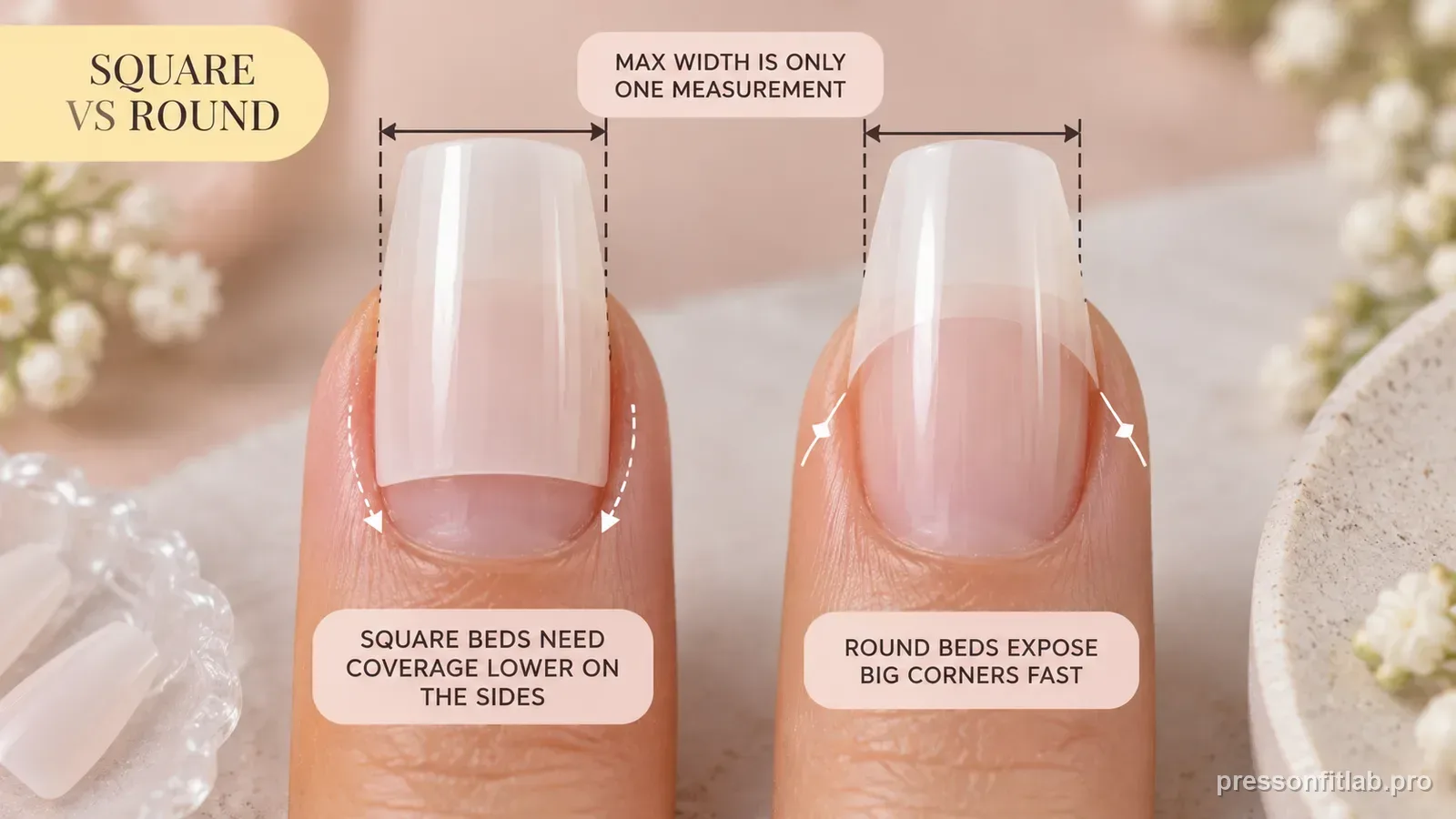
Two nail beds can share the same maximum width and still need different press-on shells. A squarer bed carries width farther toward the sidewalls, while a rounder bed narrows sooner, so the same shell can leave triangular gaps on one nail and press into skin on another. Dry-fit by outline, sidewall contact, and transverse curve—not width alone.
Check these first
- ✓ Does your nail stay nearly the same width through the middle before turning at the corners?
- ✓ Do you see triangular side gaps despite correct maximum width?
- ✓ Does the shell press into lower corners before the center fully settles?
- ✓ Do both sides spring up when the center is pressed?
- ✓ Would sizing up fix side coverage but create cuticle overhang?
Maximum width is only one measurement
Width describes one span. It does not describe when the sidewalls begin tapering, how square the cuticle corners are, or how the transverse arch behaves.
To distinguish outline from curvature, make two observations separately. First look straight down and assess whether the shell follows the sidewall outline. Then look from the free edge and assess arch. If the outline is wrong but the arch is comfortable, reshape or change shell outline; if the arch is wrong, side filing will not remove the stored spring force.
Square beds need coverage farther down the sides
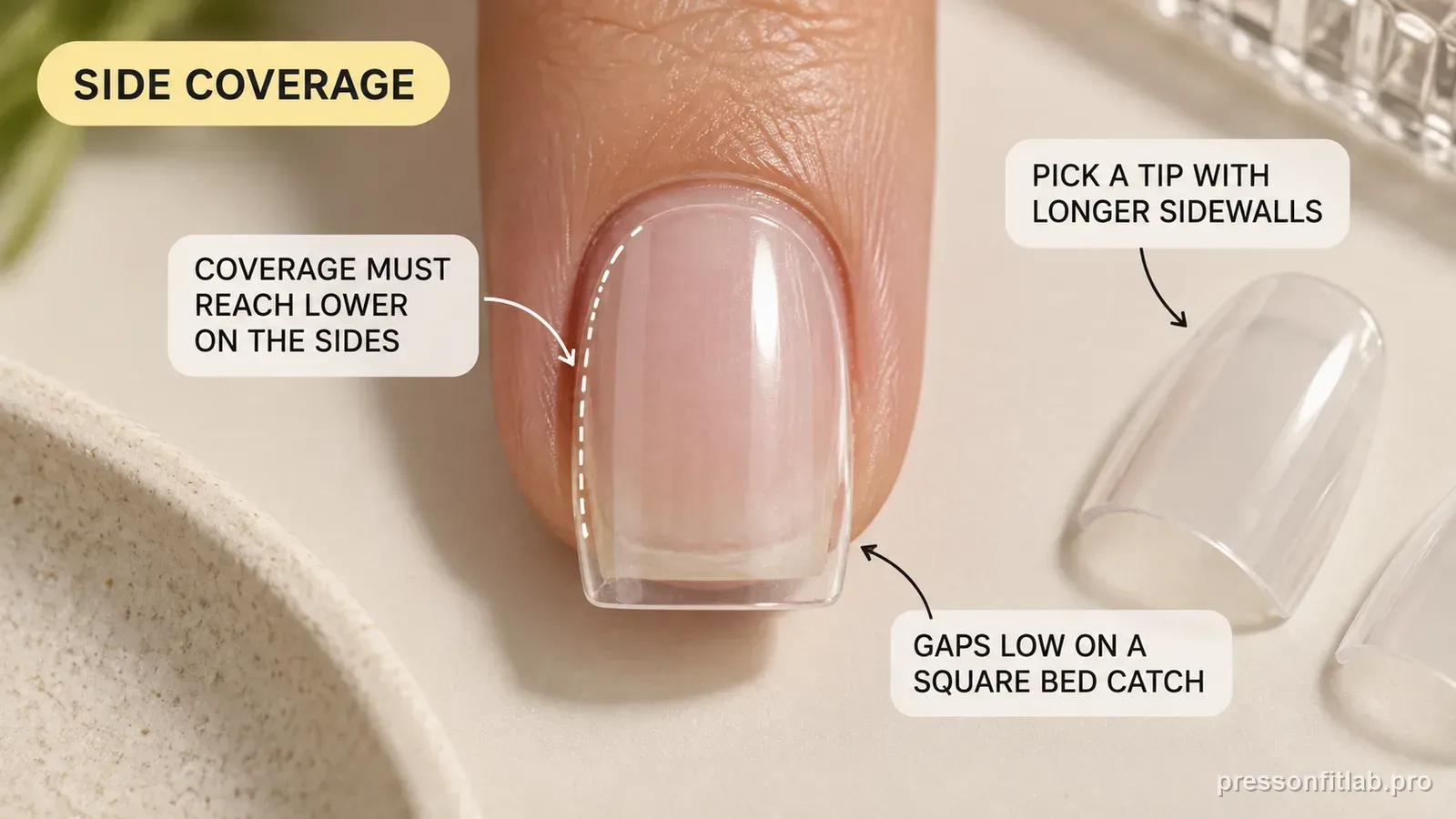
On a squarer bed, a shell that tapers early may cover the center while missing the lower sidewall zones. Sizing up can create cuticle overhang, so a straighter-sided mold may be better than a larger size.
A square bed often needs usable width lower down near the proximal sidewalls, not only at the single widest cross-section. This is why a strongly tapered shell can measure correctly yet expose narrow triangular bands of natural nail beside the base. The fix is usually a mold with straighter proximal sidewalls rather than simply a larger nominal number.
Round beds expose oversized corners quickly
A rounded bed narrows sooner. A broad lower shell can therefore sit on skin at the corners even if the center width appears correct. A shell that must be squeezed inward is not resting neutrally.
On a rounded bed, the opposite pattern is common: the shell reaches its full width too early and its lower corners drift onto skin. If you can see blanching or feel a corner digging into the lateral fold during dry fit, that is not ‘extra secure.’ It means the artificial outline is exceeding the nail plate boundary.
Curve can imitate an outline problem
Healthy nails vary substantially in transverse curvature. If both sides rise when the center is pressed, the apparent side gap may be caused by curve mismatch rather than by the top-view outline.
Normal fingernail studies confirm that transverse curvature varies across digits and people, so avoid turning shape labels into rigid anatomy claims. A person can have a visually square outline and still a pronounced C-curve. Treat top-view outline and cross-sectional curve as independent measurements every time the shell behaves unexpectedly.
Use filing for small outline corrections only
If curve and general width are correct, minor artificial cuticle-corner filing can improve fit. Large corrections usually indicate that the shell family, not just the edge, is wrong.
When filing a shell, preserve bilateral balance. Remove a small amount from one artificial sidewall, re-seat it, then compare where the cuticle centerline sits. Heavy filing from one side can make the tip look centered at the cuticle while the distal axis points sideways, which introduces a new torque problem.
Record geometry finger by finger
Thumbs, index fingers, and pinkies may not share one outline family. A useful fit record notes both shell size and observations such as straight sidewall, rounded cuticle, or needs minor corner filing.
For repeat use, annotate the size map with geometry notes instead of only numbers. ‘R index: size 5, straighter base’ is more actionable than ‘R index: 5’ because the next box or brand may use a different mold. The note captures why the shell worked, not just which number happened to fit.
Diagnostic table
| What you see | What it suggests | Next check |
|---|---|---|
| Center fits but lower sidewalls gap | Shell tapers too early for a square bed | Try a straighter-sided shell |
| Corners rest on skin | Shell base is too square for a round bed | Try a rounder or narrower lower profile |
| Both sides rise when center is pressed | Curve mismatch | Try a different transverse curve |
| One corner overlaps skin | Minor local outline asymmetry | Refine that artificial edge cautiously |
| Sizing up fixes sides but overhangs cuticle | Wrong shell geometry, not simply size | Change mold/profile |
A controlled test plan
- 1
Measure maximum width but treat it as a starting point.
- 2
Dry-fit and photograph the candidate from directly above.
- 3
Inspect the same shell from the free edge to check curvature.
- 4
Try one adjacent size and, if possible, a different mold shape.
- 5
Choose the shell that reaches nail margins without skin pressure or stored tension.
What not to do
- Using width as the only sizing criterion
- Sizing up repeatedly to cover triangular side gaps
- Forcing broad corners onto rounded skin
- Confusing sidewall spring with outline mismatch
- Removing large amounts of material before testing another mold
Worked troubleshooting example
Ari measured both middle nails at nearly the same maximum width and chose matching shells. One looked clean; the other showed two small lower-sidewall gaps.
From the free edge, curvature was fine. The second nail simply carried its width farther toward the cuticle and had a squarer outline.
A straighter-sided shell fit without sizing up, confirming that the original problem was geometry rather than bad measurement.
Field notes
A true outline mismatch often shows good center contact and compatible curve but specific lower-sidewall gaps or skin overlap.
Top-view photos help with outline; free-edge photos are necessary to rule out curve mismatch before reshaping the artificial nail.
Frequently asked questions
Can equal-width nails use different press-on sizes?
Yes. Mold geometry includes curve, taper, and cuticle outline as well as maximum width.
Should the artificial nail touch side skin?
No. It should cover the nail plate without resting on surrounding skin.
Can I file a square press-on for a round bed?
Small cuticle-corner corrections are reasonable when the rest of the fit is already correct; a major mismatch needs another shell.
Sources checked
Sources below are page-specific. We prioritize manufacturer directions for product-specific steps and use medical or dermatology guidance when a safety question requires it. Always follow the instructions for the exact adhesive or set you own.