Press-On Nail C-Curve Explained: Flat, Medium, and Curved Fit
Understand the side-to-side C-curve of press-on nails, how it differs from width, and why curve mismatch can cause pinching, rocking, or side lift.
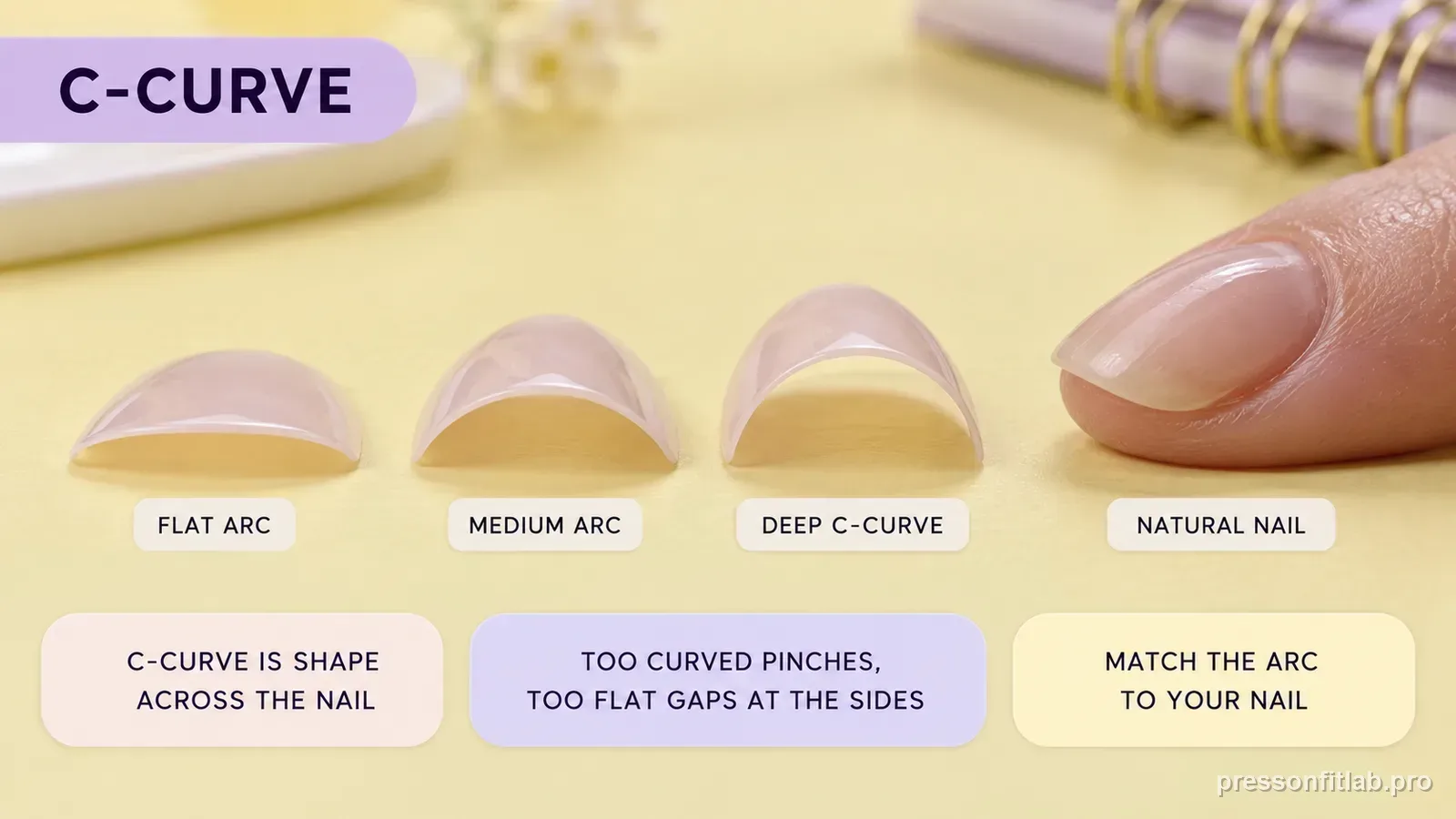
The C-curve is the side-to-side arch of the nail when viewed from the free edge. It is separate from width. A press-on can cover the correct width but still fit poorly if its curve is much deeper or flatter than the natural nail. Judge C-curve by relaxed contact: the tip should not need force to reach both sidewalls and should not hover dramatically at the sides or center.
Check these first
- ✓ View the natural nail from the free edge
- ✓ Compare the press-on underside without adhesive
- ✓ Watch for side spring-back or center hovering
- ✓ Reject pressure or pinching as a normal fit signal
C-curve describes shape across the nail, not size
Imagine looking straight toward the end of your fingertip. The arc from one sidewall to the other is the transverse curve commonly called the C-curve. A flatter nail has a shallower arc; a more curved nail has a deeper arc. That geometry is independent of how many millimeters wide the nail is.
This distinction matters because most shopping size labels emphasize width. Two pieces can be equally wide on a ruler while one has a much deeper underside arch. On the same finger, one may sit relaxed while the other pinches or springs away.
What happens when the press-on is too curved
A press-on is meaningfully too curved when its transverse arc is visibly deeper than the natural nail and it cannot rest comfortably without being squeezed or flattened. Symptoms may include spring-back, pinching, rocking, or incomplete contact, but no single gap location proves the diagnosis.
Do not interpret tension as extra security. Compare another profile at a similar width and choose the one that rests with broader, more comfortable contact before adhesive.
What happens when the press-on is too flat
A press-on is meaningfully too flat when its transverse arc is visibly shallower than the natural nail and the surfaces do not meet stably under light pressure. Depending on width, shell flexibility, and longitudinal profile, the mismatch may appear as a center gap, side gap, or rocking.
Use the free-edge view to compare the arcs themselves. The goal is to identify a closer profile, not to infer curve direction from one gap pattern.
C-curve is only one part of profile
The nail also has a front-to-back shape from cuticle toward the free edge. Some press-ons have more built-in height or apex than others. A tip can match your C-curve but still rock from front to back because the longitudinal profile is wrong.
That is why width, transverse curve, and overall contact should be checked separately. C-curve is a useful clue, but it should not become another one-number label that replaces actual dry-fitting.
How to compare curves without special tools
You do not need a curvature gauge to spot a major mismatch. Dry-fit the tip, look toward the free edge, and compare how the sidewalls meet. A photo taken at the same angle can help you compare two candidates. If one tip needs obvious side pressure while another rests naturally, the difference is meaningful even if you never assign it a numeric curve value.
For reusable sets, save a simple note such as 'flat-leaning thumb' or 'more curved middle finger' beside your millimeter width. That is more actionable than calling the whole hand flat or curved.
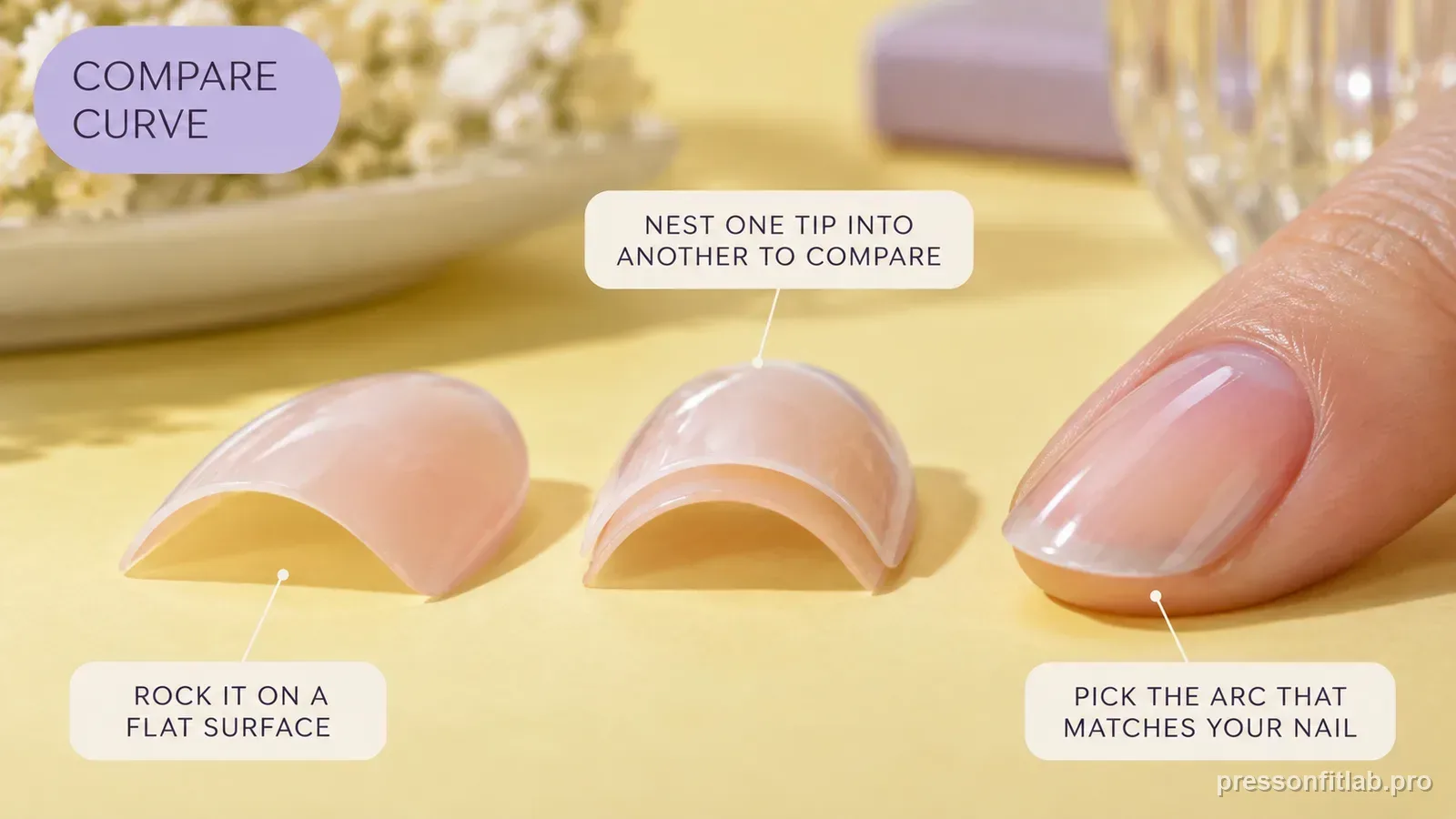
Use curve clues to troubleshoot lifting
If side lift appears on the same fingers repeatedly, revisit the C-curve before changing adhesive. If center lifting or rocking appears, check both transverse and longitudinal contact. If all fingers with previously good fit fail together, prep or application may deserve more attention.
The point is not to blame every failure on curve. It is to prevent curve mismatch from being invisible just because a width number matched.
Diagnostic table
| What you see | What it suggests | Next check |
|---|---|---|
| Sides spring upward on flat-leaning nail | Possible profile mismatch | Compare both arcs directly; test a closer profile. |
| Tip feels like a clamp | Curve and/or width too aggressive | Stop forcing and test another candidate |
| Width is correct but contact is unstable | Curve/profile mismatch | Inspect from free edge and side |
| Center contact with side hovering | Incomplete contact / profile mismatch | Compare both arcs directly; do not diagnose direction from gap location alone. |
| Only one finger has curve trouble | Finger-specific anatomy | Record that finger separately in fit profile |
A controlled test plan
- 1
Photograph the natural nail from the free edge.
- 2
Dry-fit the expected tip without squeezing the sides.
- 3
Compare one alternate profile or shape at similar width.
- 4
Note which candidate rests with the least tension and rocking.
- 5
Save the curve note beside that finger for future sets.
What not to do
- Calling every wide nail flat or every narrow nail curved.
- Using strong pressure to make a deep C-curve look flush.
- Treating a curve mismatch as proof you need more glue.
- Assuming every finger on one hand has the same curve.
Worked troubleshooting example
Example: a 13 mm press-on covers your middle nail perfectly from above but the sides rise as soon as you stop squeezing. A 13 mm tip from another shape rests with much less tension.
Nothing about your measured width changed. The difference is the molded curve and overall profile. You choose the relaxed fit and the side-lift problem disappears from the dry-fit stage.
You record '13 mm, medium/low curve preferred' instead of only a brand size number. That note becomes useful when shopping another collection.
Field notes
Terms such as flat, medium, high curve, natural fit, or sculpted fit are not standardized across the entire market. Treat them as seller-specific descriptions unless actual dimensions are published.
A product can also flex during application. Flexibility may make a moderate mismatch more forgiving, but it is still better to start with a shape that sits comfortably before adhesive rather than relying on material tension.
Frequently asked questions
What is a C-curve in press-on nails?
It is the side-to-side arch of the nail when viewed from the free edge. It describes curvature, not width.
Can a press-on be the correct size but have the wrong C-curve?
Yes. The width can match while the underside is too curved or too flat, causing pinching, side lift, or unstable contact.
How do I know if my nail beds are flat?
Compare each nail from the free edge. Rather than forcing a whole-hand label, note which individual nails have a shallower or deeper transverse curve and dry-fit accordingly.
Sources checked
Sources below are page-specific. We prioritize manufacturer directions for product-specific steps and use medical or dermatology guidance when a safety question requires it. Always follow the instructions for the exact adhesive or set you own.