Half-Cover vs. Full-Cover Nail Tips: Are the Fit Rules the Same?
Understand why traditional partial tips and full-cover shells have different contact zones, fit checks, and failure patterns.
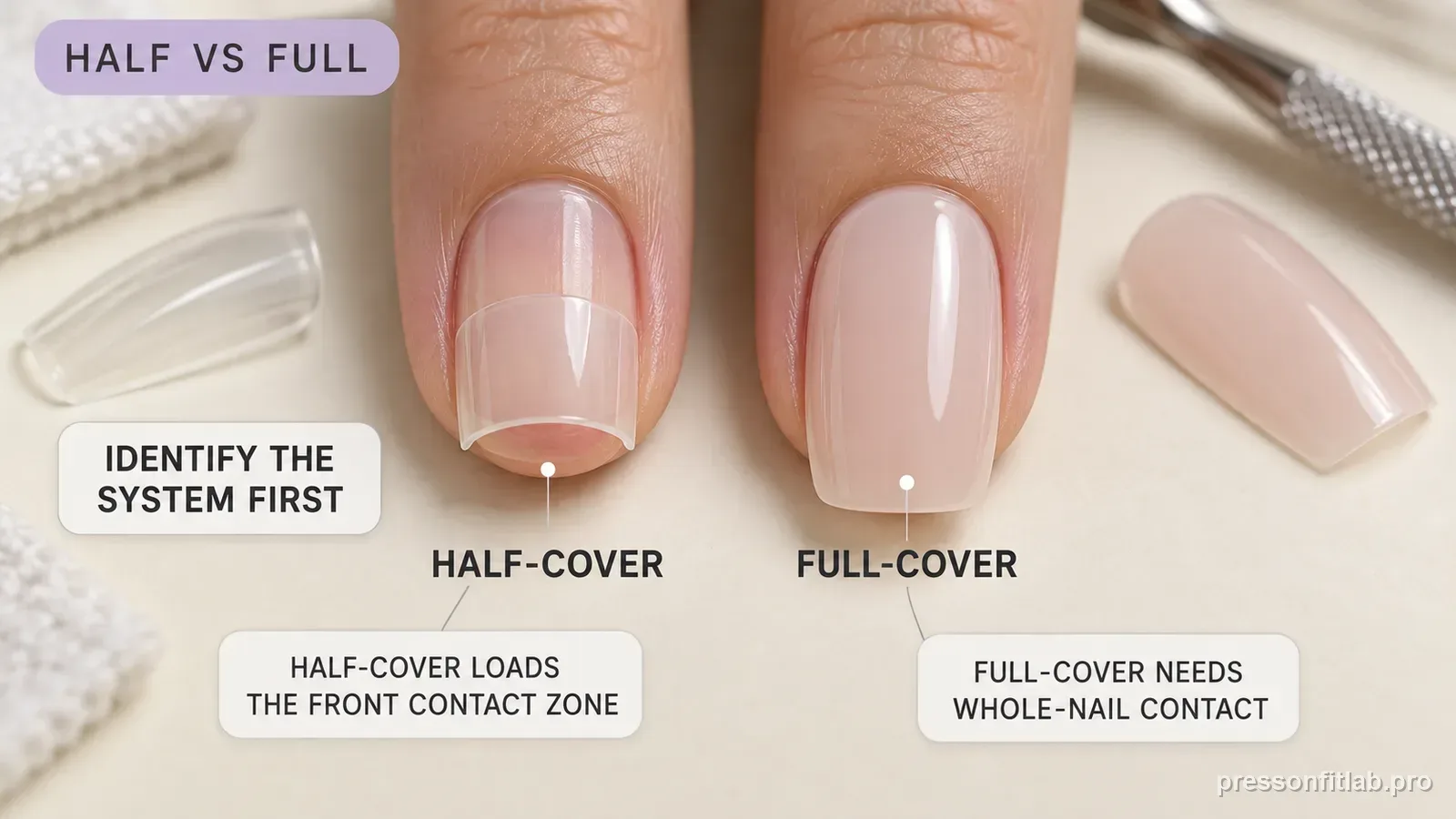
No. A traditional partial tip establishes only part of an extension and is normally reinforced with an acrylic or gel overlay, while a full-cover tip or press-on becomes the complete bonded shell. A partial tip is judged heavily by its contact area, sidewall direction, and compatibility with the overlay; a full-cover shell must match the nail from cuticle to free edge without skin overlap, pressure, or bubbles.
Check these first
- ✓ Does the product cover only the free-edge area or the whole nail plate?
- ✓ Is a separate acrylic or gel overlay required after the tip is attached?
- ✓ Does the full-cover shell contact the entire nail without a central void?
- ✓ Are you judging a partial tip by cuticle-fit rules meant for a full-cover product?
- ✓ Are you following the adhesive/cure system intended for that specific tip?
Identify the system before diagnosing fit
Traditional tip-and-overlay services attach an extension tip and then build structure over it. Full-cover soft-gel tips and press-ons instead cover essentially the entire nail plate as the finished shell.
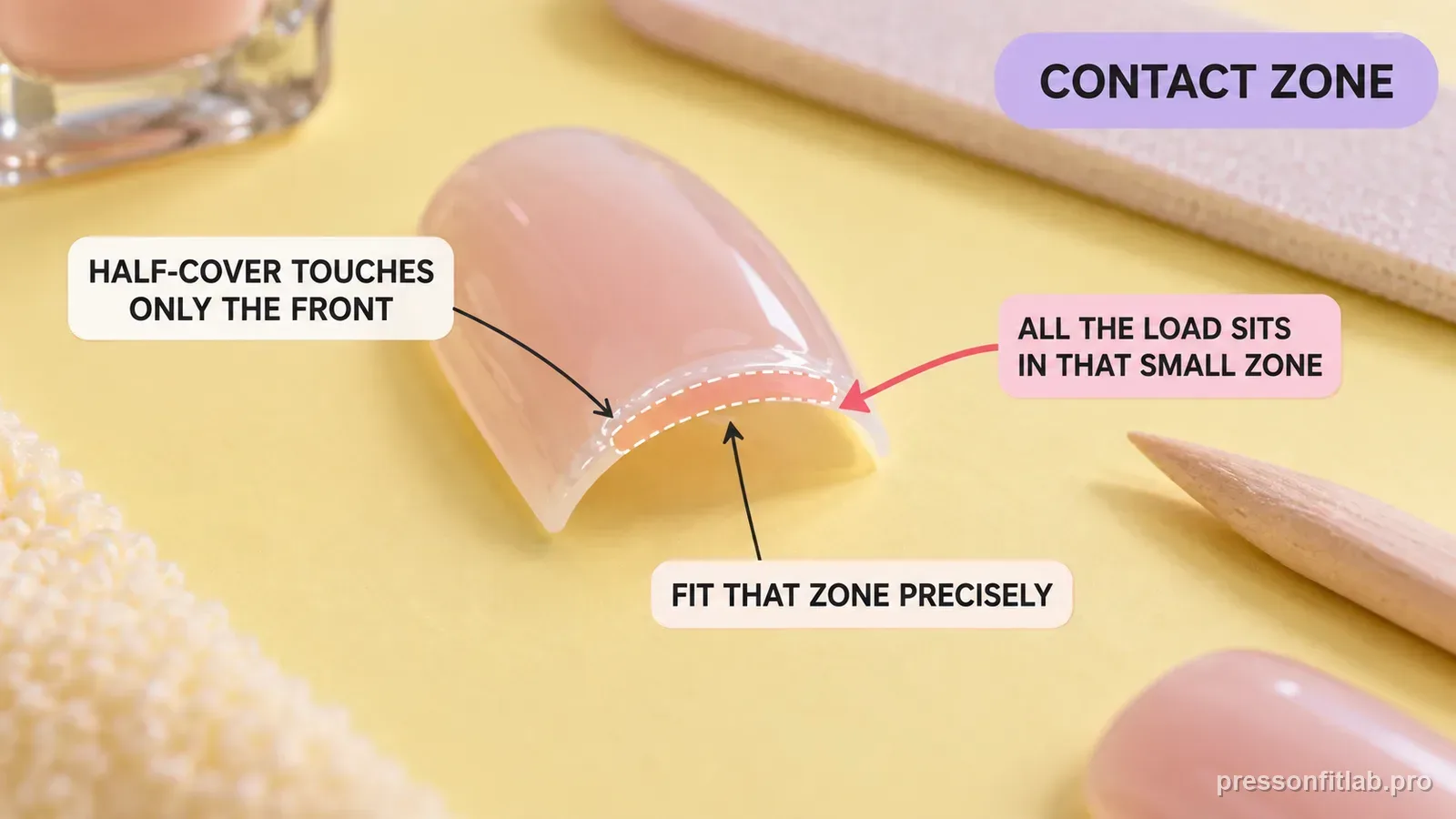
The contact-area concept is the cleanest way to separate these systems. A partial tip has a defined well or distal contact zone and relies on the overlay for final continuity and structure. A full-cover tip uses essentially the whole underside as the primary bonded interface, so a bubble near the center is directly part of the structural attachment rather than a hidden cosmetic imperfection.
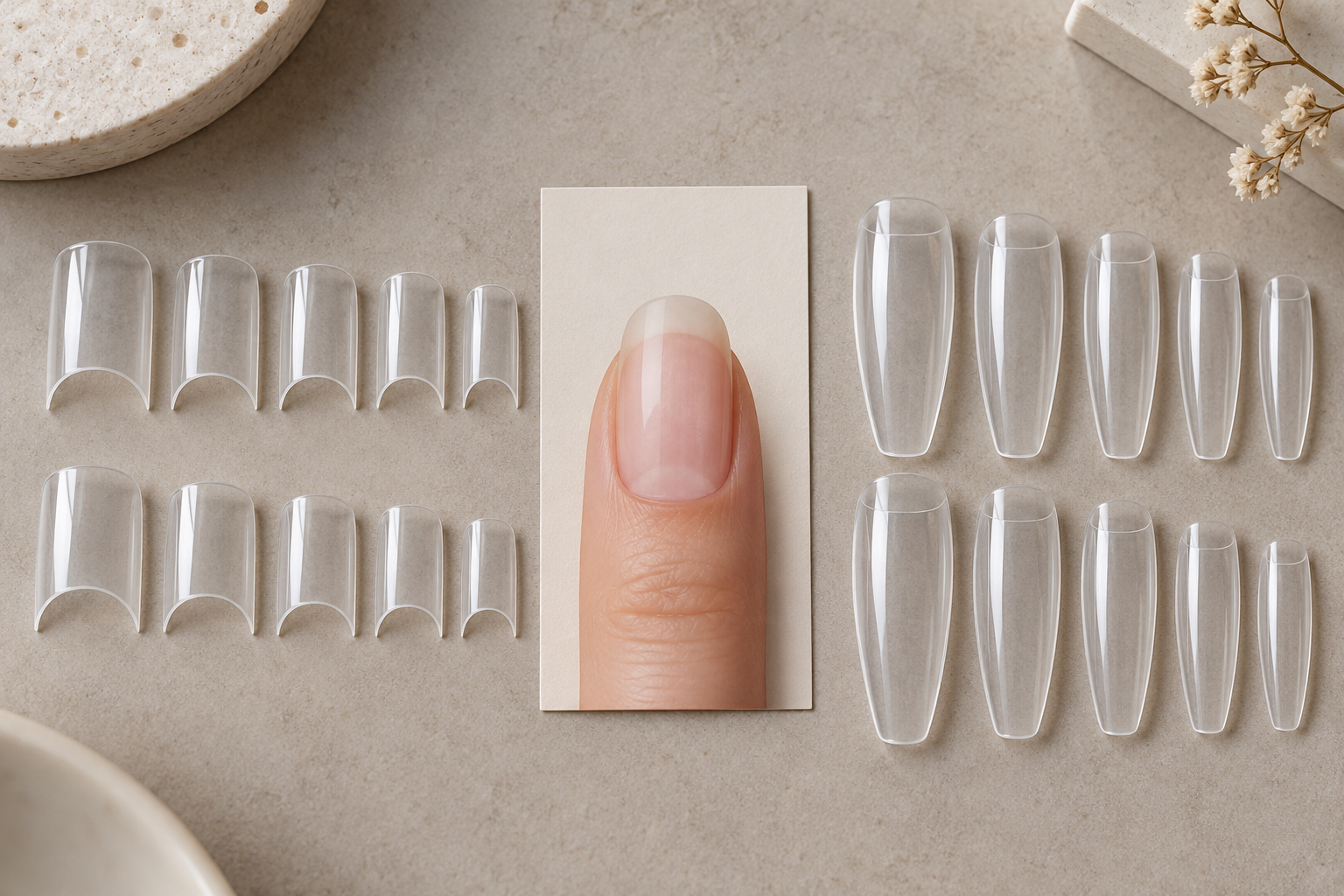
Partial tips concentrate fit at the contact zone
For a partial tip, the transition area, sidewall alignment, and C-curve matter because the overlay will build the rest of the structure. Overlay material should not be used merely to hide a badly gapped tip underneath.
For half-cover tips, sidewall direction must project cleanly from the natural sidewalls before overlay. If the tip flares outward, the enhancement will either remain wide or require aggressive corrective filing later. If it pinches inward, the completed nail can carry unnecessary side pressure even though the overlay looks smooth from above.
Full-cover shells have whole-nail contact requirements
A full-cover product must sit from cuticle to free edge without deliberate air pockets or skin overlap. A central void is part of the primary bond problem, not a cosmetic transition that an overlay will later hide.
NSI's soft-gel instructions tell technicians to size all ten tips first, measure from sidewall to sidewall, and assess the contact area and contour under pressure. That is fundamentally a full-cover criterion: the tip itself needs compatible contour before adhesive is cured. The overlay system, by contrast, separately builds apex and strength after the partial tip is placed.
Sidewall alignment means different things
On a partial extension, sidewall direction affects how the finished enhancement grows out from the natural nail. On a full-cover shell, sidewall position also decides whether the actual bonded edge lands on nail plate or skin.
Adhesive language can also mislead DIY users. Cyanoacrylate press-on glue, light-cured soft-gel adhesive, acrylic monomer/polymer, and builder gel are not interchangeable just because all can attach artificial nail material. Use the manufacturer's cure chemistry and lamp requirements for that exact system rather than borrowing steps from another tutorial.
Do not copy adhesive rules between systems
Traditional acrylic tips, soft-gel full-cover tips, cyanoacrylate press-ons, and adhesive-tab press-ons use different bonding and curing methods. Use the procedure for the system in hand rather than a universal nail-tip recipe.
Failure evidence should be read at the transition specific to the system. A partial tip cracking exactly where its contact zone meets the natural nail can implicate fit, blending, or overlay structure. A full-cover tip lifting as one sheet from a sidewall more directly implicates whole-shell contact, preparation, or trapped air.
Read failure according to the structure
A break near a partial-tip transition points toward tip contact and overlay structure. Cuticle lift or central bubbles under full-cover shells point toward whole-shell geometry and placement. The diagnosis changes with the construction method.
If the user cannot confidently identify whether the product is meant to be overlaid, that uncertainty itself is a stop signal. Check the packaging before application. A half-cover extension tip worn as though it were a finished press-on may lack the structure the system expects, while a full-cover tip should not be ground down simply to imitate a partial well.
Use the coverage boundary to choose the right fit test
“Half-cover” and “full-cover” describe different tip constructions, not interchangeable press-on adhesives. A half-cover extension attaches at a limited portion of the plate and its transition edge must sit smoothly; a full-cover shell spans the natural nail and needs comfortable width and curve contact across the whole plate. Always identify the product and adhesive system first.
Before adhesive, dry-fit the tip and check the part that is meant to contact the natural nail. Do not press a full-cover shell into a mismatch or copy a half-cover blending step onto a pre-shaped press-on. If the product is designed for gel curing, follow that system’s curing instructions; ordinary nail glue is not a substitute.
Diagnostic table
| What you see | What it suggests | Next check |
|---|---|---|
| Partial tip gaps at contact zone | Tip well or C-curve mismatch | Choose a better partial tip before overlay |
| Partial extension flares sideways | Sidewalls misaligned | Resize or reposition before building structure |
| Full-cover shell has central bubble | Whole-shell curve/placement mismatch | Remove and refit rather than covering the void |
| Full-cover shell overlaps cuticle skin | Oversized or wrong outline | Downsize or refine the artificial edge |
| Wrong adhesive/cure method used | System identification error | Return to manufacturer-specific instructions |
| Half-cover extension tip | Only its designed contact zone attaches to the plate | Check transition edge and use its specified adhesive system |
Half-cover vs full-cover fit check
| Check | Half-cover extension tip | Full-cover press-on shell |
|---|---|---|
| Coverage | Attaches to part of the natural plate; transition edge matters | Spans the natural plate from base toward the free edge |
| Dry fit | Assess the intended attachment zone and a smooth transition | Check side-to-side coverage plus curve across the whole nail |
| Adhesive | Use only the product system specified for that extension | Use the stated glue or tab; do not substitute a curing system |
| Stop if | Tip rocks or transition catches before overlay | Tip pinches, overlaps skin, or springs away from the nail |
A controlled test plan
- 1
Confirm whether the product is partial-cover, full-cover glue-on, or full-cover light-cured gel.
- 2
For a partial tip, inspect contact area, C-curve, and straight sidewalls.
- 3
For a full-cover tip, inspect the entire bonded area for bubbles, pressure, and skin overlap.
- 4
Use only the adhesive and cure method specified for the system.
- 5
Diagnose any failure at the structural layer where it actually occurred.
What not to do
- Calling every artificial extension a press-on
- Using overlay to fill a badly fitting partial tip
- Accepting bubbles under a full-cover shell
- Mixing light-cured gel instructions with air-curing nail glue instructions
- Ignoring sidewall alignment because final filing will happen later
Worked troubleshooting example
Jordan bought traditional extension tips and rejected every size because none followed the cuticle like her usual press-ons. She had applied full-cover criteria to a partial-tip system.
After reading the system instructions, she evaluated the contact zone, curve, and sidewalls instead, understanding that an overlay would complete the enhancement.
With a full-cover soft-gel tip on another finger, a central air gap was unacceptable because that shell itself formed the primary bonded extension.
Field notes
Many fit mistakes begin with naming the product incorrectly. Once you know whether the tip is only one component of an overlay or the entire shell, the relevant checks become much clearer.
A partial tip can look incomplete before overlay because it is incomplete by design; a full-cover shell should already demonstrate compatible whole-nail geometry during dry fitting.
Frequently asked questions
Is a half-cover tip weaker than a full-cover press-on?
Not inherently. It belongs to a different structural system in which the overlay contributes much of the finished enhancement.
Can I wear a traditional partial tip by itself?
Use it only as directed by its manufacturer; traditional tips are generally intended to become part of an overlay service.
Should a full-cover tip have a deliberate air gap?
No. The intended bonded area should have close, compatible contact rather than a large void.
Sources checked
Sources below are page-specific. We prioritize manufacturer directions for product-specific steps and use medical or dermatology guidance when a safety question requires it. Always follow the instructions for the exact adhesive or set you own.