How to Keep Press-On Nails From Snagging Clothes
Stop press-on nails catching sweaters, hair, towels, and fabric by finding the exact snag point and fixing fit, edge shape, or lifting instead of hiding it.
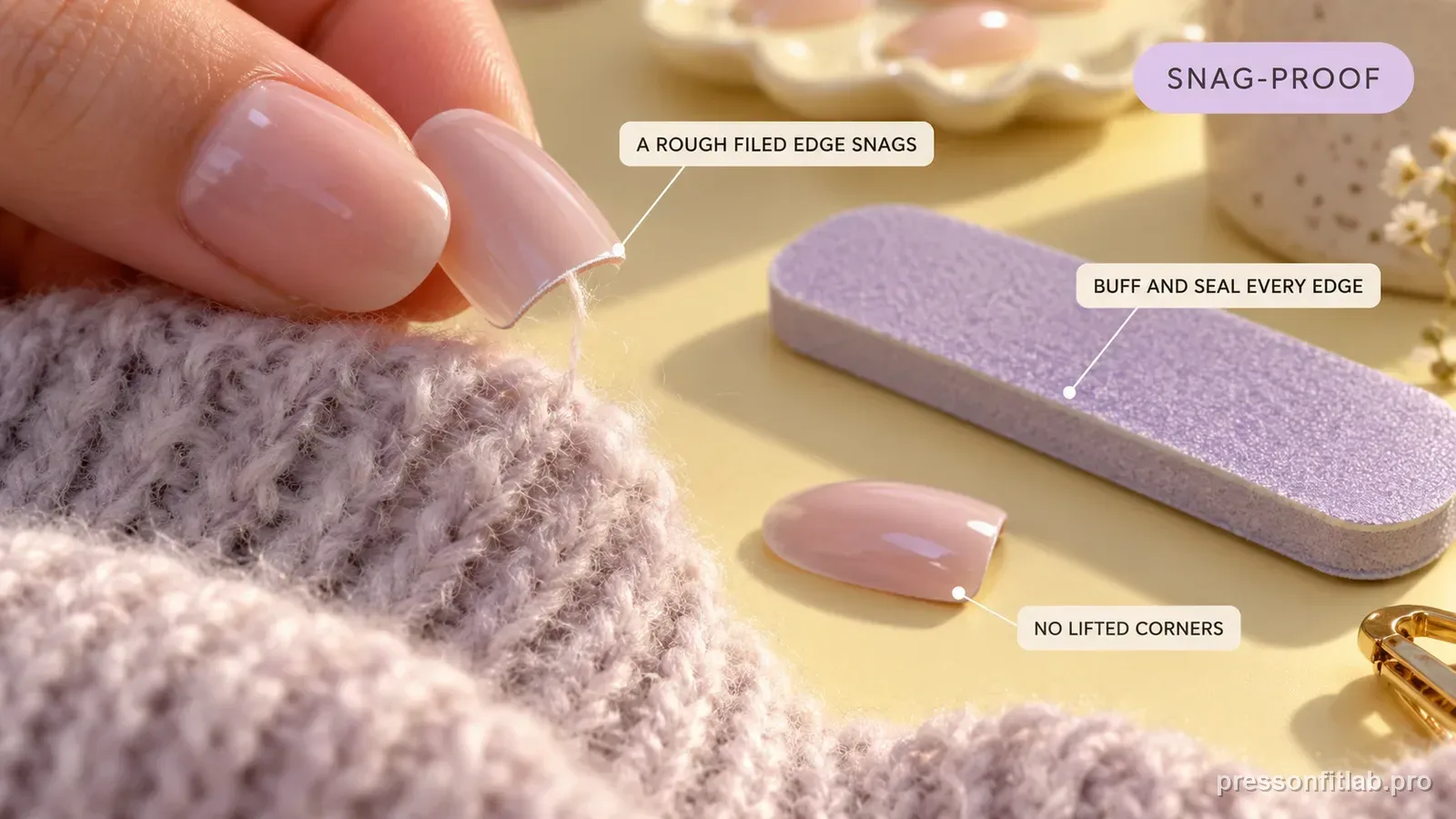
A press-on that snags fabric has a physical catch point. Find the exact location before filing anything: cuticle edge, sidewall, free edge, crack, or decorative element. If the snag comes from lifting, remove and reapply the nail rather than filing the lifted seam thinner. If it comes from a rough free edge or tiny shape mismatch, a light product-safe file can often smooth the problem without changing the whole set.
Check these first
- ✓ Does the fabric catch at the cuticle, sidewall, free edge, or decoration?
- ✓ Does the nail move when the snag point is touched?
- ✓ Is the press-on wider than the natural nail at the catching side?
- ✓ Is there a chip, crack, or sharp filing burr rather than an adhesive problem?
Map the snag point before you fix it
Do not start by filing every edge. First inspect the perimeter under good light and use the opposite fingertip to locate a rough or moving edge. Only after you have confirmed there is no lift should you use a soft cloth as a gentle final check for a free-edge burr. A cuticle snag suggests a lifted or mis-shaped base; a side snag may come from overhang; a free-edge snag may be a tiny burr.
This location-first approach protects the design and keeps you from thinning a press-on that was already fitted correctly. It also separates cosmetic roughness from a bond failure that needs removal and reapplication.
A lifted seam is not a filing problem
When fabric slides under the press-on, the bond has opened. Filing the top of that seam may make the edge feel smoother for an hour, but it does not restore contact underneath. The better move is to remove the failed nail using the correct method, clean and dry the surfaces, then reset with the same tip only if reuse is supported and it still fits, or use a fresh compatible spare.
If the same seam opens repeatedly, inspect sizing and curve. A press-on that is too narrow may spring at the sides, while a highly curved tip on a flatter nail can resist full contact. Those are fit problems, not sweater problems.
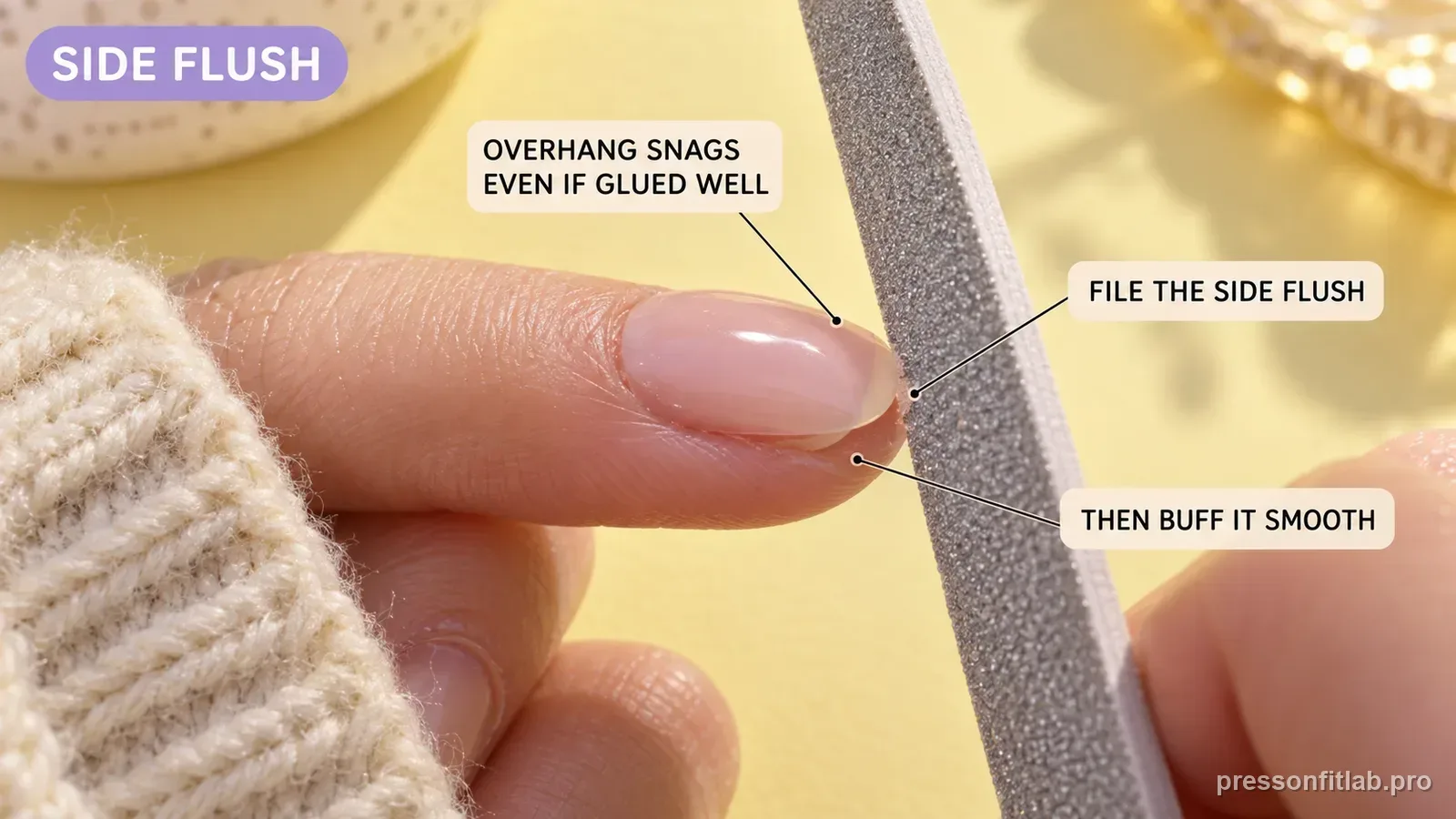
Side overhang catches even when the bond is strong
A press-on can be fully glued and still snag if its side edge extends beyond the natural sidewall. The extra lip meets fabric before your fingertip does. Dry-fitting before application is the cleanest time to correct this by choosing a different size or lightly filing a physically wider candidate to match the nail plate.
Do not file so far inward that the press-on becomes narrow and leaves natural nail exposed. The target is a smooth sidewall transition, not the smallest possible tip.
Free-edge roughness has a different fix
If the catch is at the very tip and the base remains flush, inspect for a tiny burr, chip, or shape corner. A light file can smooth many rough edges when the product finish allows it. File conservatively and protect nail art or coating near the edge.
For square shapes, the corners may naturally catch knits more than rounded shapes. Softening the corner slightly can improve daily wear, but make symmetrical changes to both matching nails so the manicure still looks intentional.
Decorations need a surface check too
Rhinestones, charms, raised gel details, and damaged topcoat can catch fabric even when the press-on itself is perfectly fitted. If the decoration is loose, do not treat it like an adhesive-lift problem underneath the nail. Decide whether the decoration can be safely secured according to the product design or whether that nail should be replaced.
Once you know the snag source, test it against a towel and knit before getting dressed. The goal is a smooth pass around the entire perimeter without having to press the nail downward to make the catch disappear.
Diagnostic table
| What you see | What it suggests | Next check |
|---|---|---|
| Fabric slips under cuticle edge | Lift at base | Remove/reapply; do not file the open seam |
| Catch at one side but nail feels solid | Width overhang or rough sidewall | Refit or lightly smooth the side edge |
| Catch only at the tip | Burr, chip, or sharp corner | Conservative product-safe filing |
| Raised art catches | Decoration issue | Inspect the embellishment, not the bond line |
| Same sidewall reopens after smoothing | Curve/size mismatch | Change the tip profile rather than repeated filing |
A controlled test plan
- 1
Use a soft cloth to identify the exact catch point without pulling hard.
- 2
Decide whether the point is a lift, an overhang, a rough edge, or a decoration.
- 3
Fix only that category: remove/reset a lift with the product-supported method, refit an overhang, or lightly smooth a confirmed burr.
- 4
Retest with two fabric types, such as a towel and knit sleeve.
- 5
If the catch returns at the same bonded edge, investigate fit rather than filing again.
What not to do
- Filing across a visibly lifted cuticle seam and leaving the gap in place.
- Over-filing sidewalls until the press-on becomes too narrow.
- Pulling fabric hard to test a snag and accidentally enlarging the lift.
- Ignoring a crack because it only catches soft clothing occasionally.
Worked troubleshooting example
Example: a medium square nail catches sweaters only at the outer corner of the right ring finger. The cuticle and sides are flush and the nail does not move.
Lightly smooth that free-edge corner according to the product's filing tolerance and retest on the sweater. Keep the base untouched because the bond is not the problem.
If fabric instead slides underneath the sidewall, stop filing the tip. Remove and refit the nail because the snag has become evidence of an open edge.
Field notes
Snagging is a better diagnostic than it sounds. The material that catches acts like a probe that points to the exact discontinuity in the edge, so use the location rather than treating 'snagging' as one generic problem.
If a set looks natural from above but repeatedly snags at the same sidewall, inspect the profile view. Overhang and curve tension are easier to see from the side than in a top-down manicure photo.
Frequently asked questions
Why do my press-on nails catch on clothes?
The catch usually comes from a lifted seam, side overhang, rough free edge, chip, crack, or raised decoration. Locate the exact point before choosing a fix.
Can I file a press-on that snags?
Yes for some rough free edges or slight sidewall overhangs, if the product allows filing. Do not use filing to hide an adhesive gap.
Why do my press-ons snag hair too?
Hair can slip into very small lifted edges. If both hair and fabric catch at the same spot, inspect that bond line closely.
Sources checked
Sources below are page-specific. We prioritize manufacturer directions for product-specific steps and use medical or dermatology guidance when a safety question requires it. Always follow the instructions for the exact adhesive or set you own.