Press-On Nails for Short Nail Beds: Fit the Base, Not Just the Length
Fit press-ons to short nail beds when width is correct but the base feels crowded, the cuticle edge looks bulky, or the free edge starts too far forward.
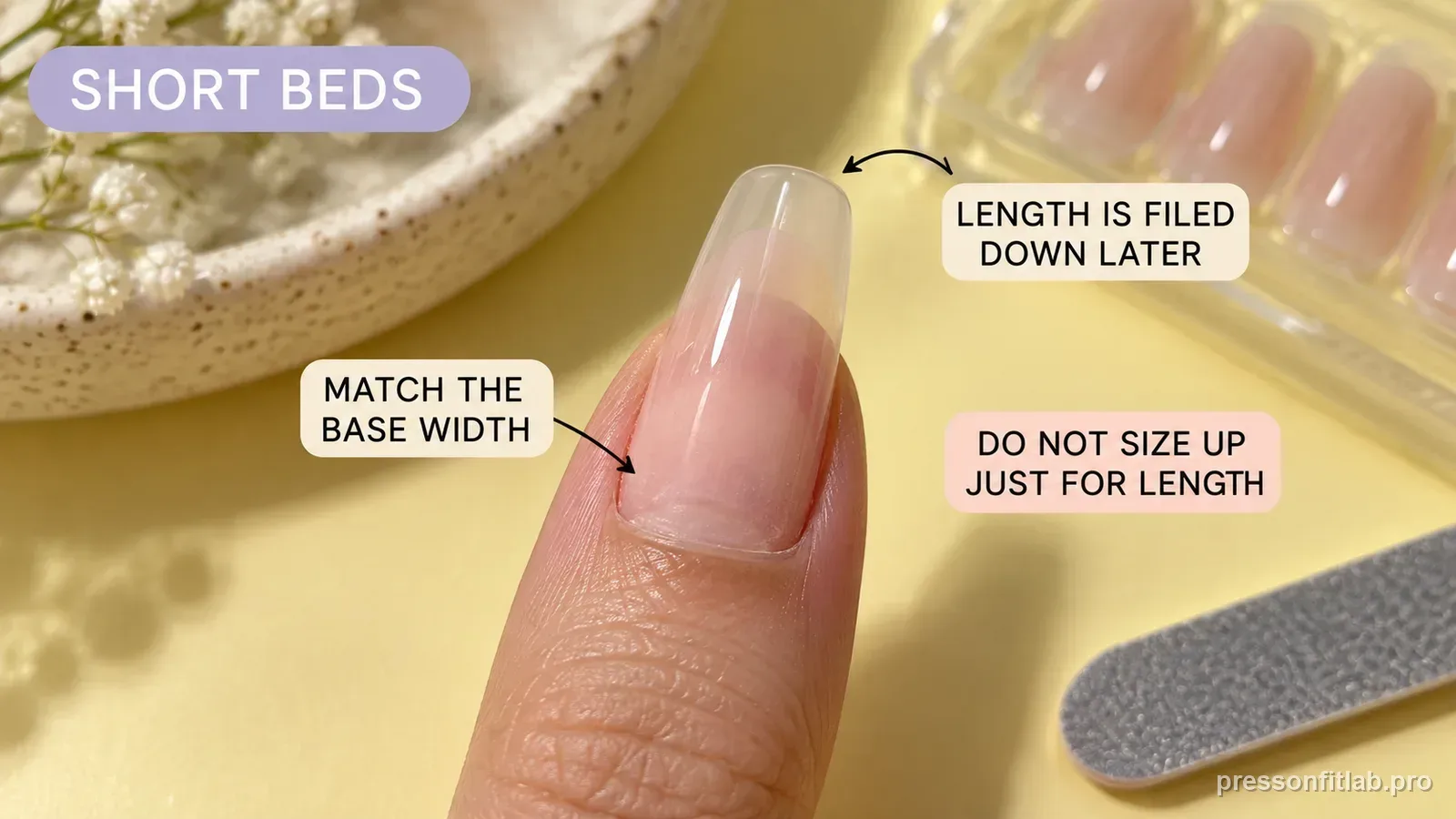
For short nail beds, separate base fit from overall press-on length. A tip can be “short” on the package yet still have a large cuticle-to-free-edge footprint. Dry-fit the base first: it should sit on nail plate, follow the cuticle arc, cover the sidewalls, and leave no need to push it under the cuticle. Then choose or shorten the free edge for your preferred look.
Check these first
- ✓ Does the base sit fully on nail plate without touching skin?
- ✓ Is the natural free edge already close to the cuticle because the nail bed is short?
- ✓ Would a shorter molded length solve the problem better than filing the base?
- ✓ Does shortening the tip reduce leverage for daily use?
Base length and free-edge length are different
A “short” label usually describes the finished nail length, but it does not guarantee a small base footprint. If your nail bed is short from cuticle area to free edge, the artificial base may still feel crowded even when the finished manicure is labeled short.
Dry-fit before trimming anything. Identify whether the extra material is beyond your natural free edge, near the cuticle, or both. Those locations require different adjustments.
Do not create room by pushing toward the cuticle
A press-on should align close to the cuticle while remaining on the nail plate. Pushing it onto skin to make more of the free edge available is not a fit solution. Skin overlap can also create a visible ledge and an early lift point.
If the base reaches too far back even when width is correct, a smaller-footprint mold is a better starting point. Only if the tip material is designed to be filed and the manufacturer allows it should you make a very small cuticle-edge refinement; needing major reshaping points to a poor mold match.
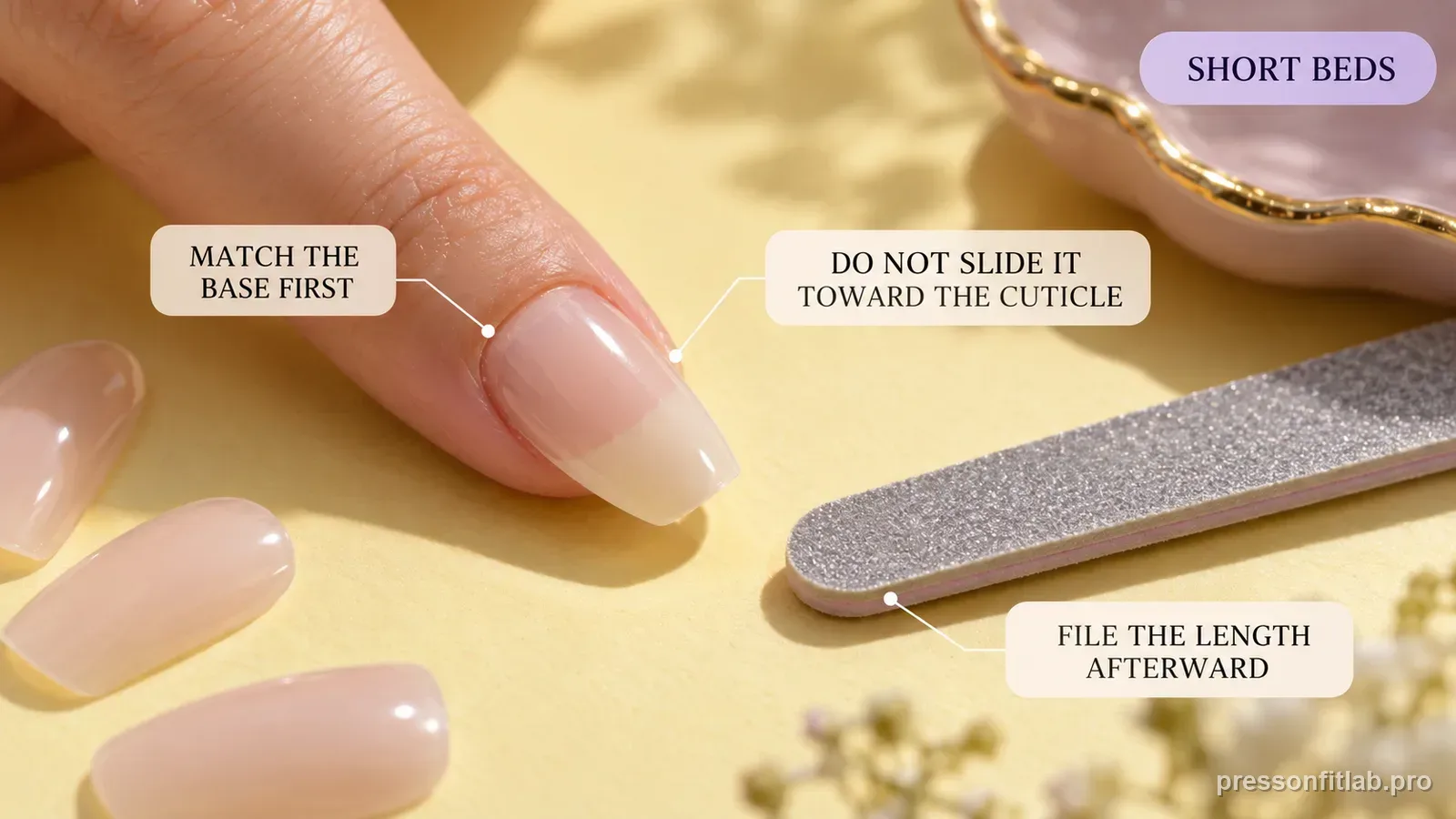
Choose shape after the base is solved
Once the base fits, overall length can sometimes be shortened at the free edge if that press-on material and design are intended to be filed or trimmed. Round, squoval, and short oval styles are generally easier to shorten without radically changing the silhouette than highly tapered long shapes or designs concentrated at the tip.
If you type frequently, shorter extension also reduces leverage. That is a wear decision, not a width decision, so keep it separate in your notes.
Watch where artwork and apex thickness sit
Heavily decorated or molded press-ons may place an apex or design feature at a position intended for a longer nail. Cutting the free edge can make that balance look different. For short nail beds, a design created in a genuinely shorter mold often looks more proportional than a long design that has been aggressively cut down.
This is mainly a visual and structural selection issue; you should not have to file through major raised decoration just to make the base fit.
Save a short-bed note with your width profile
Your millimeter widths alone will not explain why a future set feels crowded. Add a note for fingers where base length is consistently important. Something as simple as “short bed; avoid large cuticle footprint” can save time when comparing sets.
If only one or two fingers are short, customize the selection for those fingers rather than forcing every nail into the same length category.
Diagnostic table
| What you see | What it suggests | Next check |
|---|---|---|
| Base touches skin at cuticle | Footprint is too long or base shape is wrong | Try a smaller-footprint mold; do not push under cuticle |
| Width fits but manicure looks oversized | Overall extension/shape is too long | Choose a shorter molded length, or shorten the free edge only if the product is designed for that modification |
| After trimming, design looks unbalanced | Artwork/apex was built for longer length | Choose a genuinely shorter design next time |
| Only 1–2 fingers feel crowded | Finger-specific nail-bed length | Treat those fingers separately |
A controlled test plan
- 1
Dry-fit the base on every finger before judging the visible length.
- 2
Mark any nail where the cuticle edge or sidewalls touch skin.
- 3
Compare a shorter molded length with the same approximate width.
- 4
If the product is designed to be shortened, refine only the free edge and re-check shape symmetry.
- 5
Record which fingers need a smaller base footprint for the next set.
What not to do
- Pushing press-ons under the cuticle.
- Assuming “short” packaging guarantees a short base.
- Removing large amounts from the cuticle edge to rescue a poor mold.
- Cutting through thick decoration without checking how it changes balance.
Worked troubleshooting example
Example: a short squoval tip covers your width perfectly but its cuticle edge sits on skin unless you slide it forward. Sliding forward then leaves a visible gap at the cuticle. That is a base-footprint mismatch, not an adhesive problem.
Try another short mold with a smaller base while preserving the same approximate width. If it sits on nail plate from cuticle to free edge with no skin overlap, you have isolated the correct variable.
Only after that base is solved should you decide whether to shorten the visible extension. Save the result as “same width, shorter base footprint” so the next purchase is easier.
Field notes
Short nail beds can be wide, narrow, flat, or curved. Do not let the length label replace those measurements. The most reliable workflow is width first, base footprint second, then free-edge styling.
A full-cover fit can still look delicate on a short bed when the shape and extension are proportionate. Exposed sidewall is not required to make a nail look smaller.
Frequently asked questions
Are extra-short press-ons always best for short nail beds?
Not always. The important factor is the base footprint as well as the extension length.
Can I file the cuticle edge to fit a short nail bed?
Only when the tip material is designed to be filed and the manufacturer allows that kind of adjustment. Keep it to a small near-fit refinement; large reshaping means the mold is not a good match.
Should press-ons touch the cuticle?
They should align close to it while staying on the nail plate, not on skin.
Sources checked
Sources below are page-specific. We prioritize manufacturer directions for product-specific steps and use medical or dermatology guidance when a safety question requires it. Always follow the instructions for the exact adhesive or set you own.