How to Shape the Cuticle Edge on Press-On Nails for a Cleaner Fit
Refine the artificial base when a press-on is the right width but its cuticle arc is too square, too deep, or uneven for your nail.
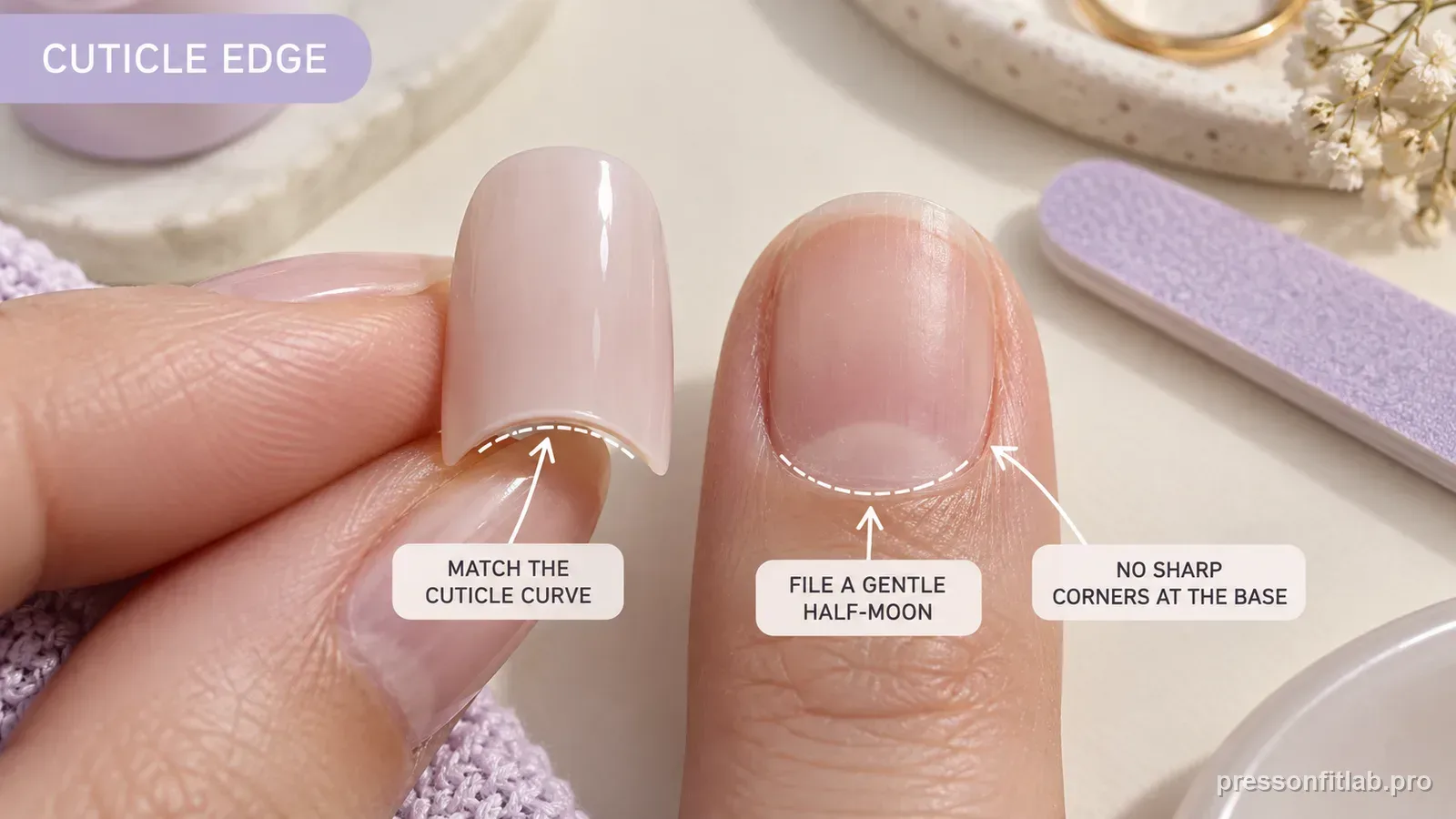
Shape the artificial base only when the press-on material is designed to be filed and the unglued tip otherwise fits. Compare the artificial base with your natural nail boundary, remove tiny amounts from the press-on—not your skin—and dry-fit after every few strokes until the base sits on nail plate without touching surrounding skin.
Check these first
- ✓ Width is already correct.
- ✓ Mismatch is localized to the base corners or arc.
- ✓ Press-on remains on nail plate, not skin.
- ✓ Curve still sits flush after reshaping.
Know when the cuticle edge is the real problem
If the sidewalls align through most of the nail but one or both base corners overlap skin, the overall size may be fine. The artificial cuticle arc simply does not match your natural boundary.
That is different from a tip that is too wide everywhere. Narrowing the whole press-on for a base-only problem can create side gaps higher up.
Trace the natural arc visually
Place the unglued press-on near its final position and compare where the artificial base would sit. Look for a corner that reaches skin or a central notch that leaves too much distance.
Use the natural nail boundary as your reference. The goal is a close visual continuation, not pushing the artificial edge under the cuticle.
Remove tiny amounts
File the press-on base in short controlled passes. Work one small area, then dry-fit again. Artificial nails can lose their intended shape quickly if you make long aggressive strokes.
Smooth any rough artificial edge before application so the base is less likely to catch hair or fibers.
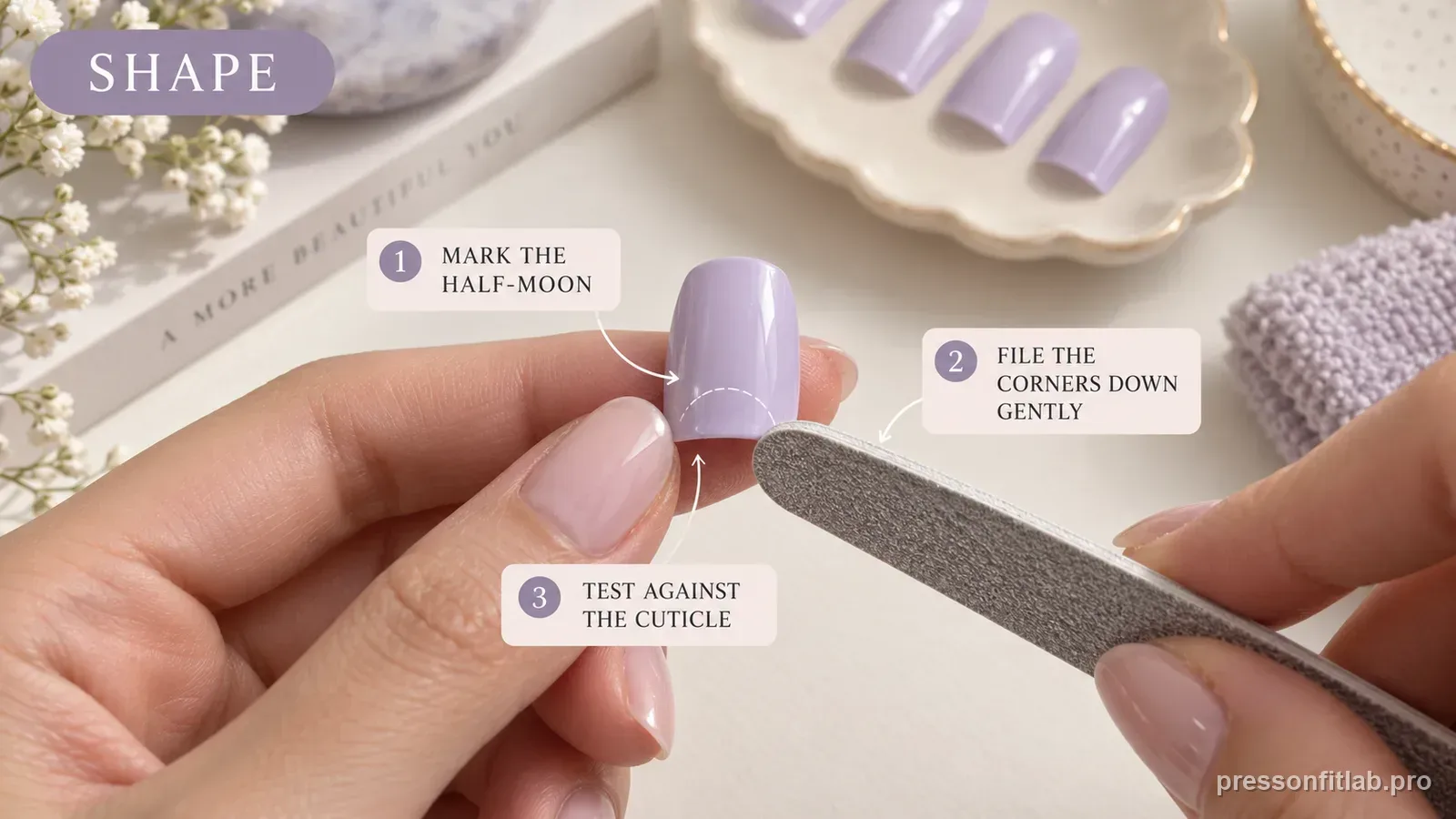
Re-center after every change
A tip that was off-center can imitate a cuticle mismatch. Each dry fit should start centered over the nail, with sidewalls checked before you remove more material.
If reshaping one corner makes the opposite side expose natural nail, the starting size or mold may not have been right.
Stop if the base becomes thin or unstable
Not every press-on is designed for extensive customization. If the edge becomes fragile, distorted, or difficult to seat flat, use a fresh tip or a different mold.
A clean replacement is better than building a manicure around a compromised base.
Check symmetry after every few file strokes
Work on the removable press-on only and remove material gradually. After a few strokes, place the tip back on the nail and check whether the center of the artificial base is still aligned with the nail-plate centerline. It is easy to overwork one corner and accidentally rotate the apparent base even when the width was correct.
A pencil mark on the artificial nail can help you preserve the center while refining only the high corner or square edge. The goal is not to recreate the natural cuticle line perfectly; it is to keep the press-on on nail plate without skin overlap and without thinning the base excessively.
Know what base filing cannot fix
Cuticle-edge shaping is appropriate for a close fit with small artificial excess. It is not a good solution for a tip that is dramatically too wide, much too curved, or too short for the nail bed. Heavy filing can distort the sidewalls, weaken the base, or remove so much material that the intended shape changes.
If several fingers need major reconstruction from the same set, treat that as a mold-selection clue. A different size range or base shape is more repeatable than rebuilding every press-on by hand.
Stop when the base clears skin and sits on nail plate
The cleanest-looking cuticle edge is not always the one with the deepest artificial curve. Stop filing once the press-on can sit close to the natural base without resting on skin and without opening a gap through the center. Chasing an exact visual outline can remove more material than the bond area can afford.
After the final dry fit, run a fingertip lightly around the artificial base and verify that no sharp filed corner remains. If the edge feels rough, smooth only the removable tip before application. Do not trim living cuticle tissue to make the press-on match.
Use the neighboring nail as a proportion check, not a template
Adjacent fingers can help you notice whether one customized base has become unusually deep or narrow, but do not copy another finger’s cuticle arc exactly. Each nail plate can have a different base shape. Compare overall proportion while still fitting the target finger on its own terms.
If your customized tip suddenly looks much narrower or shorter than its neighbors, pause and dry-fit again. That visual change can signal that filing is beginning to alter more than the small base interference you intended to fix.
Photograph the final base before application
A close-up of the customized dry fit gives you a reference for future sets and makes over-filing easier to spot. Capture the artificial base centered on the nail plate with both corners visible. If the next set needs the same adjustment, you can reproduce the small change instead of guessing from memory or filing until the tip simply looks close enough.
Diagnostic table
| What you see | What it suggests | Next check |
|---|---|---|
| Base corners touch skin | Arc too wide/square | Refine corners only. |
| Center of base sits far away | Arc shape mismatch | Compare mold before removing lots of material. |
| One side looks wrong | Possible centering issue | Re-center first. |
| Edge becomes thin/warped | Over-customized | Replace the tip. |
A controlled test plan
- 1
Confirm overall width.
- 2
Center the tip.
- 3
Identify exact base mismatch.
- 4
File tiny amounts.
- 5
Smooth and dry-fit after each change.
What not to do
- Tucking artificial nail under cuticle.
- Narrowing the entire tip for a base-only issue.
- Continuing after the base becomes unstable.
Worked troubleshooting example
Example: a short nail bed fits the width of a press-on, but the artificial base corners sit on skin before the center of the cuticle edge reaches the nail plate. Rather than trimming the natural cuticle, you work only on the removable press-on.
You mark the two artificial corners, file a few strokes, and dry-fit again. The center of the base remains intact while the corners clear the skin and the tip settles lower onto nail plate. You stop as soon as the base follows the nail closely enough for full contact.
If the whole cuticle arc were dramatically different, repeated filing could distort the tip or remove too much structure. In that case a different mold is a better candidate than trying to remake the entire base by hand.
Field notes
Cuticle-edge shaping can make a correct-width tip look dramatically more natural because the attachment point is where the eye notices fit first.
The purpose is to match the artificial base to the visible nail boundary—not to alter or cut living skin.
Frequently asked questions
Can I file the cuticle end of a press-on?
Yes, a small amount can help a close-fitting tip follow your natural cuticle arc, as long as the product material tolerates filing.
Should a press-on touch the cuticle?
It should sit close on the nail plate without resting on surrounding skin.
Why does one cuticle corner keep lifting?
The base may be mismatched or the tip may be off-center. Check those before changing adhesive.
Sources checked
Sources below are page-specific. We prioritize manufacturer directions for product-specific steps and use medical or dermatology guidance when a safety question requires it. Always follow the instructions for the exact adhesive or set you own.