Press-On Nails Too Flat for Your Nail Beds? What the Gaps Mean
Troubleshoot a press-on tip that is flatter than your natural nail by checking center contact, side gaps, width, and profile before application.
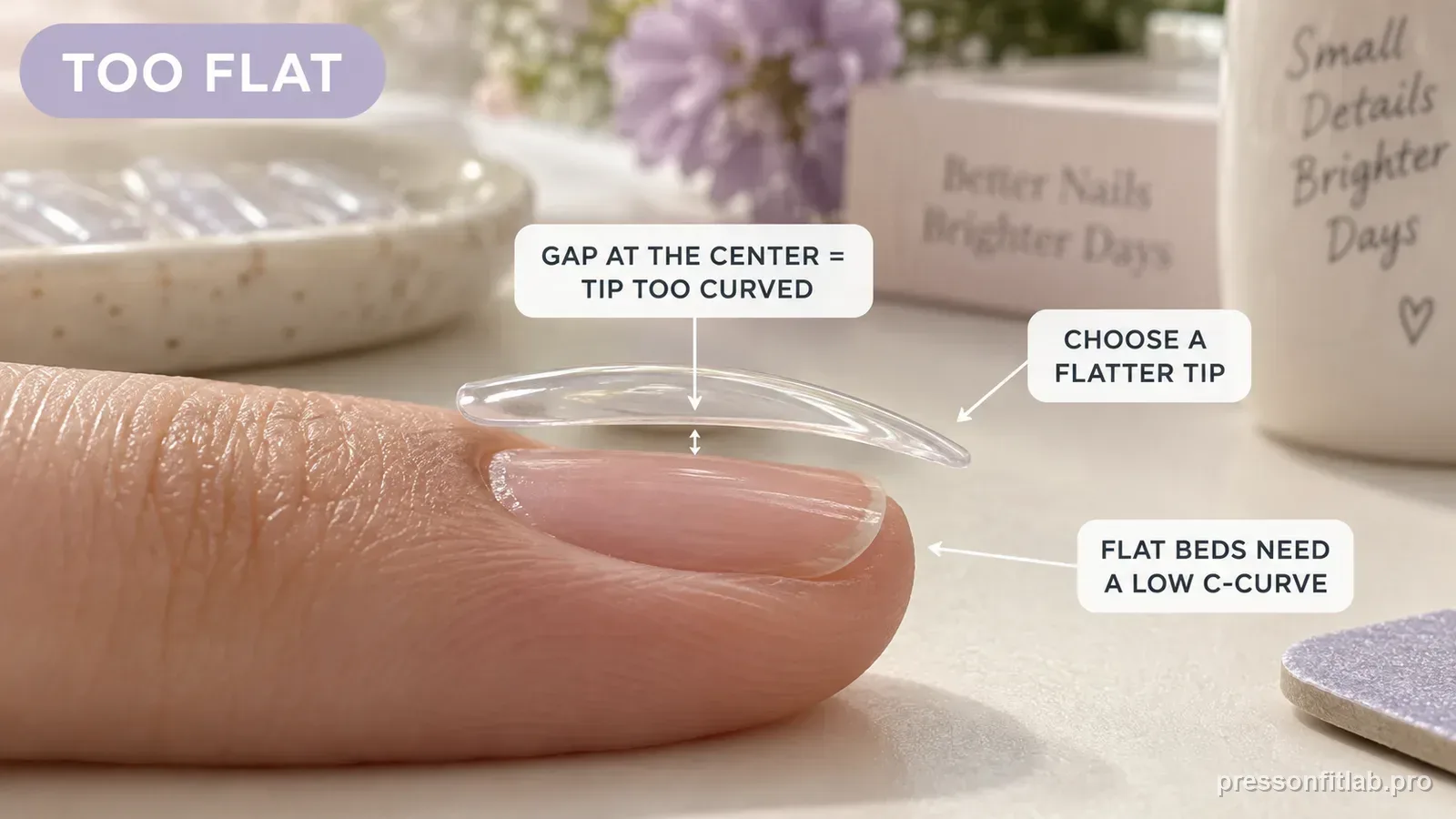
A press-on is meaningfully 'too flat' when its transverse arc is visibly shallower than the natural nail and stable contact cannot be achieved without force. A center gap, side gap, or rocking can accompany a mismatch, but gap location alone is not enough to diagnose the direction. Compare a more compatible curve at a similar width and do not use thick adhesive as a bridge.
Check these first
- ✓ Do the sidewalls touch before the center?
- ✓ Is there a visible center gap during dry fit?
- ✓ Does the tip slide instead of settling?
- ✓ Does a different profile make fuller contact without pressure?
A flat tip can be the wrong shape even when the width is right
Width is only the top view. If the natural nail and artificial tip have noticeably different transverse arcs, the surfaces may not meet broadly even when sidewall coverage looks correct.
Confirm the direction by comparing the two arcs from the free edge rather than by reading one gap pattern as a universal rule. Judge width and curvature as separate variables.
Use the gap as a mismatch clue, not a direction test
Dry-fit the tip and look from the free edge under good light. A persistent center or side gap, spring-back, or rocking means contact is incomplete. To decide whether the tip needs more or less curve, compare its actual arc with the natural nail or test another profile at a similar width.
Do not squeeze the shell painfully to manufacture contact. The goal is relaxed, broad contact; a tip that has to be held in shape will keep mechanical tension in the system.
Check the cuticle base too
A tip can match the center arch but still have a base that is too wide or too square for your cuticle line. That creates a second failure mode at the perimeter.
If the center contact is good but the base corners sit on skin, compare another mold first. Only refine the artificial base when that product and material are designed to be filed or reshaped that way.
Do not confuse thickness with curvature
A thick press-on can look bulky from the side even if its underside curve is acceptable. Conversely, a thin flexible nail can still have the wrong profile.
Make the fit judgment from actual contact and pressure, not from how “thick” the manicure looks. Appearance can be adjusted with length and shape after the geometry is solved.
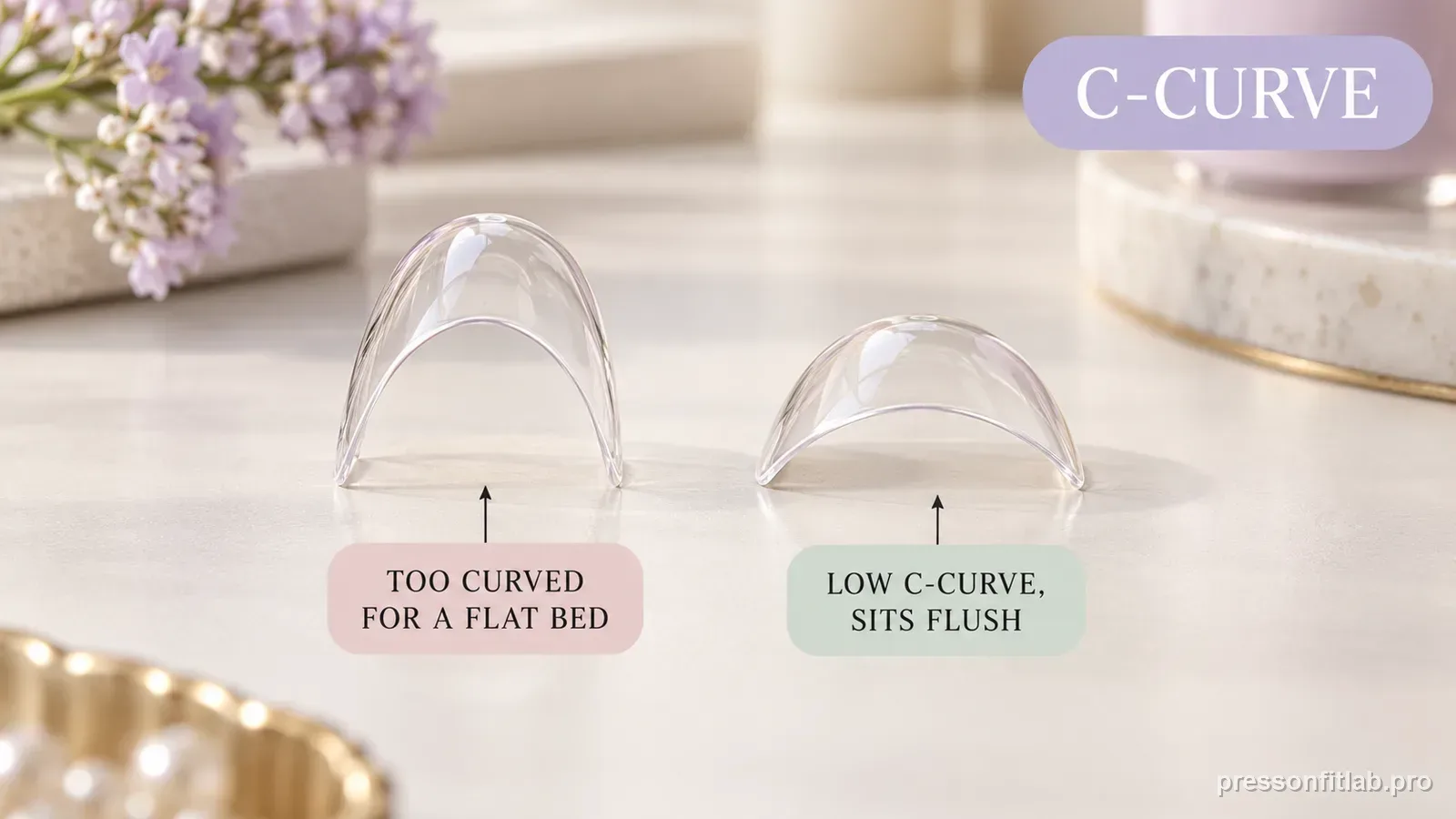
When to stop troubleshooting the set
If several nails require large gaps to be filled, repeated filing, or uncomfortable force, the mold family may simply be a poor match for your hands. Trying a different product line can be more efficient than customizing every finger.
Keep your millimeter measurements when you switch brands. They remain useful even though the brand size numbers may change.
Look for unstable contact, then compare profiles
A mismatched tip can behave like a bridge or seesaw, but the exact pivot pattern changes with width, shell flexibility, longitudinal shape, and where pressure is applied. Treat rocking as evidence of profile mismatch rather than proof of one specific curve direction.
Compare another tip with similar width but a visibly closer transverse arc. If center and sides settle more broadly under light pressure, you changed the useful dimension without chasing adhesive volume.
Do not solve a bridge by widening the shell
A wider version of the same poor profile can create skin overlap without improving contact. When rocking or a persistent gap is present, keep width as close as possible and compare curvature/profile separately.
That controlled comparison tells you whether contact improves because of shape rather than because several dimensions changed at once.
Diagnostic table
| What you see | What it suggests | Next check |
|---|---|---|
| Center gap visible dry | Profile mismatch / incomplete contact | Compare the two arcs directly; test a closer profile at similar width. |
| Sidewalls touch but center floats | Profile mismatch / incomplete contact | Compare the two arcs directly; test a closer profile at similar width. |
| Base also overlaps skin | Separate base-shape problem | Change mold, or refine only if the product permits it. |
| Gap appears only after application | Technique/coverage | Review the exact product placement method and adhesive coverage. |
A controlled test plan
- 1
Check width from above.
- 2
Check profile from the free edge.
- 3
Find whether the center gap exists before glue.
- 4
Test a closer-arc profile at a similar width.
- 5
Apply only when broad contact is possible.
What not to do
- Pinching the sidewalls into a new shape by force.
- Filling a large center cavity with adhesive.
- Confusing thickness with curvature.
Worked troubleshooting example
Example: a press-on reaches both sidewalls but rocks during dry fit and leaves a visible hollow under part of the shell. From the free edge, the artificial arc is visibly shallower than your natural nail.
You compare a tip at a similar width with a closer curve. The replacement settles with broader contact under light pressure, so you keep the adhesive routine unchanged for the controlled test.
The gap was useful evidence that contact was poor; the direct arc comparison—not the gap location by itself—identified which profile direction to change.
Field notes
When a direct free-edge comparison confirms that the press-on arc is shallower than the natural nail, the shell can bridge instead of making broad contact. That calls for a closer profile rather than simply changing the printed size.
Because natural nail curvature can vary finger by finger, one problematic nail does not mean the whole set is unusable. A single custom size/profile can solve a local mismatch.
Frequently asked questions
What does a center gap under a press-on mean?
If it is present during dry fit, contact is incomplete. Compare the natural-nail arc and press-on arc directly before deciding whether the shell is too flat, too curved, or mismatched in another dimension.
Can adhesive tabs fill a center gap?
Tabs should not be used as a structural spacer for a large gap. Start with a tip that already makes reasonable contact.
Can the correct width still fit badly?
Yes. Width and curvature are different dimensions, so both must be checked.
Sources checked
Sources below are page-specific. We prioritize manufacturer directions for product-specific steps and use medical or dermatology guidance when a safety question requires it. Always follow the instructions for the exact adhesive or set you own.