Should Your Dominant and Non-Dominant Hands Use the Same Press-On Sizes?
Stop assuming mirror-image sizing: matching fingers can differ in curvature even when left and right widths look similar.
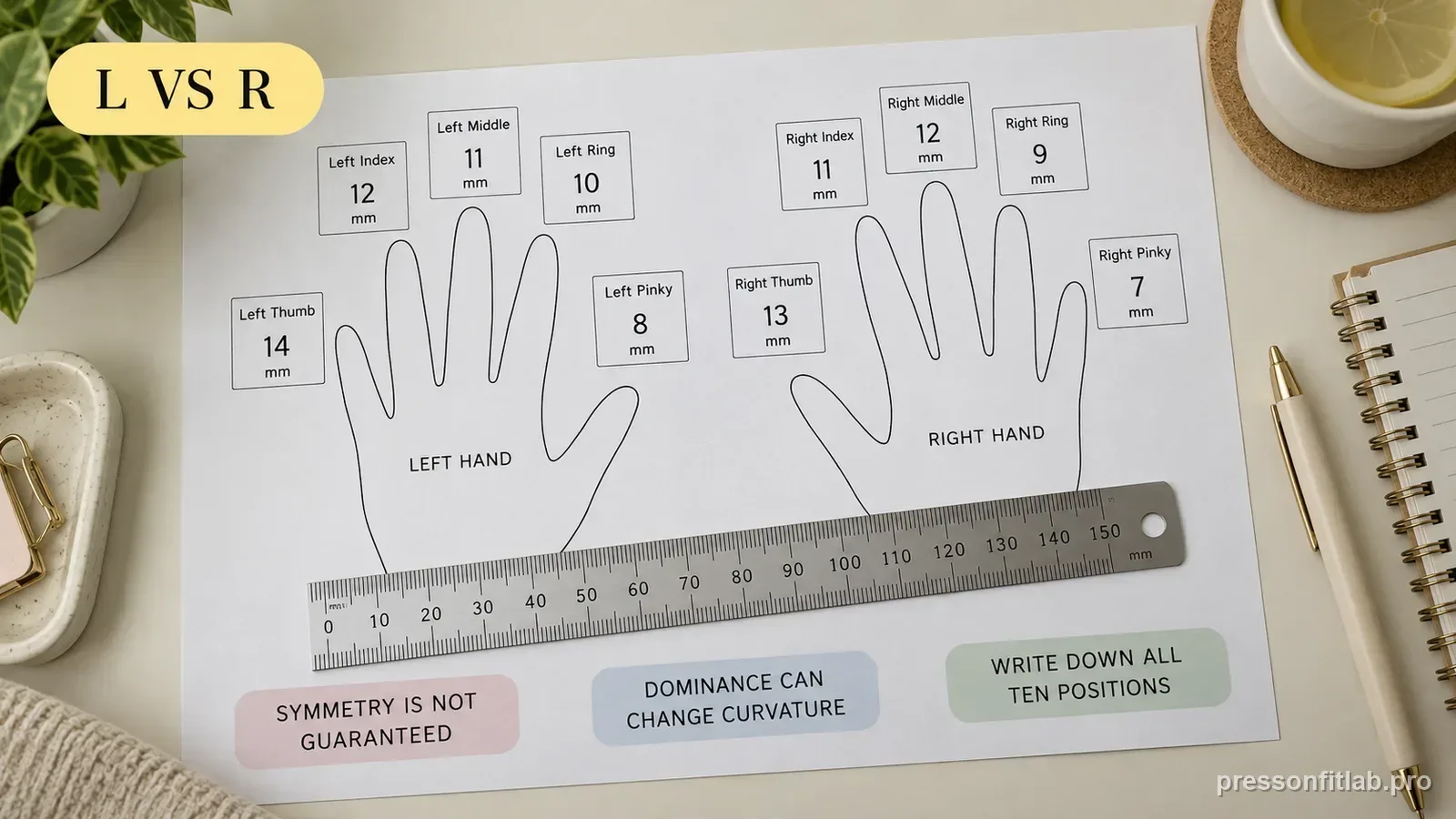
Do not assume matching fingers on both hands need identical shells. Research on healthy fingernails found hand dominance influences transverse curvature, with dominant-hand nails tending to be flatter. Measure and dry-fit all ten fingers independently, especially when one side repeatedly lifts even though width measurements look similar.
Check these first
- ✓ Does the same shell sit flatter on one hand than the other?
- ✓ Does one matching finger rock despite similar width?
- ✓ Are repeated failures concentrated on the dominant hand?
- ✓ Have you recorded ten separate sizes rather than five mirrored sizes?
- ✓ Does one hand require more side pressure during application?
Symmetry is convenient, not guaranteed
Copying five sizes from one hand to the other saves time, but it can hide small width, outline, or curvature differences.
The most useful research finding here is not that one hand is always a different size; it is that handedness can influence transverse curvature even when width-to-length ratio does not change. That explains why caliper or tape measurements can match while one shell still needs more force to sit flat.
Hand dominance can affect curvature
Published measurements of healthy adult nails found that dominant-hand nails tended to be flatter. Handedness was also associated with transverse nail configuration in another study.
A left-right dry-fit photo should be taken from the same angle. Place matching fingers side by side, seat the same numbered shell without glue, and photograph the free edges. Compare how much daylight is visible under each sidewall and whether the shell springs after pressure is released.
Width measurement can miss three-dimensional difference
Two index nails may have similar top-view span while one requires a flatter interior shell. If the same size rocks on only one side, inspect from the free edge.
Dominant-hand workload is a confounder, so separate initial fit from wear. If the dominant index already shows side spring before application, fix geometry first. If both hands dry-fit equally but the dominant side wears faster, then repeated gripping, tapping, or tool use becomes the stronger explanation.
Activity can amplify a marginal dominant-hand fit
The dominant hand often does more gripping, opening, tapping, and manipulation. A slightly wrong shell on that hand may therefore fail sooner than the same mismatch would on the other side.
Do not insist on mirrored numbers for aesthetic neatness. A size number is inventory shorthand, not an anatomical diagnosis. One hand using size 5 and the other size 4 can be correct if both shells meet the same criteria: nail-plate coverage, no skin overlap, neutral curve, and centered axis.
Write down ten positions
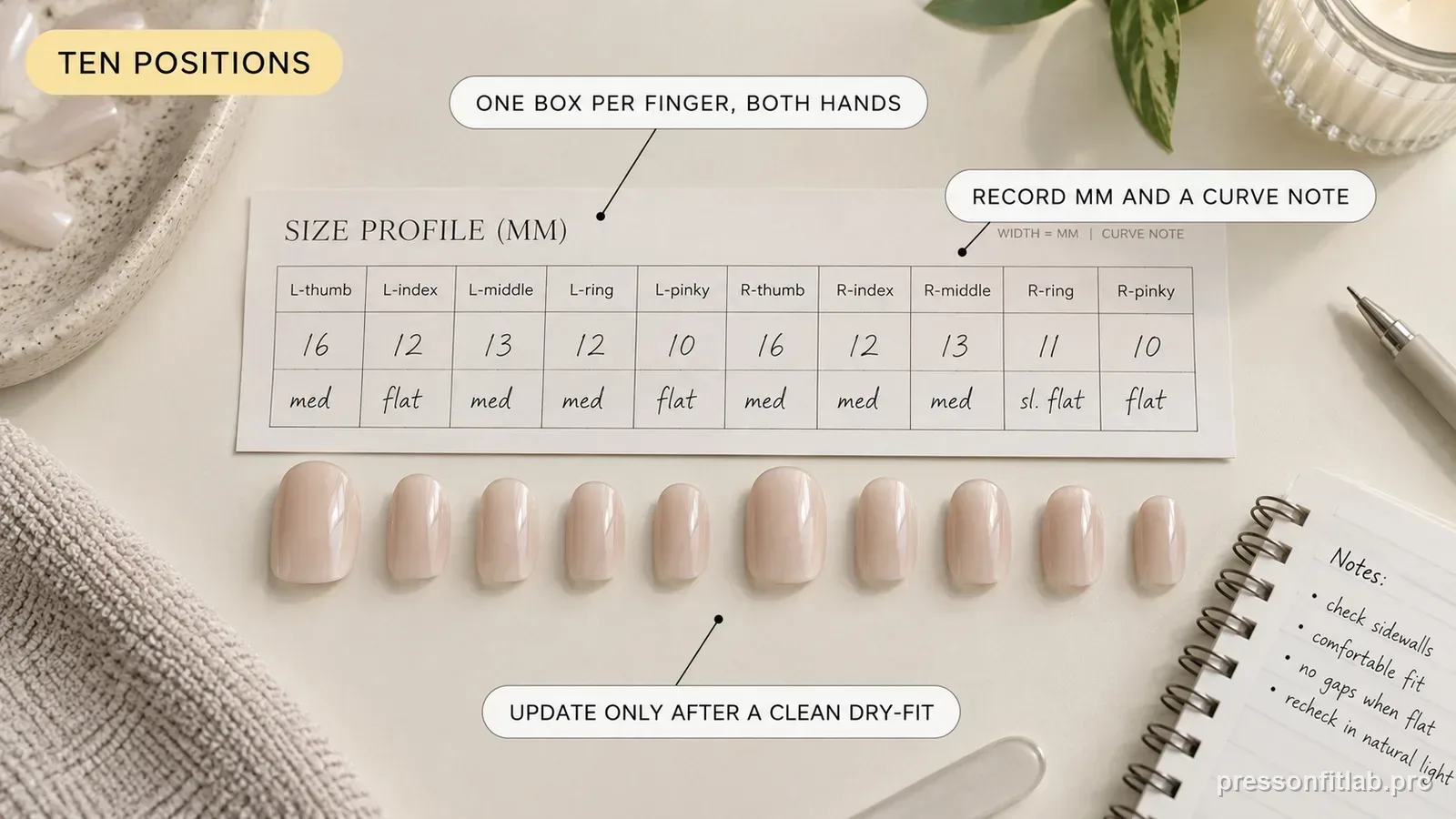
Record left thumb through left pinky and right thumb through right pinky separately. Add a curve or filing note when a numbered shell alone does not capture the fit.
Asymmetry can also come from old injury, filing habits, or differential nail length, so dominance should not be used as the only cause. The correct claim is narrower: research gives a plausible reason to recheck curvature independently when a mirrored sizing assumption keeps failing.
Use repeated one-sided failure as evidence
If the right index always lifts and the left index does not, compare their dry fit before changing glue on both hands. A consistent left-right pattern is exactly when asymmetric sizing is justified.
For reusable sets, mark the underside with left/right finger position after you finalize fit. This preserves tiny hand-specific filing corrections. Otherwise the next application can accidentally swap two nearly identical shells and recreate the exact one-sided lift you previously solved.
Diagnostic table
| What you see | What it suggests | Next check |
|---|---|---|
| Same size fits left but rocks on right | Left-right curvature difference | Fit the right finger independently |
| Widths match but one needs side pressure | Three-dimensional curve differs | Try a different curve/profile |
| Dominant-hand nails lift sooner | Fit error plus heavier use may combine | Correct geometry before altering adhesive |
| One hand shows skin overlap | Outline/width asymmetry | Use separate sizes |
| Repeated failure on one matching finger | Local finger variable | Run side-by-side dry-fit comparison |
A controlled test plan
- 1
Lay out matching size shells for left and right fingers.
- 2
Dry-fit each side independently and photograph the free-edge view.
- 3
Mark any finger where the same shell behaves differently.
- 4
Test one neighboring size/profile only on the problem hand.
- 5
Record the final ten-finger map.
What not to do
- Automatically mirroring sizes
- Using width as proof that curvature matches
- Changing glue on both hands for a one-sided issue
- Forcing the dominant-hand shell flat
- Assuming faster dominant-hand wear is entirely activity-related
Worked troubleshooting example
Morgan used size 5 on both index fingers. The left lasted a week while the right repeatedly lifted from one side in two days.
Top-view widths were similar, but a free-edge comparison showed the right nail was flatter and the shell had to be squeezed down.
She used a flatter shell on the right and kept the left unchanged. The asymmetrical lifting stopped, so she recorded separate right and left fit notes.
Field notes
The dominance finding is most useful when a person already has reliable general sizing but cannot explain one-sided lifting. It is a reason to repeat the curve check rather than endlessly changing prep.
A separate ten-finger size map takes little time to maintain and prevents repeating the same asymmetrical error every new set.
Frequently asked questions
Are dominant-hand nails always flatter?
Population research found a dominance effect, but individual nails vary. Use the finding as a reason to measure rather than a rule that predicts everyone.
Can left and right thumbs use different size numbers?
Yes. Use the shell that actually fits each nail without skin contact, gaps, or stored pressure.
Why might the dominant hand still wear faster after fit is corrected?
It can receive more mechanical loading. Fit and workload are separate variables and may both influence wear.
Sources checked
Sources below are page-specific. We prioritize manufacturer directions for product-specific steps and use medical or dermatology guidance when a safety question requires it. Always follow the instructions for the exact adhesive or set you own.