Why Do Press-On Nails Lift During Long Hours of Driving?
Diagnose steering-wheel pressure and fingertip torque without confusing driving wear with ordinary typing or glue failure.
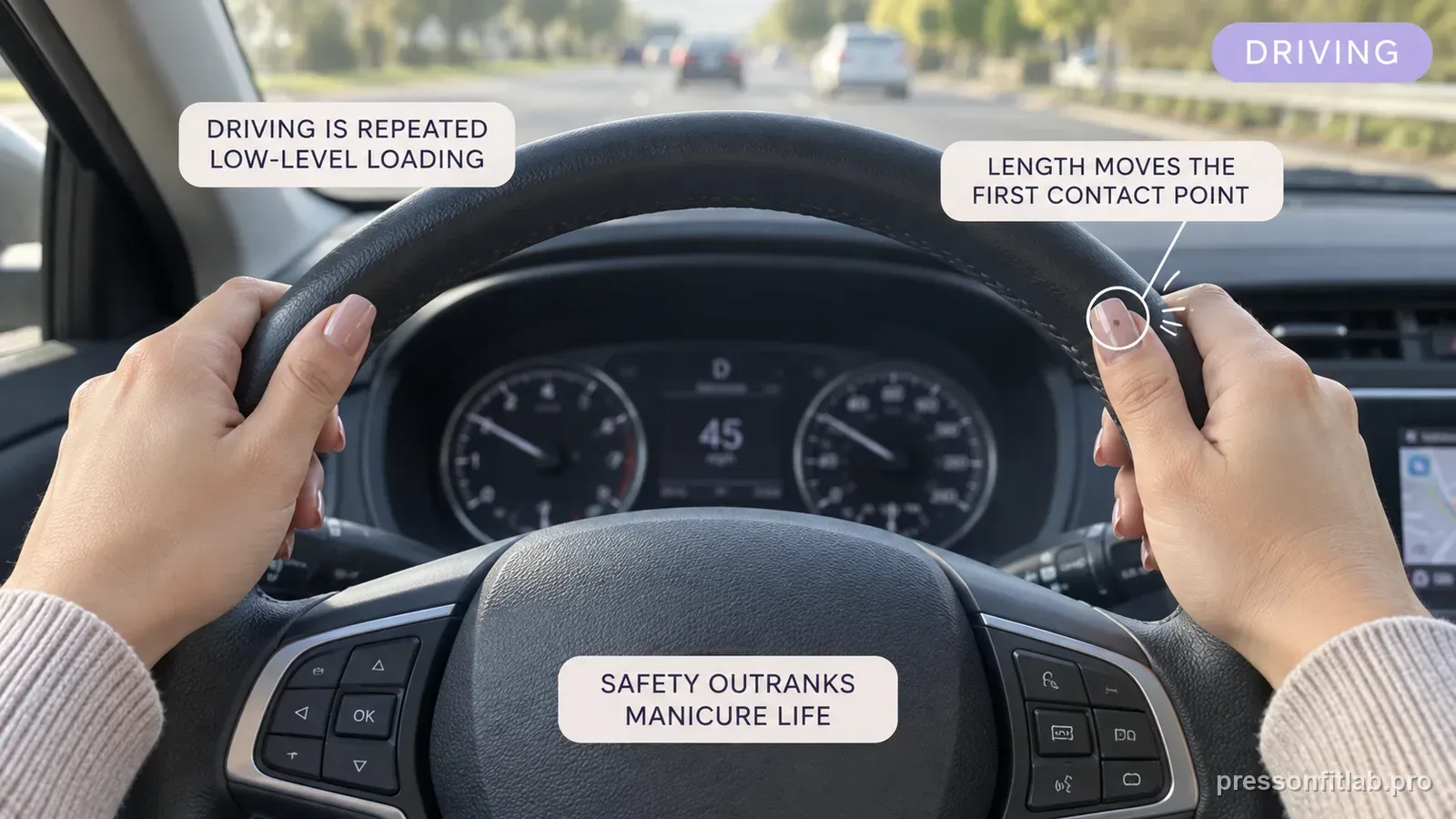
Long drives can repeatedly load press-ons through steering-wheel grip, fingertip repositioning, buttons, stalks, seat belts, and other controls. This is primarily a mechanical wear pattern. If lifting follows long trips, map which artificial free edges physically contact the wheel or controls and shorten those nails before escalating glue strength.
Check these first
- ✓ Do long nails contact the steering wheel before the finger pads?
- ✓ Do thumbs repeatedly strike wheel controls?
- ✓ Does a tightly curled grip push index or middle free edges into the rim?
- ✓ Do failures follow long drives more than ordinary days?
- ✓ Are the affected nails also the longest or marginally fitted?
Driving creates repeated low-level loading
A long trip can apply many small grip and repositioning forces without one dramatic snag. The eventual pop may therefore feel spontaneous even though the bond has been loaded repeatedly.
Driving stress is best mapped while the vehicle is parked. Hold the wheel in your normal positions and look at whether the artificial free edge contacts the rim before the finger pad. Then test common controls such as indicator stalks and steering-wheel buttons. This identifies contact without distracting you during actual driving.
Grip style determines the affected fingers
Some drivers wrap fingers deeply around the wheel; others rely heavily on thumb controls. Inspect your actual safe hand position while the vehicle is parked.
Long sessions add cumulative cycles rather than one dramatic force. Each small regrip can bend or twist the same shell in the same direction. A marginal lateral fit may therefore appear fine at the start of a trip and show a thin white lift line hours later, especially on the fingers wrapped most tightly around the rim.
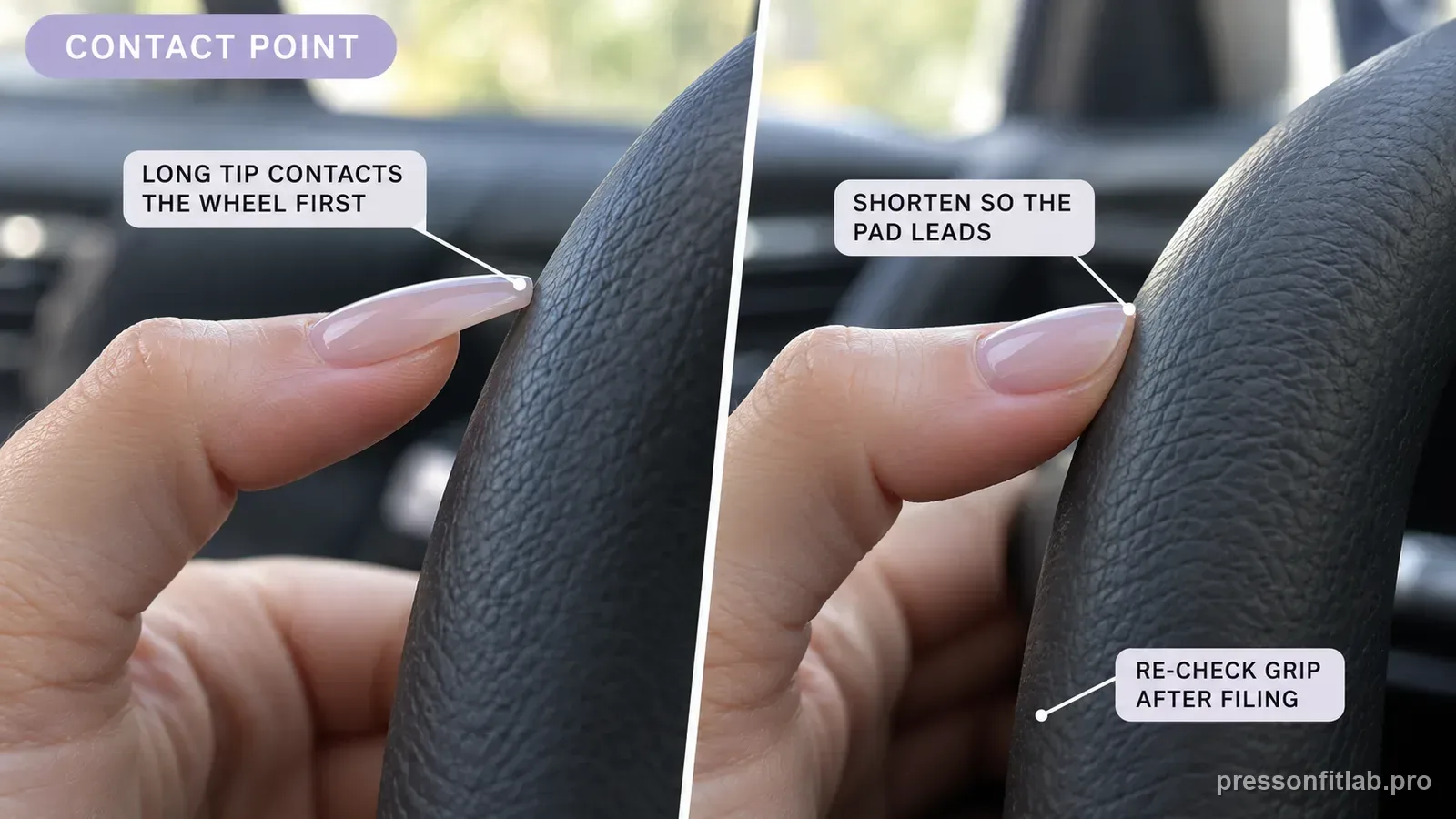
Length changes the first contact point
With short nails, the finger pad typically reaches a surface first. With longer artificial nails, the free edge may reach the wheel or button first and transfer force directly into the shell.
Thumbs deserve their own branch because modern steering wheels often place controls under them. If the thumbnail, rather than the thumb pad, repeatedly lands on a button edge, a short thumb can solve a problem that would never be fixed by changing the index or middle nails.
Driving can expose a marginal fit
A tiny side gap may survive light use but peel faster under steering torque. Dry-fit the problem finger again before assuming the activity alone is the root cause.
Cabin temperature is usually a weak first explanation compared with direct contact. Do not jump from ‘it happened in the car’ to heat or air-conditioning damage. If the same fingers fail only after long drives and their free edges visibly touch the wheel, you already have a much stronger mechanical hypothesis.
Safety outranks manicure life
Do not change safe driving technique, grip, or access to controls to protect nails. If length interferes with safe vehicle operation, shorten or remove the press-ons.
Safety overrides cosmetic testing. Never loosen your grip below what driving conditions require and never inspect, press down, or re-glue a lifting nail while the vehicle is moving. If a shape interferes with controls, the diagnostic conclusion is simply that the set is too long or poorly shaped for that driving task.
Inspect after the trip, not while driving
Once parked, look for the earliest cuticle line or side gap and match it to your observed contact pattern. Repeated patterns across trips are more useful than one accidental failure.
A controlled test can be as small as shortening the right index and both thumbs while leaving everything else unchanged. If those contact points stop lifting over comparable trips, you have useful activity-specific evidence without redesigning the entire manicure.
Diagnostic table
| What you see | What it suggests | Next check |
|---|---|---|
| Index/middle lift after long drives | Wheel-rim contact or curled grip | Shorten those fingers and reassess contact |
| Thumbs fail first | Repeated steering-wheel button use | Shorten thumbs and keep pad-based control access |
| Only one sidewall opens | Grip torque exposes marginal fit | Correct that shell geometry |
| Nails interfere with controls | Length incompatible with safe operation | Shorten/remove immediately |
| No driving pattern after fit correction | Original issue likely general fit | Return to standard lifting diagnosis |
A controlled test plan
- 1
With the car parked, note which free edges contact the wheel and controls in your normal safe positions.
- 2
Shorten only the two highest-contact nails.
- 3
Keep glue and preparation unchanged for the next trip.
- 4
Inspect once parked after a long drive for first-lift location.
- 5
If shortening removes the pattern, keep a driving-compatible length.
What not to do
- Changing safe steering technique for manicure preservation
- Keeping nails long enough to interfere with controls
- Adding more glue before checking contact
- Inspecting or adjusting nails while actively driving
- Ignoring a pre-existing sidewall gap before a trip
Worked troubleshooting example
Priya noticed right thumb and index lifting after three-hour drives. With the car parked she saw that the index free edge pressed into the wheel rim and the thumbnail hit audio buttons.
She shortened only those two nails and left the rest of the set and application unchanged.
After the next trip neither showed new lift, pointing to repeated contact and leverage rather than weak glue across the manicure.
Field notes
Driving wear often concentrates on preferred steering and control fingers rather than evenly across all ten nails. That distribution is diagnostically useful.
A parked contact check is sufficient; there is never a need to troubleshoot nails while the vehicle is moving.
Frequently asked questions
Are press-ons unsafe for driving?
The relevant question is whether your chosen length interferes with safe grip or control operation. If it does, shorten or remove them.
Why might thumbs fail more during driving?
Steering-wheel controls can concentrate repeated button pressure under the thumbs.
Should I use stronger glue for a road trip?
Only after confirming good fit. Stronger glue does not remove mechanical interference from excessive length.
Sources checked
Sources below are page-specific. We prioritize manufacturer directions for product-specific steps and use medical or dermatology guidance when a safety question requires it. Always follow the instructions for the exact adhesive or set you own.