Press-On Nails for Gym Workouts: Fit, Length, and Grip Checks
Choose press-on length and fit for gym sessions, reduce snag and leverage, and troubleshoot which movements are stressing the same nails repeatedly.
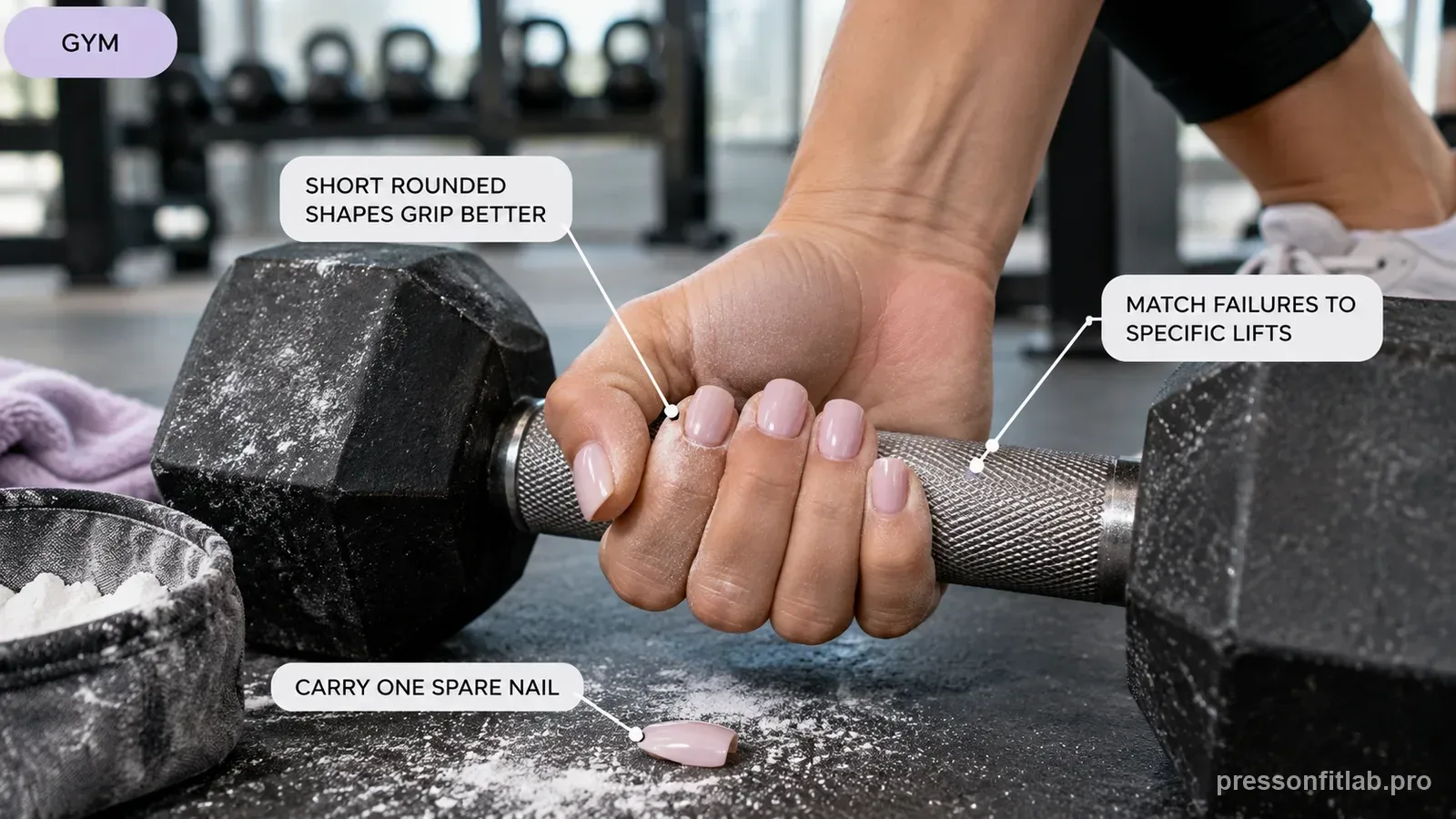
Press-ons can be compatible with many gym routines, but the set needs to match how you grip equipment. Shorter, well-fitted nails reduce leverage and snag risk. Treat repeated lifting on the same fingers as a movement-and-fit clue, not a reason to keep adding glue. If a nail or fingertip is injured, skip cosmetic reapplication and address the injury first.
Check these first
- ✓ Can you wrap your hand around bars or handles without the free edge colliding?
- ✓ Which fingers take the most pressure during your main exercises?
- ✓ Are the nails short enough that they do not catch straps, mats, or gloves?
- ✓ Is any nail already cracked, painful, or lifted before training?
Start with grip geometry, not a “gym-proof” glue
A press-on becomes harder to live with when its free edge changes the way your fingertip meets a bar, dumbbell, cable handle, kettlebell, or machine grip. The adhesive may be strong, but the longer the nail extends beyond the fingertip, the more leverage an accidental contact can create at the bond.
Before a workout, close your hand around the equipment you use most. If the tip collides with your palm, the bar, or a glove seam, choose a shorter length rather than trying to make the bond carry repeated impacts. A comfortable grip is a better selection criterion than an advertised maximum wear time.
Short and softly edged shapes are easier to manage
For an active routine, short round, squoval, or other low-projection shapes often create fewer catch points than extra-long, sharply tapered sets. That does not mean a single shape is required for every person; nail-bed width, finger length, and the exact exercise all affect comfort.
The AAD recommends keeping nails short as one way to reduce nail injuries because shorter nails are less likely to bend or catch. For press-ons, the same mechanical idea is useful: less free-edge leverage gives you a larger margin for imperfect hand placement.
Map failures to specific exercises
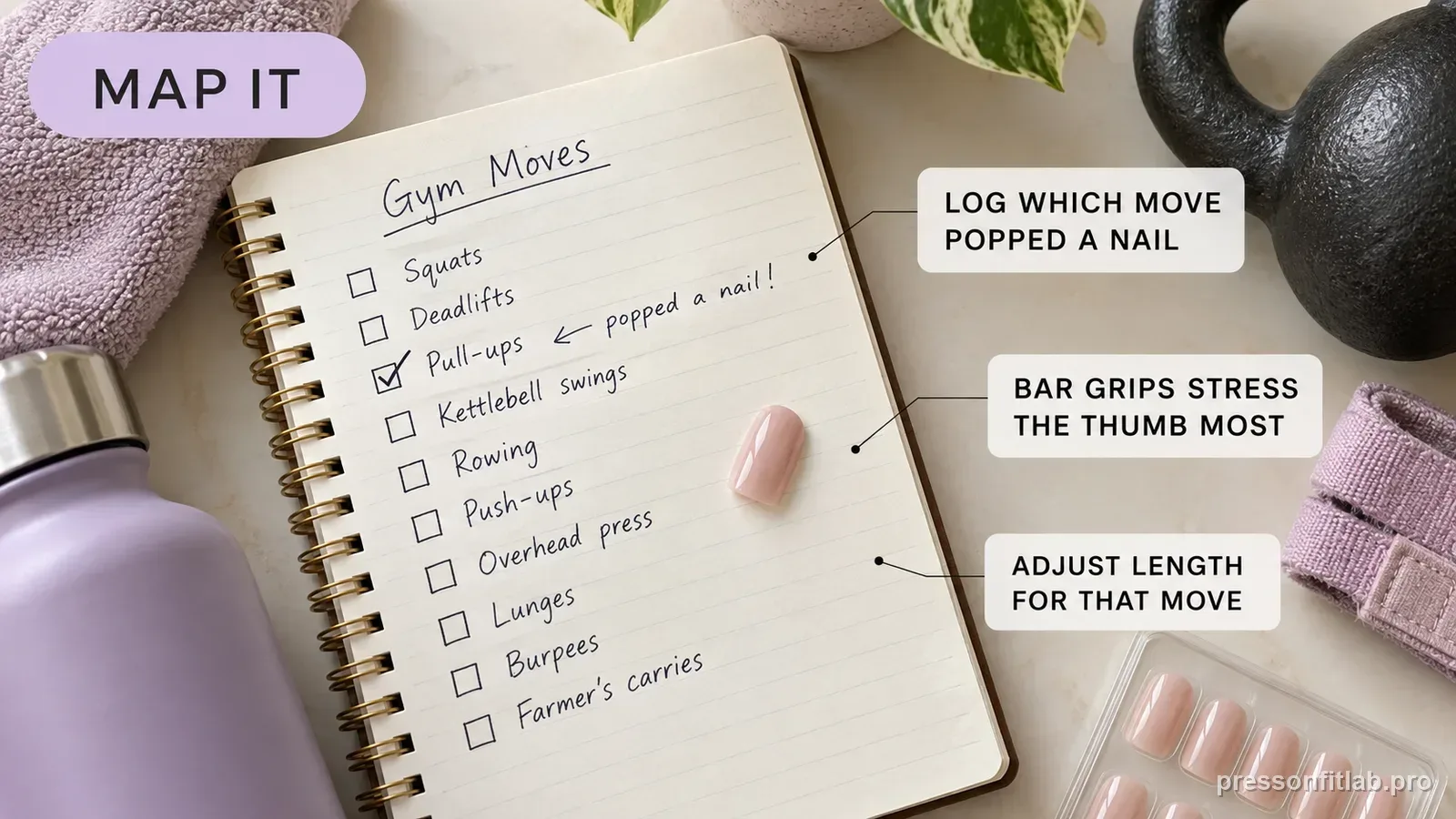
If the same thumb loosens after deadlifts, the same index catches during cable work, or several nails shift after a sweaty class, write that down. Do not change five variables at once. A repeat-offender finger may need a different tip size or length, while a full-set issue points more toward prep, moisture, or the adhesive system.
Gym troubleshooting works best when you know when the first change happened. Check the set before training, after the warm-up, and after the movement most likely to stress your hands. That turns “my nails never survive the gym” into a specific failure pattern you can solve.
Sweat and water are separate from impact
Hand sweat, showering after training, and equipment cleaning introduce moisture, but they are not the same problem as a nail hitting a hard surface. If nails lift mainly after prolonged moisture exposure, review water-management advice and adhesive directions. If one edge chips immediately during a grip, look at length and impact first.
Wear gloves for household detergents or cleaning tasks when appropriate, but do not use a glove as a way to hide a nail that is already loose. Trapped moisture under a meaningful lift is a reason to remove and inspect the press-on instead of continuing the workout.
Have a one-nail contingency plan
A small case with the correct spare sizes, a file if the product permits edge smoothing, and your normal removal/application supplies is more useful than random emergency glue. If one nail pops off cleanly, inspect both surfaces. Reuse that same tip only if the exact system permits reapplication and it still dry-fits; otherwise use a fresh compatible spare. If it cracks or the natural nail is injured, retire the cosmetic piece for that finger.
For people who train frequently, a reusable size profile also saves time. Record which thumb or index needs a shorter or slightly different size so future sets are gym-ready before adhesive is opened.
Diagnostic table
| What you see | What it suggests | Next check |
|---|---|---|
| Free edge hits bar during grip | Length creates leverage | Choose a shorter tip before changing adhesive |
| Same thumb lifts after pulling exercises | Finger-specific stress or fit | Re-measure thumb and review curve/length |
| Several nails loosen after sweaty session | Moisture/prep/application may contribute | Compare with a low-sweat workout using same fit |
| Sidewall cracks after equipment contact | Impact damage | Replace cracked piece; do not file through split |
| Natural nail is injured | Cosmetic troubleshooting stops | Leave adhesive off the injured area and follow appropriate care |
A controlled test plan
- 1
Dry-fit the set and test a relaxed fist plus the grips used in your main workout.
- 2
Use a practical short length through several comparable training sessions before judging the pattern.
- 3
Log which finger changes first and during which exercise.
- 4
If one finger fails, change only its length/size or contact pattern on the next session.
- 5
If many fingers fail together, review prep and moisture rather than shortening only one nail.
What not to do
- Using nails to hook plates, pry clips, or scrape equipment.
- Training through a painful, cracked, or partially detached cosmetic nail.
- Assuming sweat is the cause when the nail is visibly colliding with equipment.
- Applying a longer replacement to a finger that repeatedly catches.
Worked troubleshooting example
Example: a medium almond set looks good at home, but the index tips press into your palms when you grip a rowing handle. After two sessions, both index nails lift while the other eight remain secure.
On the next set, keep the same prep and adhesive but use a shorter index tip that matches the same width and curve. The grip no longer forces the free edge backward, and the index failure disappears.
That result supports a length/leverage cause. There was no need to make every nail shorter or switch to a stronger glue.
Field notes
The best gym set is not necessarily the strongest-looking set. It is the one that lets you grip normally without changing wrist position or protecting the manicure at the expense of the exercise.
If you alternate heavy lifting and lower-impact sessions, compare wear patterns. A nail that survives yoga but fails under barbell grip is giving you a mechanical clue, not an inconsistent mystery.
Frequently asked questions
Can I lift weights with press-on nails?
Many people can, especially with shorter, well-fitted sets. Test your actual grip and reduce free-edge leverage rather than relying on a “gym-proof” label.
What press-on nail length is best for the gym?
There is no single best length, but shorter tips generally create less leverage and fewer catch points. Choose based on how your fingers meet your equipment.
What if a press-on cracks during a workout?
Stop stressing that nail. A structural crack or natural-nail injury should be addressed rather than covered with more glue and continued use.
Sources checked
Sources below are page-specific. We prioritize manufacturer directions for product-specific steps and use medical or dermatology guidance when a safety question requires it. Always follow the instructions for the exact adhesive or set you own.