How Should Press-On Nails Be Sized for Kids or Teens?
Use product age guidance, small nail geometry, conservative length, and supervised removal for younger users.
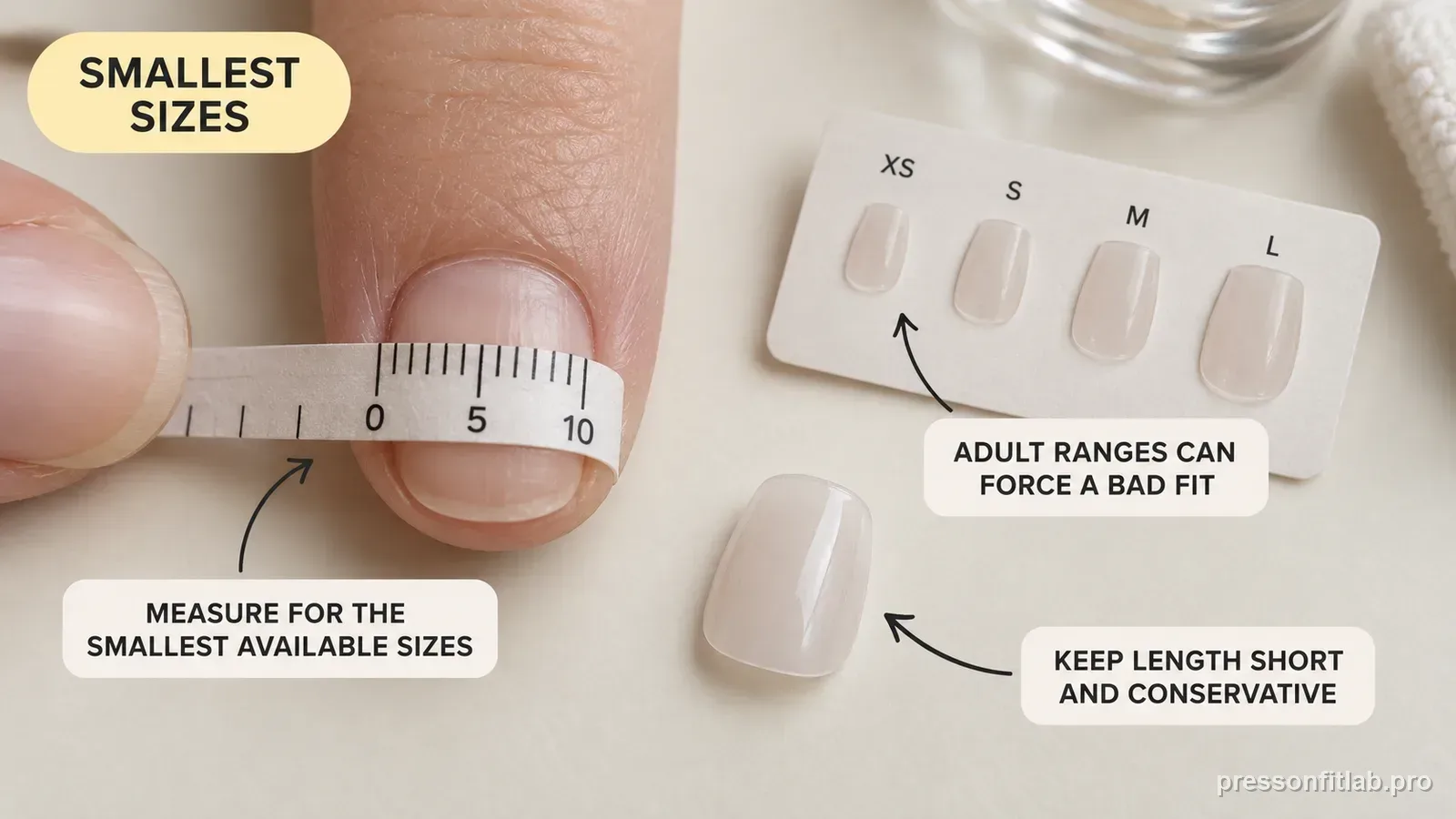
Do not assume an adult press-on kit is suitable for a child just because its smallest shell fits. Some brands explicitly state that their adult press-ons are not suitable for children. Follow the exact product’s age labeling first; for any age-appropriate system, choose a short shell that fits entirely on healthy nail plate without skin contact and plan supervised application and removal.
Check these first
- ✓ Does the specific product state an age restriction or adult-only use?
- ✓ Does the smallest shell still overlap skin?
- ✓ Is the chosen length short enough for the user’s activities and small nail plate?
- ✓ Are the nail and surrounding skin healthy and intact?
- ✓ Can removal be supervised rather than peeled or bitten off?
Age suitability comes before geometry
A smallest size is not an age approval. Glamnetic, for example, says its adult press-ons are not suitable for children and recommends products designed for kids.
Separate three questions that are often collapsed: Is the product labeled for this age? Does the shell physically fit? Can the user manage wear and removal safely? A yes to only one is not enough. Product age guidance comes first, then geometry, then behavior and supervision.
Adult size ranges can force bad fit decisions
On a small nail plate, even the smallest adult shell may reach onto side skin. Do not solve this by gluing skin, squeezing the shell, or making extreme modifications to an adult-only product.
Kits that include ‘kids’ or petite size rows show that manufacturers recognize smaller geometry, but sizing language should not be confused with medical or age approval. Always read the exact package. The smallest physical shell from an adult system may still use an adhesive or removal process the maker did not intend for children.
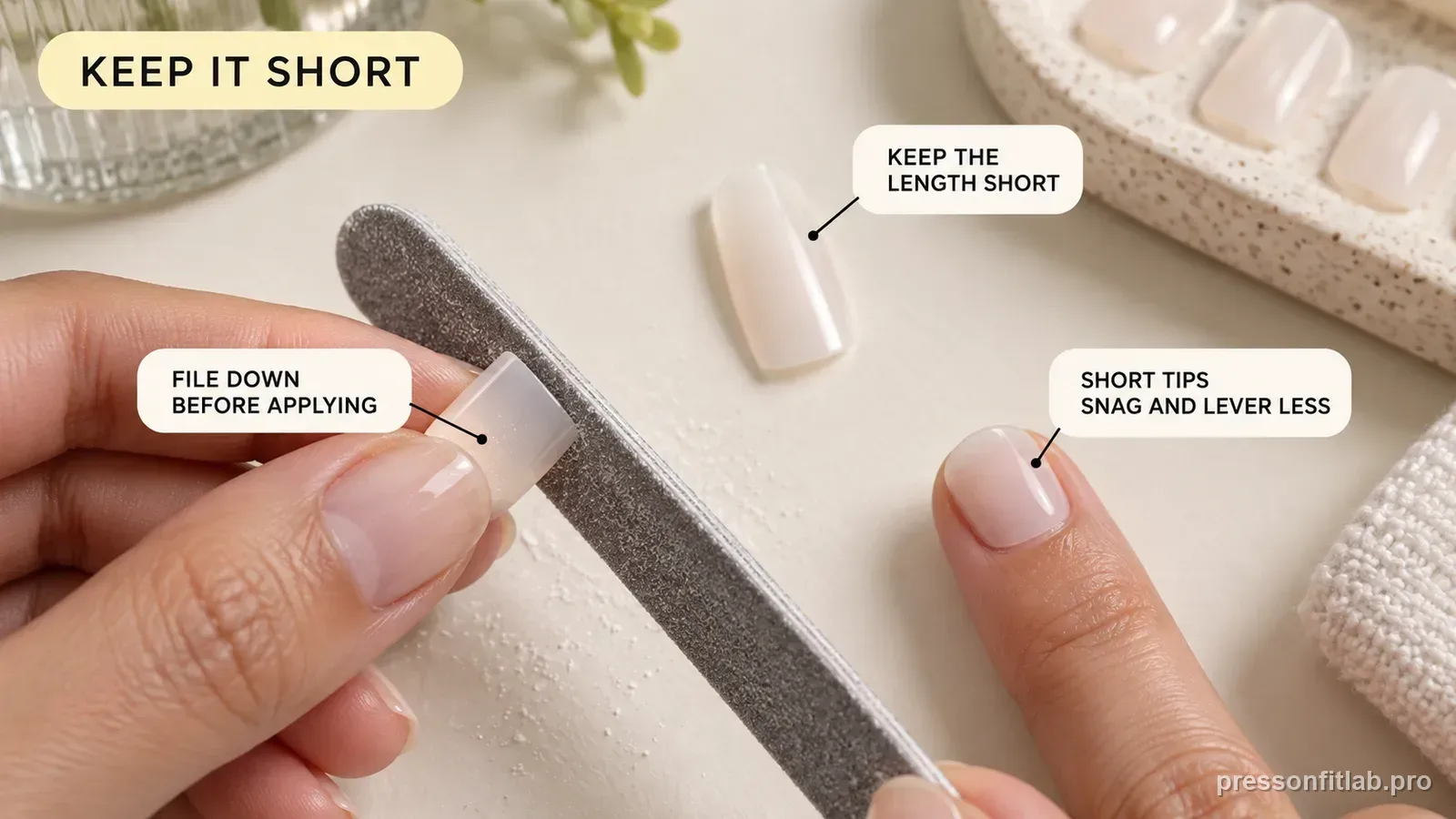
Length should be conservative
Long extension creates more leverage and can interfere with school activities, play, sports, dressing, or instruments. A small bonding area gives even less margin for a catch.
For teens using an age-appropriate product, treat nail-biting damage, hangnails, or sports injuries as separate health gates. FDA advises following nail-product warnings and using good ventilation, and dermatology guidance warns against covering damaged nails. A cosmetically inconvenient nail should still be left uncovered if the tissue is compromised.
Healthy skin and nail are mandatory
FDA guidance emphasizes following nail-product warnings and using products safely. Do not apply over bitten, bleeding, inflamed, infected-looking, or otherwise damaged tissue.
Length should be tested against real tasks: opening school bags, sports equipment, instrument practice, contact with desk surfaces, and clothing. A short shell reduces the lever arm and is less likely to convert a snag into a natural-nail injury. If the nail changes how the user performs an activity, the length is not functionally appropriate.
Adhesive choice is also a safety decision
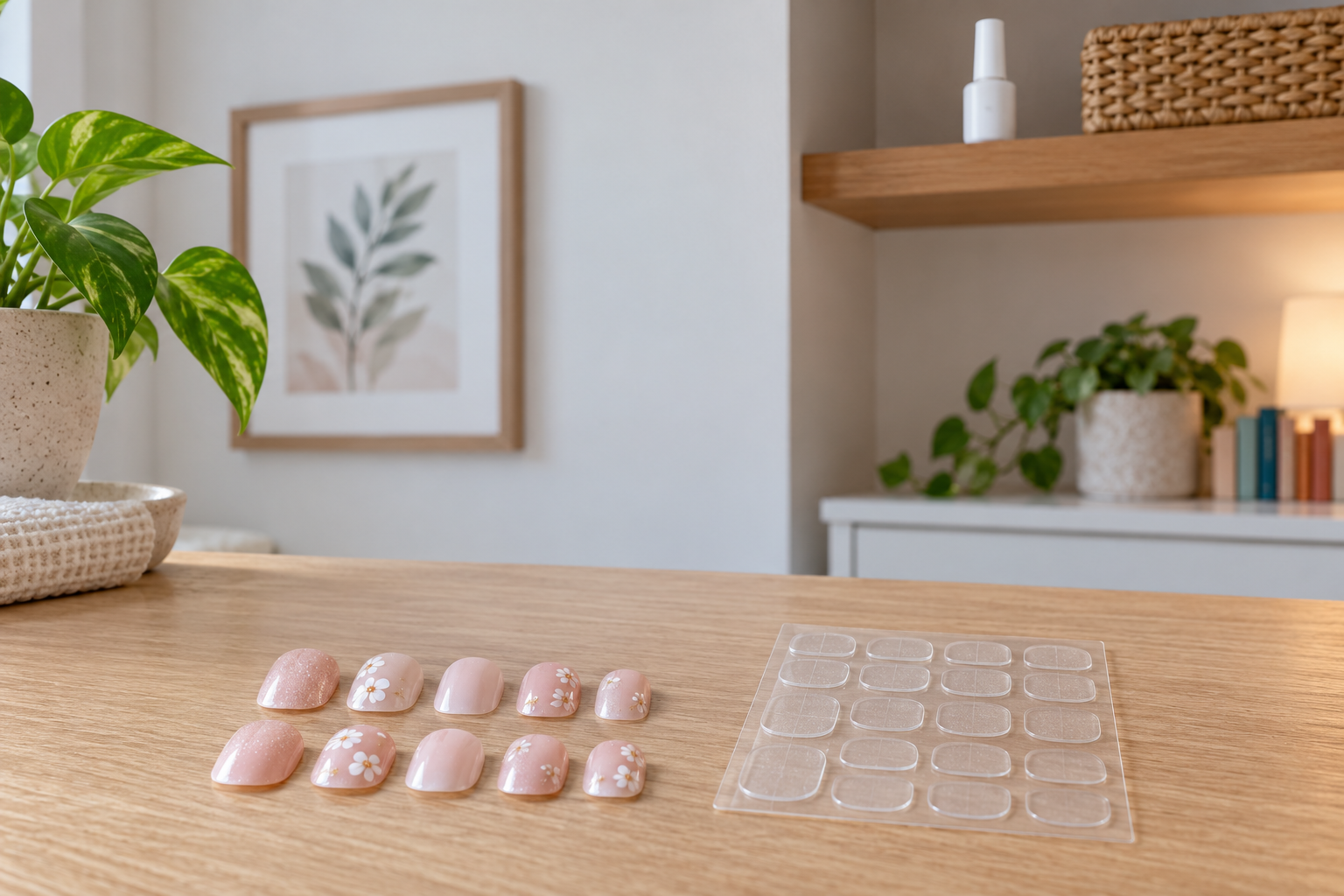
A child-specific tab system may be lower commitment than liquid glue if the manufacturer intends it for that age group. Keep nail glue and removers securely away from young children.
Liquid cyanoacrylate deserves extra handling controls because accidental skin, eye, mouth, or fabric exposure can be more consequential than an ordinary cosmetic mess. Adults should manage the bottle, cap it immediately, and keep it away from cotton or wool spills because cyanoacrylate can react exothermically with those fibers.
Plan removal before application
A suitable application can still cause damage if the shell is later pried, peeled, or chewed off. Younger users need a removal method they can follow safely with supervision.
Removal behavior is often the practical deciding factor. A young user who repeatedly peels, bites, or pries at lifting shells may do more plate damage than someone using a shorter supervised system. If gentle removal cannot realistically be maintained, temporary polish or another non-bonded option may be more appropriate.
Make supervision and removal part of the decision
There is no universal age cutoff that makes every press-on kit suitable. Check the exact package age guidance, product ingredients and warnings, and the child’s ability to leave the nails alone and follow care instructions. An adult should handle and store liquid adhesive; for a temporary look, a product’s adhesive tabs may avoid liquid-glue handling, but they still need correct fit and gentle removal.
Choose a short, smooth shape that will not interfere with play or school tasks. Skip application over a sore, damaged, or discolored nail; stop if redness, itching, swelling, or pain appears. Keep glue and removers away from eyes and mouths and out of reach when not in use. FDA guidance calls for ventilation and notes that nail products can cause irritation or allergic reactions.
Diagnostic table
| What you see | What it suggests | Next check |
|---|---|---|
| Smallest adult shell overlaps skin | Adult range is not geometrically suitable | Use a petite/child-specific age-appropriate product |
| Product says adult use only | Age restriction overrides physical fit | Choose a product intended for the younger user |
| Nail feels tight or pinched | Shell undersized or too curved | Remove and refit |
| Long tip repeatedly catches | Excessive leverage/activity interference | Use much shorter length |
| User peels or bites attached press-ons | Unsafe removal behavior | Use supervised removal or discontinue |
| Child cannot follow product directions or nail is sore | The set is not a good fit for this moment | Skip application; keep adhesive/remover out of reach and follow age-label warnings |
A controlled test plan
- 1
Check age guidance before opening the kit.
- 2
If age-appropriate, dry-fit every finger and reject any shell that touches skin.
- 3
Choose the shortest practical shape and test one nail first.
- 4
Watch for pressure, redness, itching, or lifting.
- 5
Supervise removal exactly as the product directs.
What not to do
- Assuming the smallest adult size is child-safe
- Ignoring adult-only labeling
- Applying liquid glue where it reaches surrounding skin
- Choosing extra-long shapes for small nail beds
- Allowing peeling, chewing, or prying during removal
Worked troubleshooting example
A parent tried to size an adult kit for a ten-year-old and found that the smallest index shell still touched skin. Filing it narrower would not have changed the brand’s adult-only guidance.
They stopped and selected a product specifically intended for the child’s age group, then chose a short shape and dry-fit each nail.
The critical decision happened before adhesive: age suitability and skin clearance were treated as mandatory rather than as details to work around.
Field notes
For younger users, product suitability is a separate gate from technical fit quality. A perfect-looking sidewall does not override an adult-only manufacturer warning.
A short, age-appropriate system also makes it easier to observe the natural nail and remove promptly if irritation or lifting begins.
Frequently asked questions
What age can a child start wearing press-ons?
There is no single age for every product. Follow the age guidance and warnings for the exact system.
Are adhesive tabs always safe for kids?
No. A tab is not automatically child-appropriate; use a product intended for the user’s age and follow its directions.
Can teens use normal adult press-ons?
That depends on the product labeling, nail/skin condition, fit, and safe application and removal. Check the exact brand rather than generalizing.
Sources checked
Sources below are page-specific. We prioritize manufacturer directions for product-specific steps and use medical or dermatology guidance when a safety question requires it. Always follow the instructions for the exact adhesive or set you own.