Press-On Nails for Long Fingers: Balance Length, Width, and Daily Use
Choose press-ons for long fingers by separating hand proportion from nail-bed fit, then compare lengths without creating unnecessary leverage.
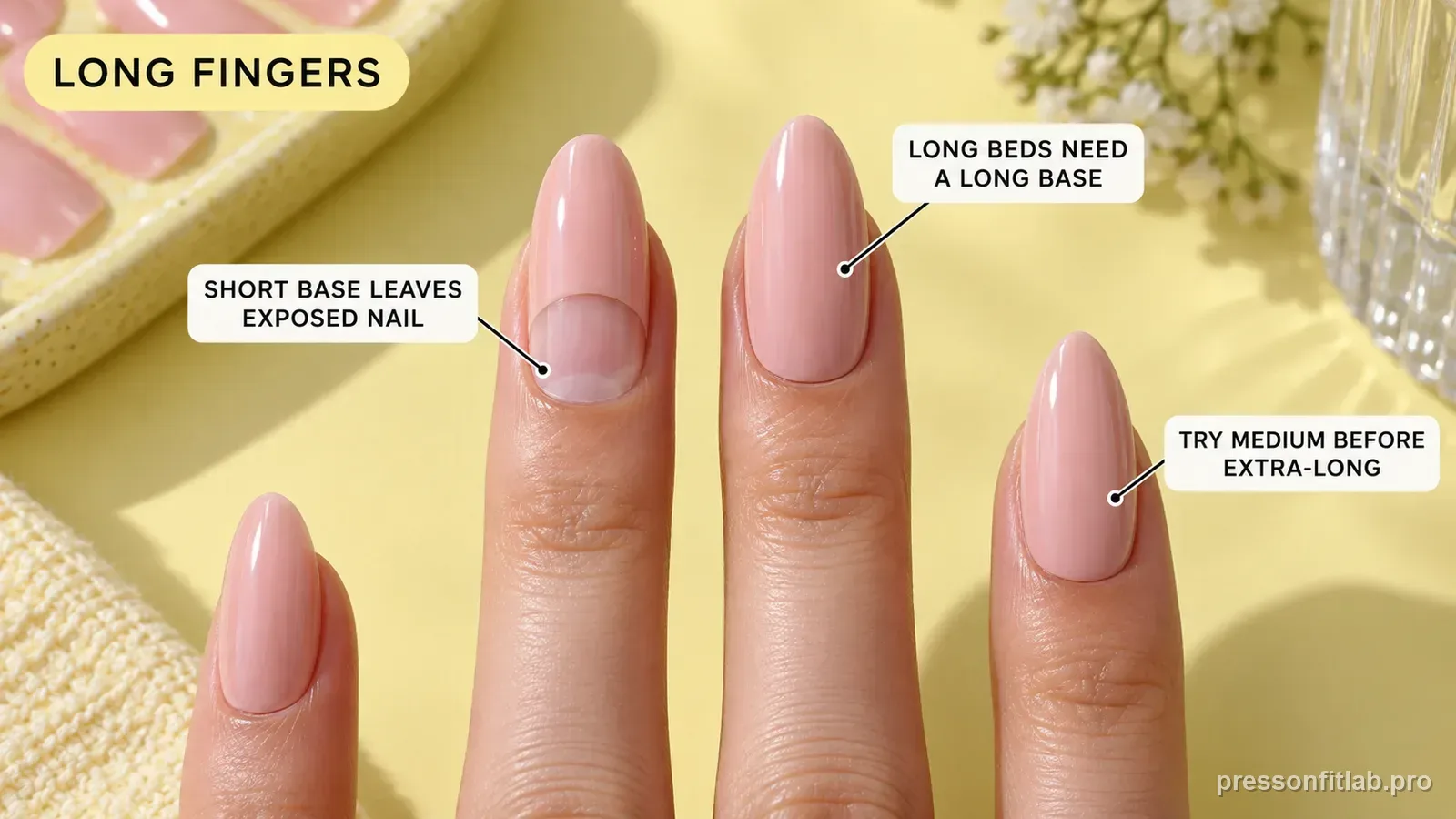
Long fingers can carry many press-on shapes visually, but that flexibility does not change the fit rules. Measure the nail beds, match the underside curve, then choose length based on the look and daily use you want. A very short tip can look intentionally minimal; a long tip can look dramatic. Neither is “correct” if it pinches, rocks, or repeatedly catches.
Check these first
- ✓ Are your nail beds also long/narrow, or are only the fingers long?
- ✓ Does the set offer enough width choices for each nail plate?
- ✓ Do short tips end at a comfortable point on your nail bed, or look undersized because the base is wrong?
- ✓ Does extra length change typing, gripping, or snagging in your routine?
Long fingers give styling freedom, not sizing freedom
Hand-shape guides often say long fingers can wear many silhouettes, and visually that is often true. But the press-on still has to cover the nail plate correctly. A long finger with a narrow nail bed may need a very different size range from a long finger with a broad nail bed.
Measure first and keep the hand-proportion decision separate. If a square, oval, almond, and coffin tip all fit the same nail plate correctly, then shape is a style question. If only one of them sits flush, geometry has already narrowed the choice.
Compare short and medium before jumping to extra-long
Because long fingers already create a long visual line, a short or medium press-on can look balanced rather than stubby. It can also reduce leverage for typing, gym work, cleaning, and other hand-heavy routines. If you want a dramatic set, test medium first so you learn how much free edge you can manage.
A dry-fit whole-hand photo is useful. Compare identical lighting and hand position so you are judging proportion rather than the design. Then test the chosen length against a keyboard, phone, bag zipper, and the grips you use most.
Long nail beds need enough base length
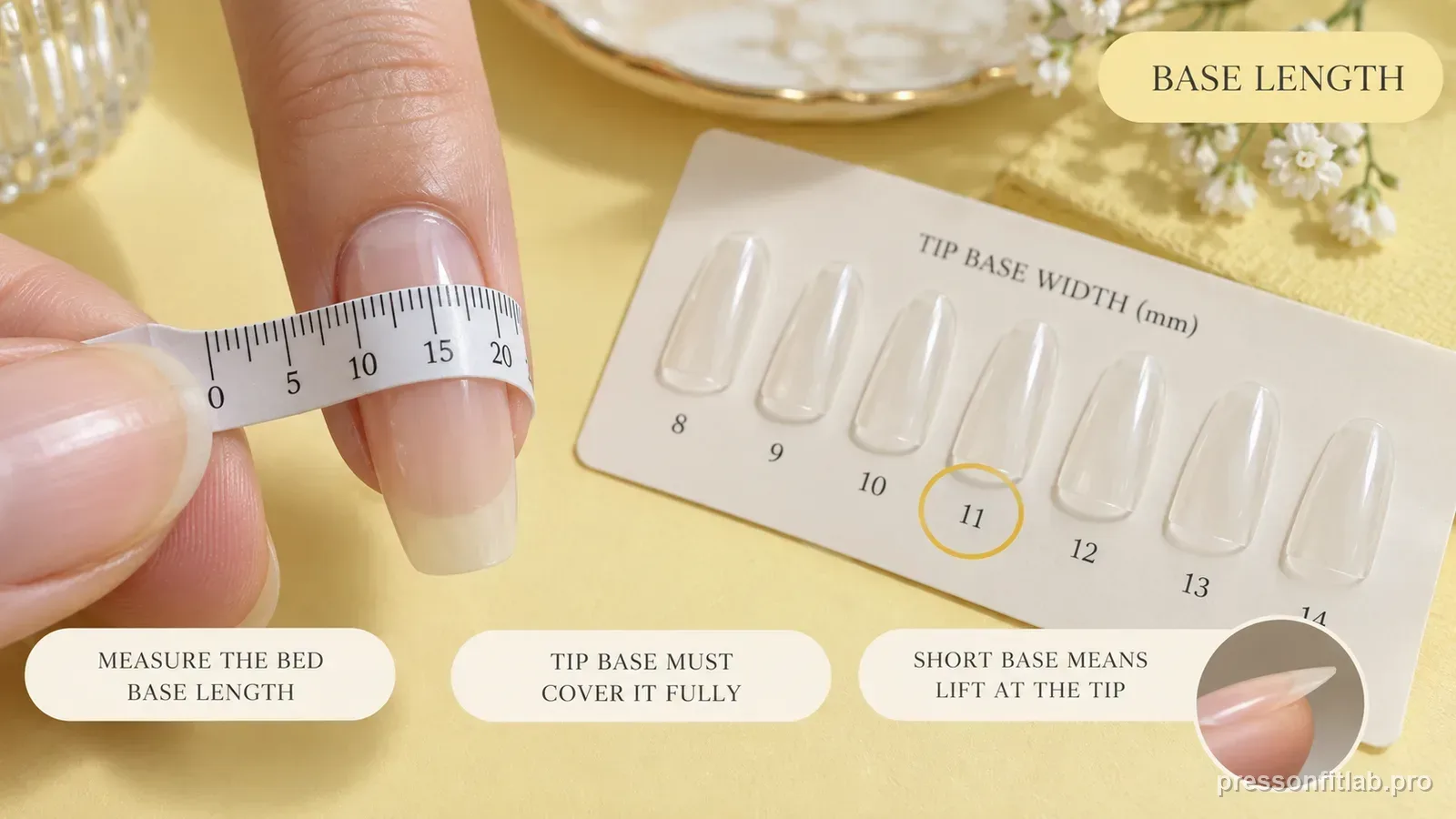
Some people with long fingers also have long nail beds. In that case, a very short press-on may fit the width but leave the cuticle-to-free-edge proportion looking wrong or may not cover the natural nail as intended by the product. This is a nail-bed-length issue, not proof that long fingers always need long nails.
Use the guide for long nail beds to check whether the press-on base and apex position suit your natural nail. Width alone cannot tell you whether the entire shell geometry is appropriate.
Narrow long nail beds can make “standard” tips look broad
If long fingers are paired with narrow nail beds, some mass-market tips may look bulky even when their free-edge shape is elegant. A set with more size options or a slimmer cuticle base can produce a more natural result than filing every finger heavily.
Do not choose a physically narrower tip just to make the hand look delicate if that physically narrower candidate exposes the sidewalls. Coverage and comfort are non-negotiable; the visual refinement should come from a better size range or shape, not under-sizing.
Use different lengths for different wear goals
A long-fingered hand can support a minimal short set for work and a longer set for events without any contradiction. Your fit profile—width, curve, cuticle arc—stays useful across both. Only the free-edge length and resulting leverage change.
If you switch often, keep notes on which length causes typing errors or snagging. Over time you can define a personal “daily maximum” and an “occasion length” instead of treating every purchase as a fresh experiment.
Diagnostic table
| What you see | What it suggests | Next check |
|---|---|---|
| Short tips look visually tiny | Could be style preference or long nail-bed mismatch | Check base coverage and nail-bed length |
| Standard tips look broad | Narrow nail bed may need more size options | Measure width; do not simply choose a narrower tip for appearance |
| Long tips repeatedly snag | Free-edge leverage exceeds routine tolerance | Move to medium/short while keeping correct width |
| Many shapes fit comfortably | Geometry allows styling freedom | Choose by proportion and use case |
| Tip rocks despite flattering shape | Curve mismatch | Prioritize underside fit over silhouette |
A controlled test plan
- 1
Measure widths and note nail-bed length before choosing a style.
- 2
Dry-fit short and medium options that both pass the curve test.
- 3
Compare whole-hand photos, then test keyboard and grip comfort.
- 4
Wear the lower-leverage option first and log any finger-specific failure.
- 5
Use the result to define daily and event lengths for future sets.
What not to do
- Sizing down because a standard tip looks visually broad while leaving sidewalls uncovered.
- Assuming long fingers require long press-ons.
- Ignoring a center rock because the overall silhouette flatters the hand.
- Buying by shape name without checking underside curve or size range.
Worked troubleshooting example
Example: your fingers and nail beds are both long and narrow. A popular short square set covers the width but looks unusually blunt and the sidewalls require filing. A medium oval from a set with more sizes sits flush without filing.
You try the medium oval for work and find it comfortable. For a weekend event, you use a longer coffin in the same measured widths but discover the index nail catches on zippers.
Your saved profile now says “medium daily; long only when low-activity; index one step shorter.” That is more useful than a generic rule for long fingers.
Field notes
Long fingers can make styling advice sound easier than it is. The real advantage is that many proportions may look intentional, so you can optimize comfort more aggressively without feeling forced into one silhouette.
When long fingers are paired with long nail beds, inspect the front-to-back profile and where the shell reaches its highest point. A base that is too short or a shell that changes shape in the wrong place can look off even when width is accurate.
Frequently asked questions
What press-on shape looks good on long fingers?
Many shapes can work visually. Square, oval, almond, coffin, and others may all be options when the nail-bed fit is correct.
Should long fingers wear short press-ons?
They can. Short or medium nails may look balanced and are often easier for everyday use. Length is a style-and-leverage choice, not a requirement.
Why do press-ons look too wide on my long fingers?
The nail beds may be narrow even though the fingers are long. Measure the nail plate and look for a size range that matches rather than sizing down past the sidewalls.
Sources checked
Sources below are page-specific. We prioritize manufacturer directions for product-specific steps and use medical or dermatology guidance when a safety question requires it. Always follow the instructions for the exact adhesive or set you own.