Press-On Nails for Narrow Nail Beds: A Fit-First Guide
Find press-ons for narrow nail beds by separating width, cuticle shape, curve, and length so a slim fit does not become a pinching fit.
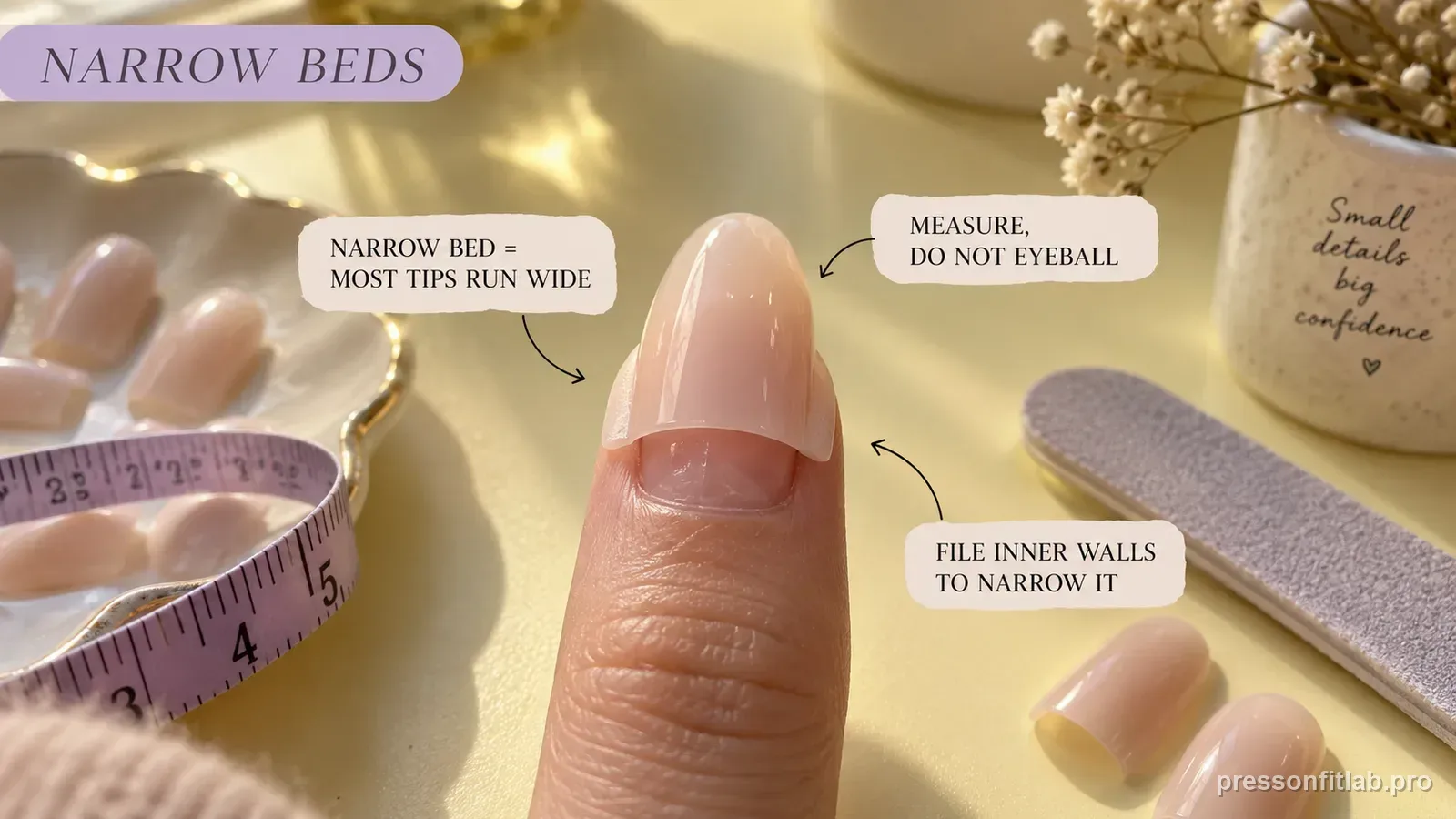
For narrow nail beds, the best fit is not simply the smallest numbered tip. Measure each nail in millimeters, then dry-fit for sidewall coverage and curve. If you are between sizes, check the current brand or product rule and compare both neighboring candidates; only file an artificial edge when the chosen tip has a compatible curve and the material or manufacturer directions support that adjustment.
Check these first
- ✓ Do the sidewalls line up without covering skin?
- ✓ Does the cuticle arc match instead of leaving two bulky corners?
- ✓ Does the tip sit down with light pressure rather than pinching?
- ✓ Is the apparent problem width, or is a long tip making the whole nail look oversized?
Narrow is a width problem, not a hand-size label
People with narrow nail beds often get pushed toward vague labels such as petite, small, or extra-small. Those labels can be useful for shopping, but they do not tell you whether a specific tip matches your nail. The useful measurement is the widest part of each natural nail, recorded in millimeters and checked against the actual set you plan to wear.
Two people with equally narrow index nails can need different press-ons because one nail is flatter and the other has a stronger C-curve. Treat width and curve as separate variables. A narrow tip that fights your natural curve can feel tight even when its top-view width looks correct.
Watch the cuticle corners
On a narrow nail, an oversized press-on often gives itself away near the base. The center may appear aligned while the lower corners extend onto skin. If the tip material is intended to be filed, customize only in small steps and dry-fit after each change; otherwise compare a narrower-base mold. Avoid cutting a deep notch into one spot. The goal is a smooth artificial edge that stays on nail plate without creating a ledge that hair or fabric can catch.
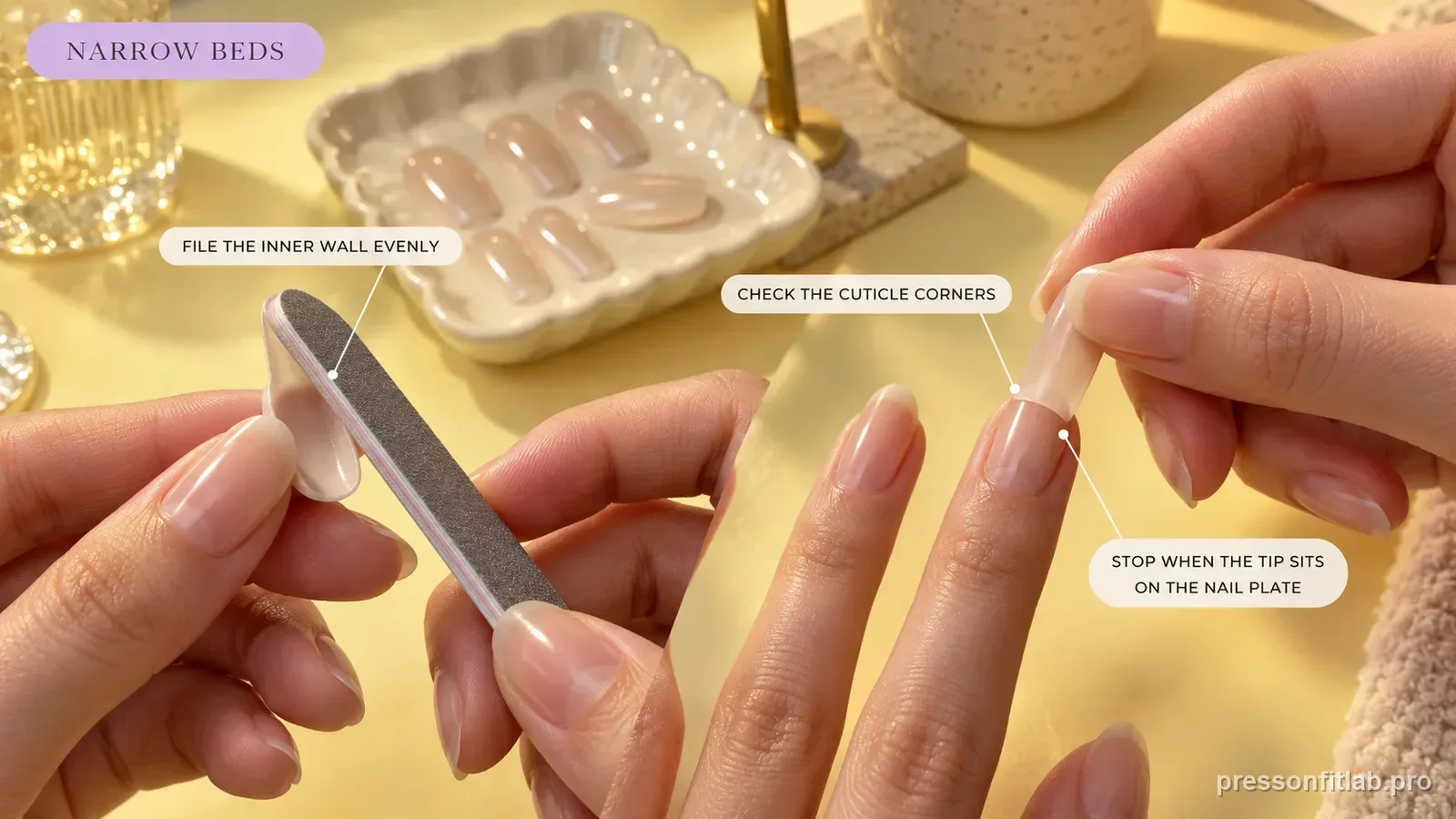
Do not choose a narrower tip just to make the nail look slimmer
A too-small tip may look visually narrow from above, but exposed natural nail at the sides means the fit is incomplete. Choose coverage first, then use shape and length for the visual effect. If the neighboring physically wider candidate looks bulky, ask whether the issue is artificial-edge excess that can safely be refined or whether the set simply uses a mold family that is too broad at the base for your nails.
Use length as a separate styling decision
Shorter nail beds can make even a correctly sized medium or long press-on look visually large. Before blaming width, compare a shorter length in a similar shape. Oval, round, squoval, and tapered shapes distribute visual width differently even when the base measurement is similar.
For typing or daily work, shortening the free edge can also reduce leverage without changing the fitted base.
Build a reusable narrow-nail profile
Once a set fits well, record the millimeter width and any customization for each finger. Note details such as “right pinky: file lower corners lightly” or “left index: same width but flatter profile.” That profile is more useful than memorizing one brand size number.
When trying another brand, start from your measurements and its own chart, then dry-fit. Press-on size numbers are not universal across brands or mold families.
Diagnostic table
| What you see | What it suggests | Next check |
|---|---|---|
| Tip covers skin at lower corners | Base is too broad or wrong shape | Try a narrower-base mold or refine only the artificial edge when the material allows filing. |
| Natural nail shows at both sides | Tip is too narrow | Try a physically wider candidate or choose a set with smaller width increments |
| Width looks right but nail pinches | Curve mismatch is likely | Compare a flatter profile before filing more width |
| Fit is correct but looks bulky | Length/shape is driving the appearance | Compare a shorter or more tapered shape |
A controlled test plan
- 1
Measure all ten nails in millimeters and save the values.
- 2
Dry-fit one full set and photograph the top view plus free-edge view.
- 3
Mark which nails fail because of width and which fail because of curve or cuticle shape.
- 4
Customize a larger candidate only when its curve is comfortable and the tip material or manufacturer directions allow filing; re-check coverage after each small adjustment.
- 5
Wear the best-fitting test nail long enough to confirm comfort before applying the full set.
What not to do
- Choosing the smallest tip because the printed size sounds right.
- Filing so deeply that the sidewall becomes thin or uneven.
- Accepting exposed nail at the sides for a slimmer look.
- Forcing a curved narrow tip flat to make it reach the sidewalls.
Worked troubleshooting example
Example: your index measures about 11 mm with your chosen measurement method. One tip leaves a visible strip of natural nail, while the neighboring physically wider candidate covers the plate but slightly overlaps the lower corners. The useful test is not to force the physically narrower tip. Start with the physically wider candidate and make a few light file strokes only at the lower sidewalls, then dry-fit again.
If that wider candidate sits flush with no spring-back after the edge is refined, you solved a base-width mismatch. If it still pinches from side to side, stop filing: the problem is more likely the mold curve. Try a lower-curve tip with similar width instead.
Record the result as a fit profile rather than a brand number. On the next set, you can begin with “index ≈ 11 mm with your chosen measurement method, narrow base, lower curve” and get to the correct candidate faster.
Field notes
Recent press-on user discussions repeatedly separate “small hands” from “narrow nail beds.” That distinction matters because a hand can be small while the thumb is relatively wide, or a nail can be narrow but long. Build your profile finger by finger rather than shopping from hand size alone.
If a brand offers more size increments, that can reduce the amount of filing needed. But more sizes do not guarantee a better curve or cuticle shape, so dry-fit remains the deciding step.
Frequently asked questions
Are petite press-ons always best for narrow nail beds?
No. Petite labels may help narrow the search, but the individual tip still needs to match your width, cuticle shape, and curve.
Should narrow nail beds size down in press-ons?
Only if the physically narrower candidate still covers the nail plate sidewall to sidewall without pinching. Do not choose a narrower fit just for appearance.
Can I file regular press-ons to fit narrow nails?
Often, if the physically wider candidate has a comfortable curve, needs only modest artificial-edge refinement, and the material or manufacturer directions allow filing. A major width mismatch is better solved with another mold or size range.
Sources checked
Sources below are page-specific. We prioritize manufacturer directions for product-specific steps and use medical or dermatology guidance when a safety question requires it. Always follow the instructions for the exact adhesive or set you own.