Press-On Nails for Long Nail Beds: Avoid Short Bases and Exposed Edges
Fit press-ons to long nail beds by checking base coverage, free-edge position, width, and curve so natural nail does not show beyond a wide-enough tip.
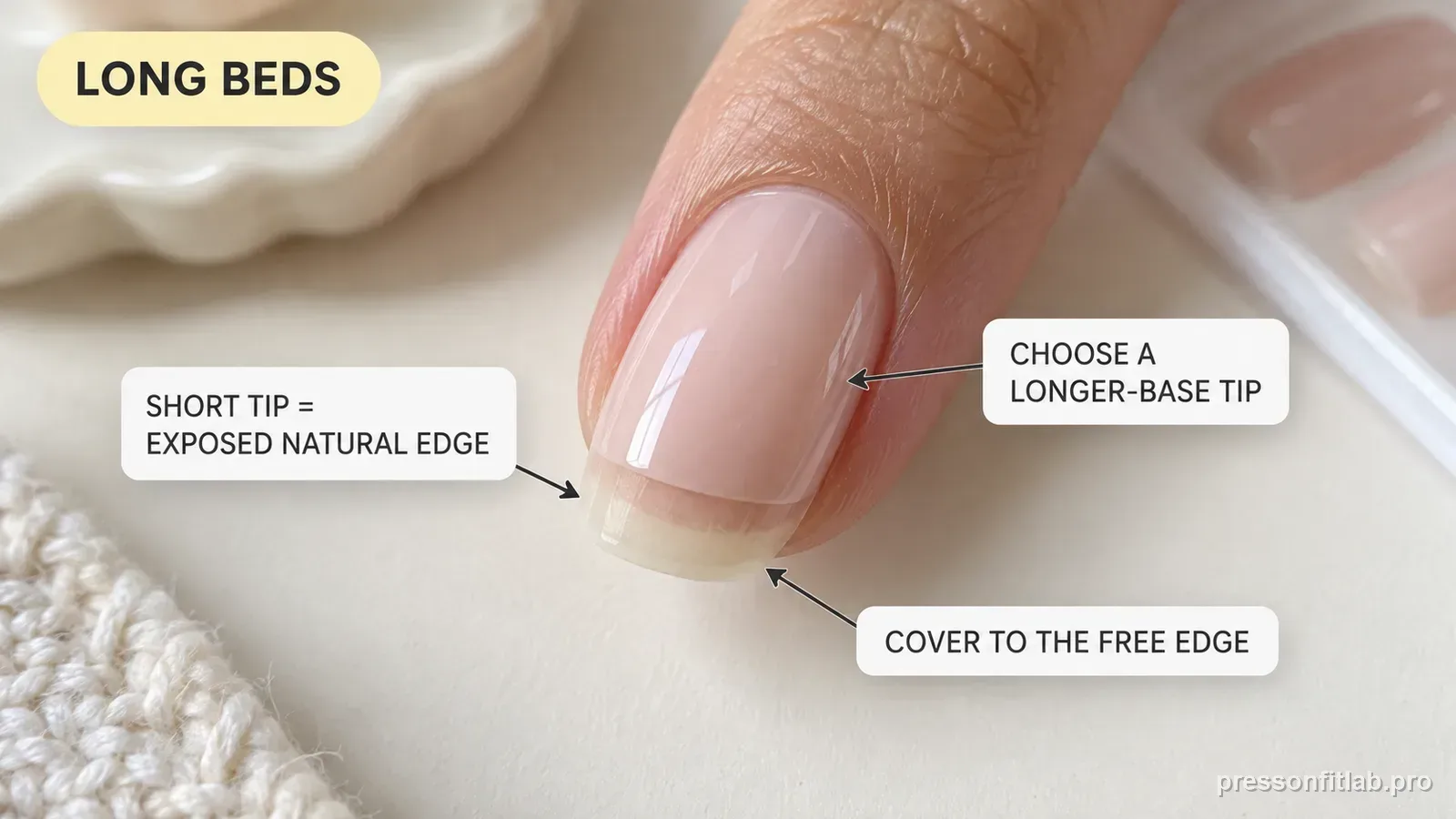
Long nail beds need enough full-cover length from the cuticle area to your natural free edge. A tip can match width but still end too early, especially on thumbs and middle fingers. Do not compensate by placing the press-on far from the cuticle. Choose a mold with enough base length, then match width and curve as usual.
Check these first
- ✓ Does the tip reach from near the cuticle to beyond the natural free edge?
- ✓ Are you sliding the tip forward to make it reach?
- ✓ Does a longer mold change the curve or width fit?
- ✓ Are one or two fingers longer than the rest?
The telltale sign is a base that ends too early
When the natural nail bed is long, a press-on can look correctly sized from the top while failing to cover the full plate from base to free edge. You may see natural nail peeking near the front or feel tempted to start the artificial nail farther away from the cuticle so it reaches the tip.
That forward placement creates a new problem at the base. The better solution is a full-cover tip with enough molded length for the nail bed.
Length should not replace width
Moving to a longer style can also change the size distribution, sidewall taper, or curve. Re-check width instead of assuming the same printed size will fit. The base still needs full sidewall coverage without skin overlap.
If your nail is long and narrow, look for a mold that combines those traits. A long, wide base may create unnecessary overlap; if the product allows filing, only minor edge refinement should be needed.
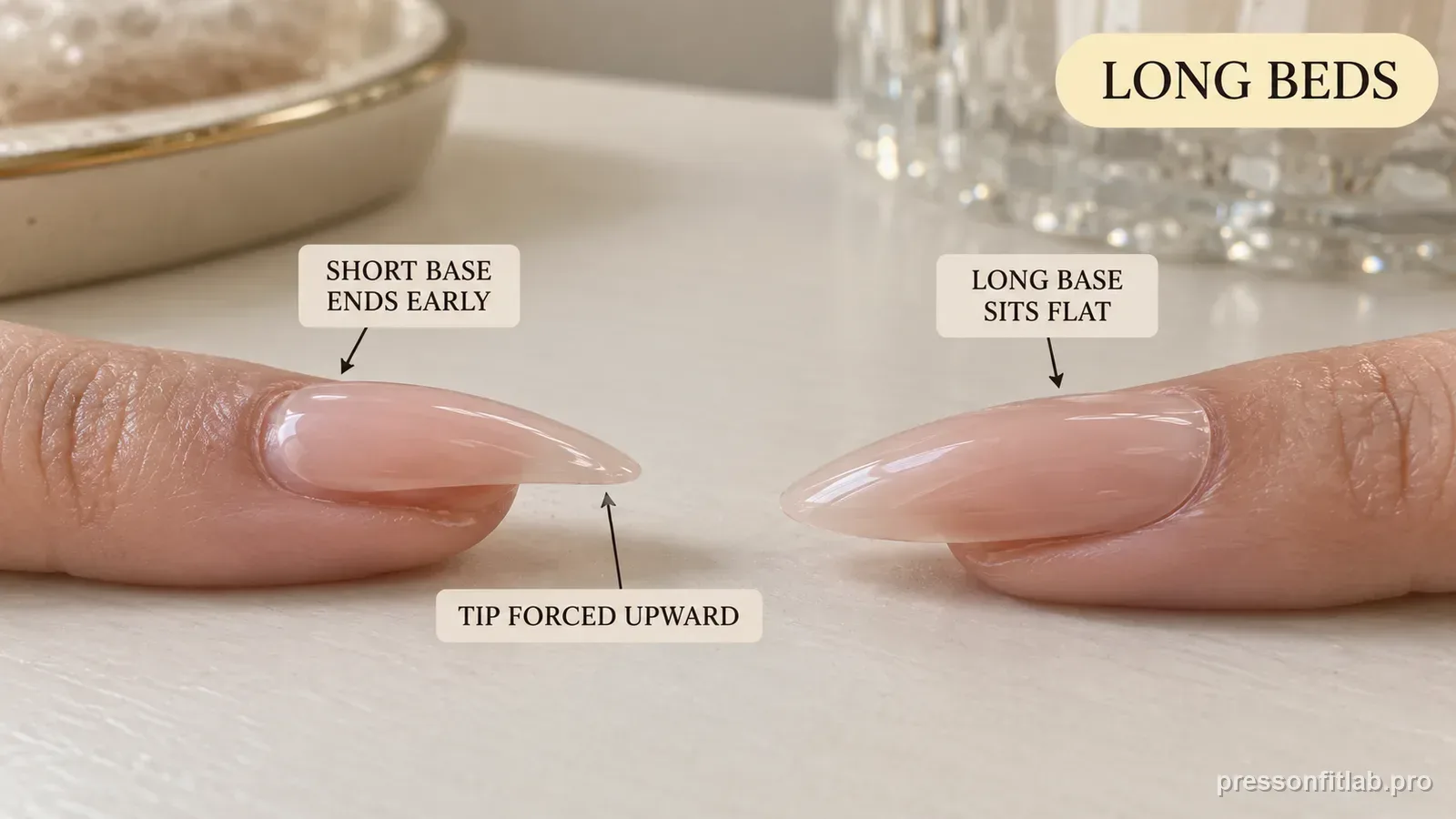
Natural free edge should not force the press-on upward
If your natural nail extends significantly under a short artificial tip, it can interfere with seating depending on the product shape. Keep the natural nail at a length compatible with the press-on system and follow its preparation directions.
Do not carve out the underside of a finished press-on unless the manufacturer specifically supports that modification. Choosing sufficient base length is the cleaner fix.
Pay special attention to thumbs and middle fingers
Long nail beds are not always uniform across a hand. A thumb may need both extra width and extra base length, while the ring finger fits a standard mold. Lay out the ten tips in order and judge each finger individually.
If only one finger is the outlier, a different tip from the set may solve it without moving the whole manicure to a longer category.
Record length-fit notes alongside millimeters
Width measurements travel well between brands, but they do not capture base length. Add a short note such as “long thumb bed” or “middle finger needs longer base.” Photos of a successful dry fit can also be useful references.
The goal is not to turn nail-bed length into another universal number system. It is to preserve enough information to recognize the same fit issue quickly next time.
Diagnostic table
| What you see | What it suggests | Next check |
|---|---|---|
| Natural nail shows near free edge | Artificial base is too short | Choose a longer full-cover mold |
| Tip reaches only when moved away from cuticle | Base length mismatch | Do not trade a cuticle gap for front coverage |
| Longer style covers length but overlaps sides | Width changed with mold | Re-size by actual width |
| Only thumb is too long for set | Finger-specific length | Select a different thumb tip/profile if available |
A controlled test plan
- 1
Dry-fit from cuticle area to natural free edge.
- 2
Reject any tip that only reaches when shifted forward.
- 3
Re-check width and curve in the longer candidate mold.
- 4
Prepare natural length according to the product directions.
- 5
Record which fingers require extra base length.
What not to do
- Leaving a large cuticle gap so a short base reaches the front.
- Assuming all long styles have the same base dimensions.
- Grinding the underside to manufacture extra room without product guidance.
- Ignoring one long thumb because the other nine fit.
Worked troubleshooting example
Example: your middle finger tip matches sidewall width but your natural free edge is visible because the artificial base ends too early. Sliding the press-on forward hides that edge, but now there is an obvious gap near the cuticle.
That tradeoff confirms the problem: the base is too short. Move to a longer full-cover mold and re-check the width from scratch. If the longer mold is wider, choose the closest comfortable width; make only minor edge adjustments when that tip material and manufacturer instructions support filing.
Save “middle finger needs longer base” with your measurements. On future sets you can test that finger first and avoid applying nine nails before discovering the tenth cannot be covered properly.
Field notes
Long nail-bed fit is a coverage question before it is a fashion-length question. You can still choose a short-looking manicure if the full-cover base is long enough and the free edge is shaped appropriately.
A set with many sizes can still fail if the molded base is consistently short. Width assortment and base-length coverage are separate product characteristics.
Frequently asked questions
Can I wear short press-ons with long nail beds?
Yes, if the molded base fully covers the nail plate and the visible extension can still be kept short.
Why does my natural nail show under a press-on?
One possibility is that the full-cover tip is too short for your nail bed or has been positioned too far forward.
Should I leave a cuticle gap to make the press-on reach?
Do not use a large cuticle gap as a sizing fix. Choose a mold with enough base length instead.
Sources checked
Sources below are page-specific. We prioritize manufacturer directions for product-specific steps and use medical or dermatology guidance when a safety question requires it. Always follow the instructions for the exact adhesive or set you own.