Why Do Press-On Nails Lift When Playing Piano or Guitar?
Diagnose instrument-specific free-edge impacts, fingertip angle, and repeated force on press-on nails.
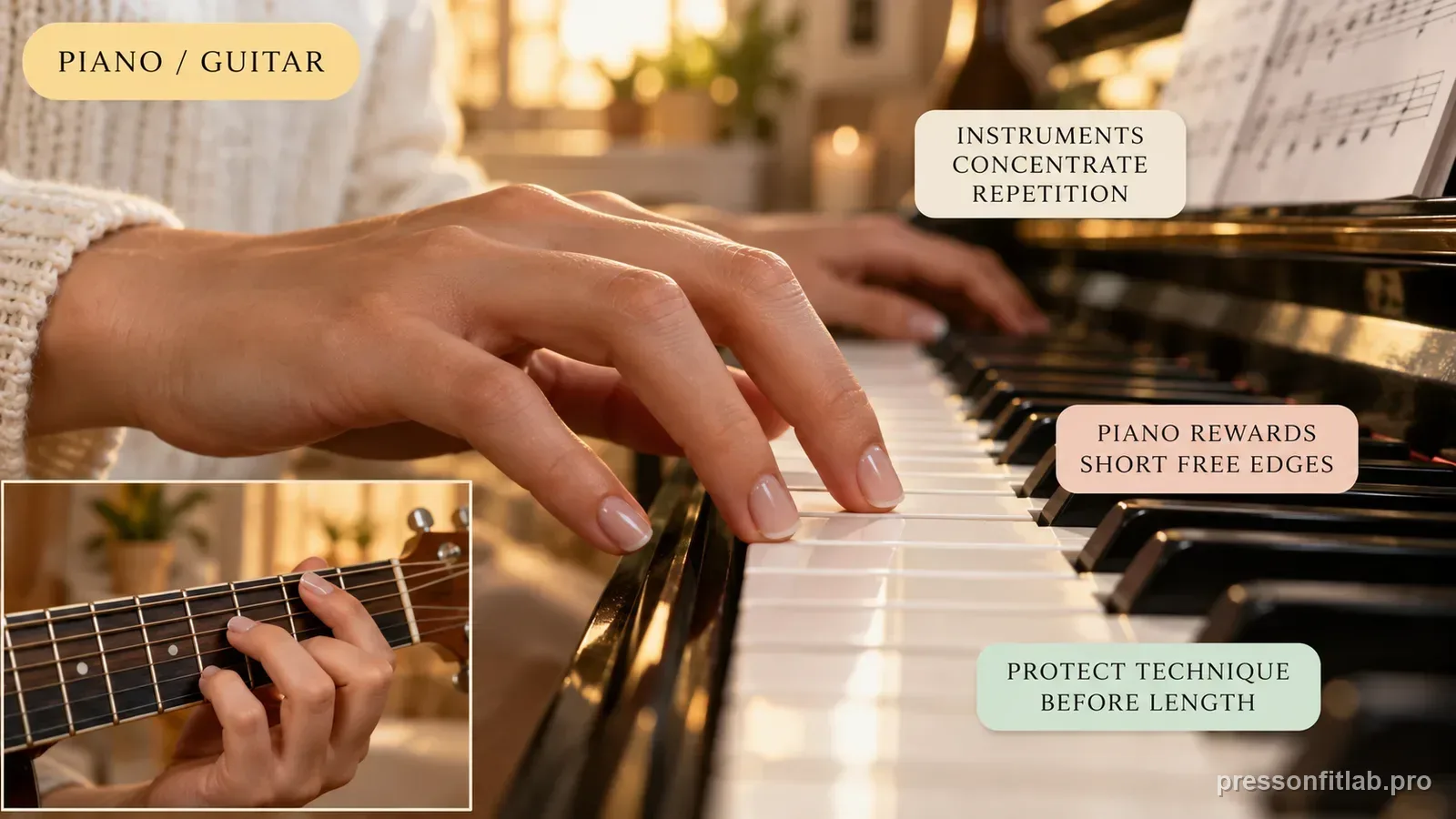
Piano and guitar can load press-ons more directly than ordinary typing. Piano may make the artificial edge strike the key before the fingertip, while guitar can require either very short fretting nails or deliberate string contact on the picking hand. If the shell repeatedly enters the instrument’s contact path, shorten or reshape the relevant fingers instead of simply adding more glue.
Check these first
- ✓ Do press-ons strike piano keys before fingertip pads?
- ✓ Does a fretting-hand nail contact the fingerboard and alter fingertip angle?
- ✓ Are picking-hand nails intentionally contacting strings?
- ✓ Do the same playing fingers fail repeatedly?
- ✓ Can a shorter test nail preserve normal technique?
Instrument use creates concentrated repetition
Musical playing combines high repetition with consistent contact angles. That makes it easier to identify exactly which fingers and edges are loading the press-on bond.
Piano troubleshooting starts with contact order. During a slow scale, observe whether the finger pad or the artificial edge reaches the key first. If the nail clicks before the pad and is then pushed backward with every note, the press-on is acting as a repeated impact surface rather than merely sitting above the fingertip.
Piano usually rewards short free edges
If the artificial nail reaches a key before the finger pad, every strike drives force through the shell and may also alter normal technique. Shorten until the intended fingertip contact is restored.
For fretting-hand guitar, the constraint is different: the fingertip often needs to approach strings with a steep enough angle that the nail clears the fingerboard. A press-on that touches wood first can force a flatter finger posture, reduce clean fretting, and simultaneously transmit pressure into the shell. Shortening is a technique-preserving fix, not just a wear fix.
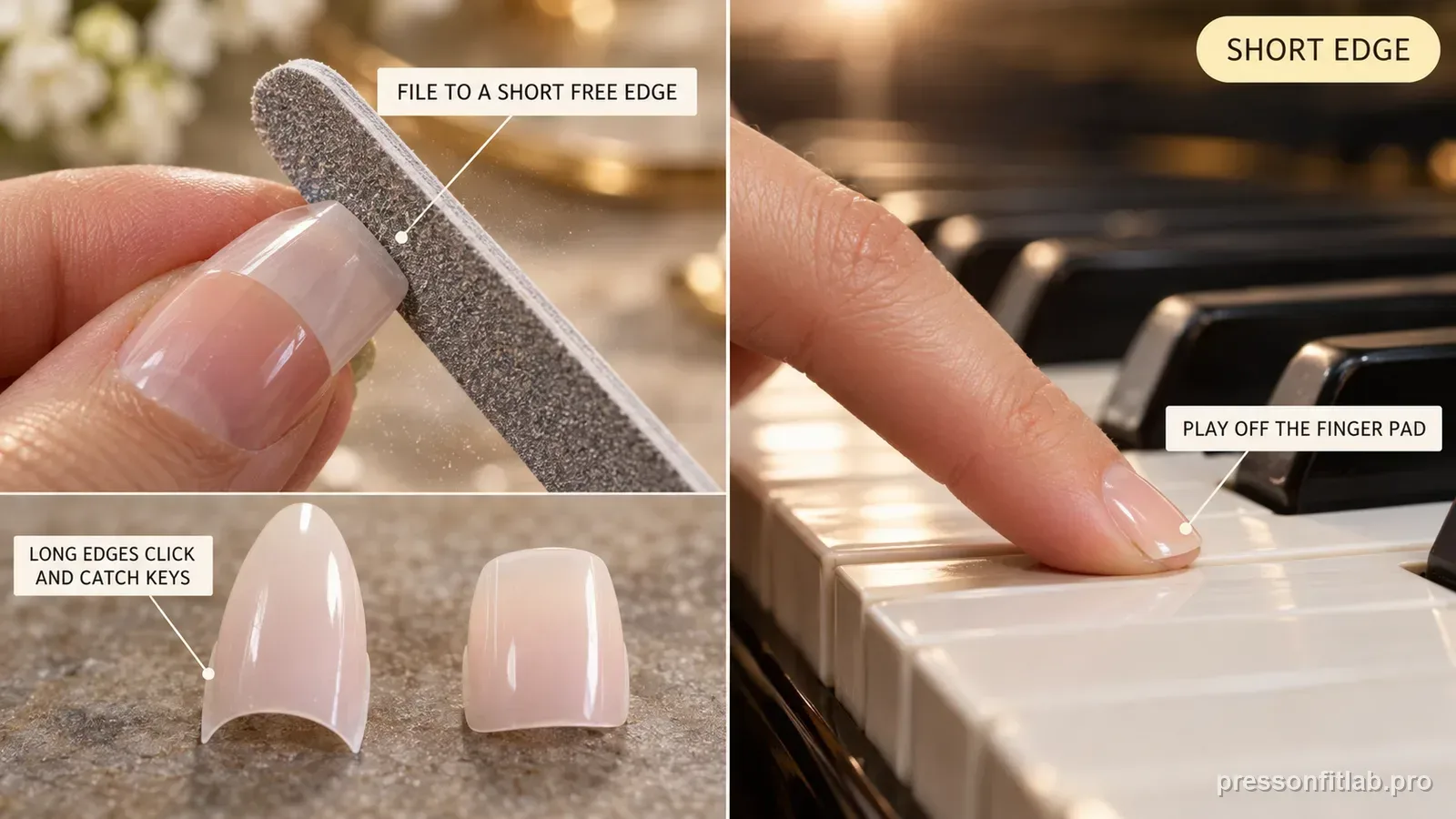
Fretting-hand guitar has a different constraint
Long nails can prevent the fingertip from approaching strings and fingerboard at the required angle, causing both playing interference and repeated pressure on the artificial nail.
Picking-hand guitar can intentionally load nails, so ask whether the press-on is being used as a plectrum substitute. Consumer fashion shells are not automatically engineered for repeated string attack. Inspect for edge notching, cracks, white stress marks, or natural-nail discomfort and stop if structural damage appears.
Picking-hand guitar may use the nail intentionally
Some guitar techniques deliberately use nails against strings. In that case, impact is the function, not an accident. A fashion press-on should not be assumed to be a purpose-built playing nail; stop if it cracks, lifts, or causes pain.
Instrument-specific force is finger-selective. A pianist may stress index and middle fingers more; a guitarist may have nearly opposite requirements between hands. That makes a ten-finger uniform length unnecessary. Mixed lengths can be mechanically sensible even if they are less visually symmetrical.
Match the failure fingers to technique
A pianist’s index/middle pattern and a guitarist’s fretting-versus-picking pattern reveal different loads. Modify only the fingers exposed to the relevant mechanism.
Do not use adhesive strength to compensate for a nail that physically blocks correct technique. A stronger bond can transfer more of a string catch or key impact to the natural nail. If playing improves immediately when one shell is shortened, that is high-value evidence that geometry—not glue—is the limiting variable.
Protect technique before manicure length
Do not adopt uncomfortable hand positions just to preserve long artificial nails. Choose nail length around the instrument and test during a short practice session before committing to long wear.
Use normal practice material for the test, not an exaggerated stress session. Ten to twenty minutes of representative scales, chords, or repertoire is enough to reveal whether the free edge is in the movement path. The goal is to reproduce your real load while changing only nail length or shape.
Diagnostic table
| What you see | What it suggests | Next check |
|---|---|---|
| Piano nail clicks/strikes key first | Free edge too long for normal attack | Shorten until fingertip contact is restored |
| Fretting nail hits fingerboard | Length blocks proper fingertip angle | Use very short press-on or no extension |
| Picking shell cracks/lifts at edge | Repeated string impact | Use a shorter or purpose-appropriate setup |
| Only two playing fingers fail | Technique-specific load | Modify those fingers only |
| Shell rocks before playing | Underlying fit problem | Correct fit before instrument testing |
A controlled test plan
- 1
Identify exact fingers whose artificial edges touch keys, strings, or fingerboard.
- 2
Shorten one high-contact nail while keeping application variables unchanged.
- 3
Play a normal short practice session.
- 4
Inspect immediately afterward for early cuticle/sidewall lift.
- 5
Adopt the shortest length that allows normal technique without repeated shell impact.
What not to do
- Changing healthy technique to protect long nails
- Using extra glue to counter constant key/string impact
- Treating fretting and picking stresses as identical
- Playing through a cracked or painfully lifting shell
- Assuming typing-compatible length is piano-compatible
Worked troubleshooting example
Noah typed comfortably with medium almond press-ons, but piano practice made both index nails lift. He noticed an audible click because the artificial edge reached the key before his fingertip.
He shortened one index until the pad contacted normally and left the other hand unchanged for comparison.
After several practice sessions the shortened nail stayed stable while the longer control developed proximal lift, isolating instrument-specific free-edge impact.
Field notes
Instrument wear is unusually localizable because players repeat the same movements. The same two or three fingers often reveal the whole mechanism.
Unexpected clicking of a press-on against a key or fingerboard is direct evidence that the artificial edge has entered the mechanical path.
Frequently asked questions
Can pianists wear press-ons?
Possibly, but usable length depends on technique. A shell that hits keys before the fingertip should be shortened.
Can guitarists use press-ons for picking?
Some players use artificial nails, but a fashion press-on is not automatically designed for repeated string work. Monitor cracking, lifting, and discomfort.
Why do only fretting-hand nails fail?
Those nails may be contacting the fingerboard or blocking normal fingertip positioning, a load the picking hand does not share.
Sources checked
Sources below are page-specific. We prioritize manufacturer directions for product-specific steps and use medical or dermatology guidance when a safety question requires it. Always follow the instructions for the exact adhesive or set you own.