Press-On Nail Turning White Under the Tip: What It Means
A white patch under a press-on tip usually points to trapped moisture or a lifted edge letting air in, not a defect in the press-on material itself.
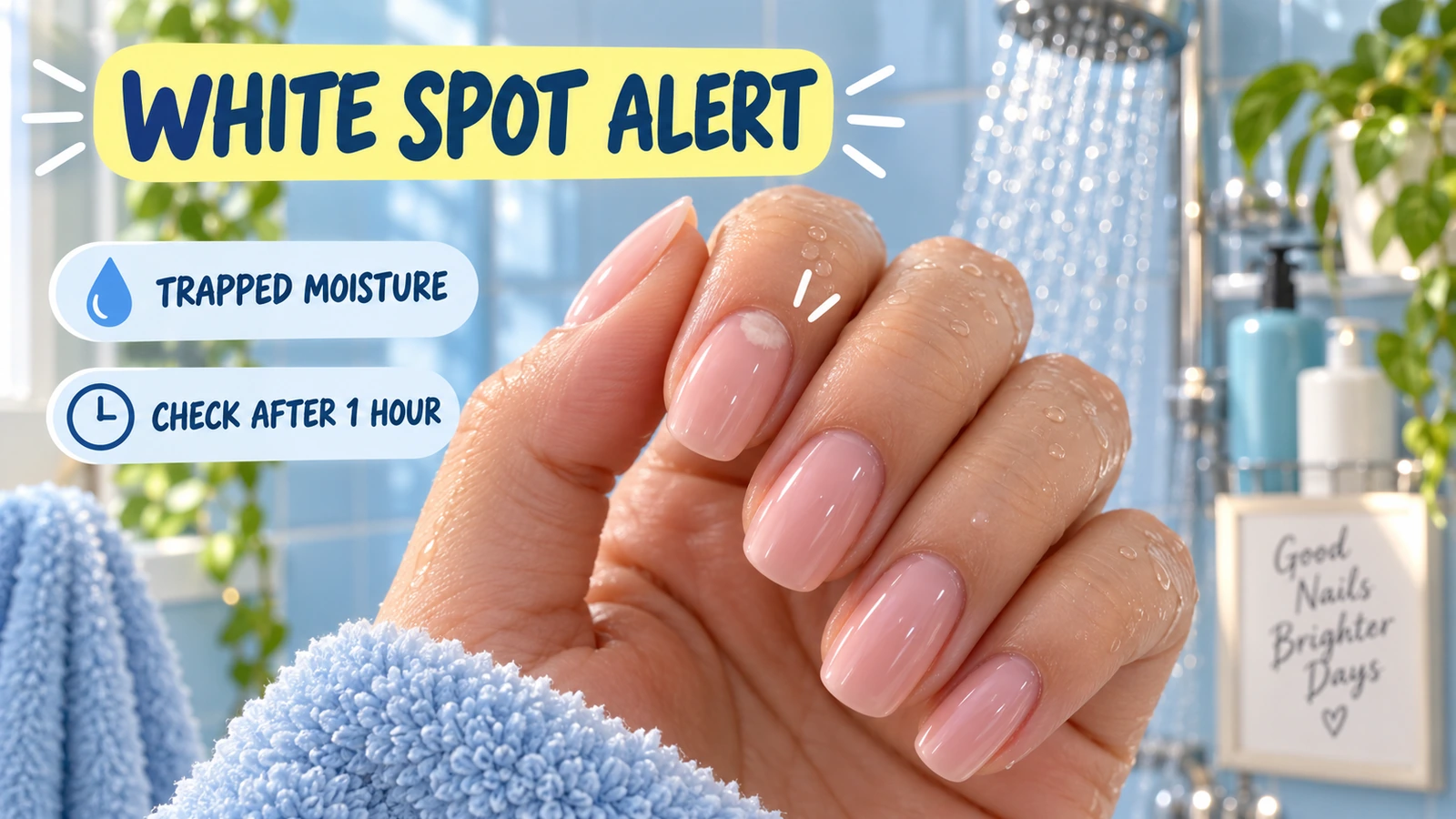
White discoloration visible through or under a press-on tip is most often trapped moisture or air under a partially lifted section, which scatters light differently than a fully bonded surface. It is rarely damage to the press-on material itself, but it does usually mean the bond has failed in that spot even if the nail has not popped off yet.
Check these first
- ✓ Is the white area only visible when the nail is wet, or does it stay white once fully dry?
- ✓ Can you see or feel a lifted edge anywhere near the white patch?
- ✓ Did the white area appear gradually over days, or suddenly after one specific wet activity?
- ✓ Is the white patch spreading toward the free edge or staying in one spot?
Why moisture under a nail looks white
When water or trapped air sits between a press-on and the natural nail plate, it changes how light passes through and reflects off that layer. A fully bonded, dry press-on transmits light fairly evenly against the natural nail color underneath; a pocket of moisture or air scatters that light differently, which reads visually as a whitish or cloudy patch rather than the nail's normal color showing through.
This is similar in principle to why a water droplet trapped under a screen protector looks like a pale patch — it is not that the material changed color, it is that light is behaving differently where a gap or moisture layer exists.
Temporary whitening that clears vs. whitening that stays
If the white patch appears right after a shower or dishwashing session and fades within an hour or two as the nail fully dries, that usually means water got under an edge temporarily but the bond itself is still largely intact — the moisture is finding its way back out rather than being permanently trapped.
If the white patch does not fade after the nail has clearly had time to dry, or if it keeps reappearing in the same spot after every wet activity, that is a stronger sign the bond has actually failed in that area and water is repeatedly getting into a real gap rather than just briefly sitting on the surface.
Where the white patch shows up tells you something
A white patch that starts at the cuticle end and does not extend toward the free edge often points to a small lift right at the base, sometimes from placement that left a slight gap during application rather than anything that happened afterward. A white patch that starts at the free edge and grows inward over several days more often points to a slow-progressing lift from daily wear and tear, since the free edge takes the most repeated mechanical stress.
Either pattern is worth treating the same way in practice: as an early sign that a specific spot has lost its bond, whether or not the nail feels loose yet to the touch.
What to actually do once you see it
A press-on with a persistent white patch is functionally already lifted in that spot, even if it still feels stuck everywhere else. Continuing normal wear risks the lift spreading further, since a pocket of trapped moisture flexes more than a solid bond does with every bump or grip. The most reliable fix is treating the affected nail the same way you would treat any confirmed lift: address it before it progresses to a full pop-off, rather than waiting to see if it resolves on its own.
It is not necessary to remove the entire set for one nail with a white patch. Addressing that single nail — checking whether it can be re-secured, or planning for its earlier replacement — while leaving properly bonded nails alone is a more efficient response than treating the whole set as compromised.
Diagnostic table
| What you see | What it suggests | Next check | |
|---|---|---|---|
| Pattern | Likely explanation | How urgent | What to do |
| White patch fades within an hour of drying | Brief moisture under a mostly-intact bond | Low | Monitor; no action usually needed yet |
| White patch persists after nail is fully dry | Real lift trapping moisture or air | Moderate | Treat as a confirmed lift on that nail |
| White patch starts at cuticle, doesn't move | Small base-level gap from application | Moderate | Check if it can be re-secured at the base |
| White patch starts at free edge, spreading inward | Progressive lift from mechanical wear | Higher | Plan for early replacement of that nail before it pops off |
A controlled test plan
- 1
Note whether the white patch appears right after a wet activity and check again after the nail has had a full hour to dry.
- 2
Gently press near the white area (not hard enough to force it further) to see if you can feel any give or looseness.
- 3
Track whether the patch's size or position changes over a few days rather than judging from a single observation.
- 4
If the patch is persistent, treat that specific nail as lifted and follow your normal repair or early-replacement approach rather than waiting.
What not to do
- Assuming a white patch is a manufacturing defect in the press-on material before checking whether it's moisture-related.
- Ignoring a persistent white patch because the nail doesn't feel loose to the touch yet.
- Removing the entire set over one nail's white patch when only that nail needs attention.
- Repeatedly wetting the same nail (dishes, showers) without drying it fully in between once you've noticed a persistent patch there.
Worked troubleshooting example
After a morning shower, a small pale patch is visible near the base of one nail. By early afternoon, once hands have been dry for a few hours, the patch is gone and the nail looks and feels normal — this pattern points to brief trapped moisture rather than a real lift, and no action is needed.
A different nail shows a similar-looking pale patch near the free edge that is still visible the next morning, well after any wet activity. Gently pressing near the area reveals a small amount of give that was not obvious just from looking. This nail is treated as lifted: it gets re-secured following the standard repair approach for a partial lift, rather than being left to see if the patch resolves on its own, since a full day of persistence after drying is a stronger signal than a same-day patch that fades.
Field notes
A white patch that only shows up under bright direct light and disappears under normal indoor lighting is more likely a very shallow, mostly-resolved moisture spot than a real structural lift.
Patches near the cuticle are sometimes present from the very first day after application, which usually points back to placement during application rather than anything from daily wear.
Frequently asked questions
Does a white patch under a press-on mean it's ruined?
Not necessarily. If it fades within an hour or two of the nail being fully dry, it was likely brief trapped moisture. If it persists well after drying, it usually means that spot has lifted and needs attention, but the rest of the nail is often still fine.
Why does the white patch only show up after I shower or wash dishes?
Water is getting under an edge, even a very small one, and briefly changes how light passes through that spot. If it clears once the nail fully dries, the bond there is likely still mostly intact and just letting in moisture temporarily.
Should I remove the whole set if one nail has a white patch?
Usually not. Address the specific nail that shows the persistent patch — checking whether it can be re-secured or needs earlier replacement — rather than treating properly bonded nails on the same set as compromised.
Is a white patch the same thing as a visible air bubble?
They're related but not identical. A visible raised or domed air bubble is usually easy to see as a shape change, while a white patch can appear on a spot that still looks flat, making it a subtler early sign of the same underlying issue: air or moisture where there should be solid contact.
Sources checked
Sources below are page-specific. We prioritize manufacturer directions for product-specific steps and use medical or dermatology guidance when a safety question requires it. Always follow the instructions for the exact adhesive or set you own.