Press-On Nails While Gardening: What Actually Holds Up
Soil, repeated water exposure, and glove friction stress press-on bonds differently than everyday wear. Here is what actually shortens wear time outdoors.
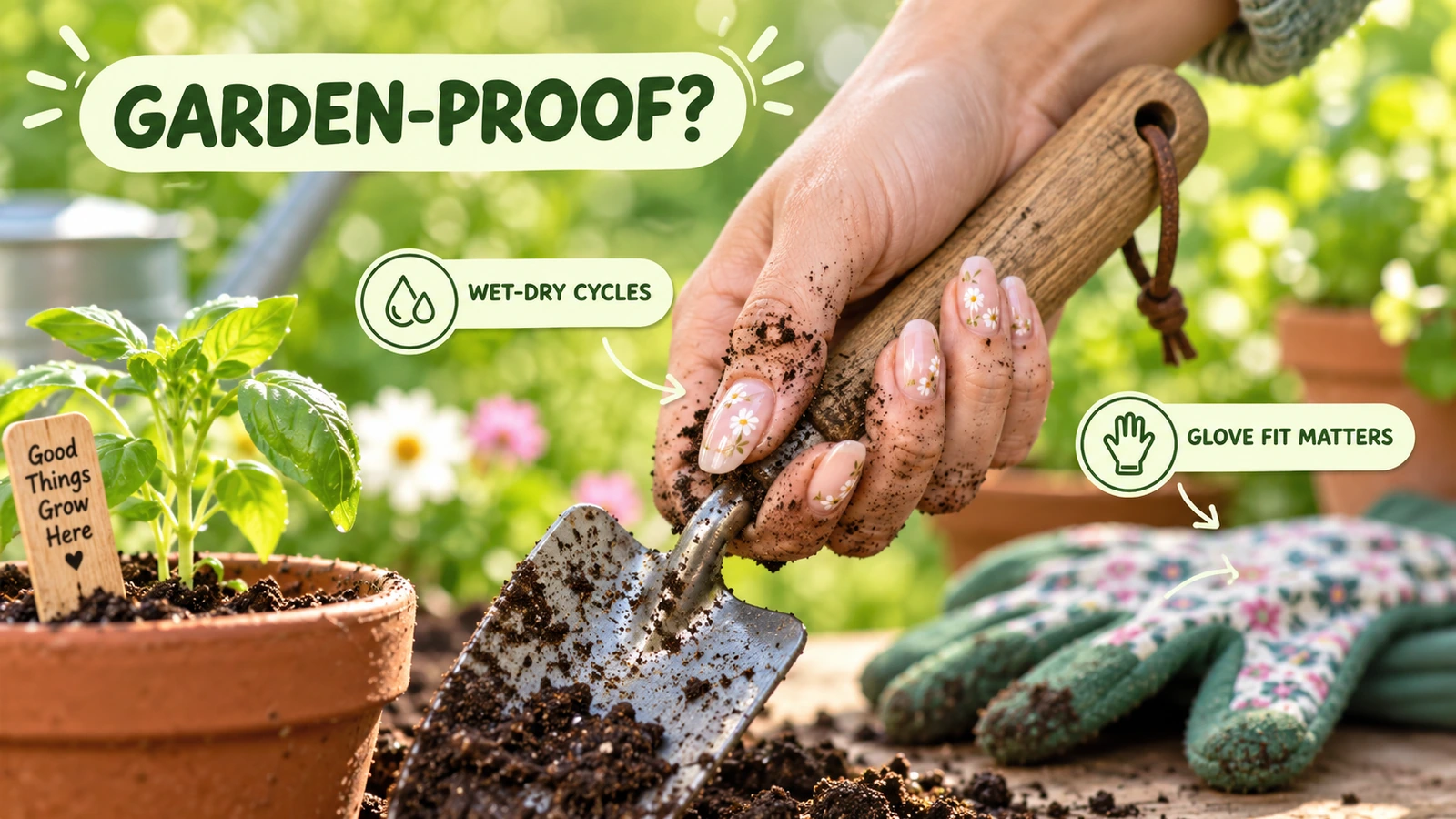
Gardening combines three specific stresses at once: repeated wet-to-dry cycling from soil and hose water, direct lateral force from pulling weeds or gripping tools, and grit working into any existing lift point. A well-fitted, well-cured press-on can usually survive light garden work; heavy digging or prolonged glove wear is where most gardening-related pop-offs happen.
Check these first
- ✓ Did you wait the full cure time before gardening, not just before it felt dry to the touch?
- ✓ Are you wearing gloves, and do they fit snugly at the fingertips without bunching?
- ✓ Is soil or grit visibly packed at any nail edge after a session?
- ✓ Did lifting start at a spot that already had a small gap before you went outside?
Wet-to-dry cycling is the real stressor, not water itself
A single wash or a quick rinse rarely does much to a properly cured press-on bond. Gardening is different because it usually means repeated wetting and drying within the same session: soaking soil, rinsing hands at an outdoor spigot, wiping hands on a towel, then getting them wet again a few minutes later. That cycle expands and contracts the adhesive layer repeatedly in a short window, which is a meaningfully different load than one shower or one dish-washing session.
If you already had a marginal bond anywhere on a nail, several wet-to-dry cycles in a row during a gardening session is a common way a slow lift turns into a full pop-off before the day is over. This is not a sign the press-on itself is defective; it is closer to how repeated freeze-thaw cycles stress a material more than one cold snap does.
Gloves help the bond but can hurt the fit
Gardening gloves reduce direct grit and moisture contact with the nail edge, which is genuinely protective for the adhesive. The tradeoff is fit: a glove that is snug everywhere except the fingertips can let the fingertip area bunch or shift slightly with every grip, and that repeated shifting transfers small amounts of shear force to the free edge of the press-on over the course of a task like pulling weeds.
If you garden in press-ons regularly, a glove sized specifically to your hand rather than a generic one-size-fits-most glove reduces this fingertip slack. It will not fully eliminate friction at the free edge during heavy pulling motions, but it removes one avoidable source of it.
Grit under the free edge is a slower, quieter failure mode
Soil and fine grit can work their way under a free edge that already has any degree of lift, even a lift too small to notice by feel. Once grit is trapped there, it acts as a tiny wedge every time the nail flexes, which can widen a barely-there lift into a visible gap over a few gardening sessions rather than all at once.
Checking free edges for trapped debris after a gardening session, and gently clearing it out rather than leaving it, is a small habit that prevents this specific slow-failure pattern from compounding session after session.
Which garden tasks put the most load on a press-on bond
Hand-pulling deep-rooted weeds, twisting a hose nozzle repeatedly, and gripping a trowel handle at an angle all put lateral or twisting force on the nail tip specifically, which is a harder load for an adhesive bond to resist than straight-down pressure. Tasks like watering with a wand, light deadheading, or arranging potted plants put much less lateral stress on the nail and are considerably lower risk for a same-day pop-off.
If you know a gardening day will involve heavy pulling or digging, treating that day like a higher-risk wear day — checking fit and cure time carefully beforehand — is more useful than assuming any well-applied press-on will hold up the same regardless of the specific task.
Diagnostic table
| What you see | What it suggests | Next check | |
|---|---|---|---|
| Symptom | Likely cause | What to check | What usually helps |
| Lift appears after one long session | Repeated wet-to-dry cycling | How many times hands got wet and dried during the session | Shorter sessions or a mid-session dry-off pause |
| Fingertip nail shifts inside glove | Glove fit, not adhesive failure | Whether the glove bunches at the fingertip specifically | A better-fitted glove or trimming excess glove material at the tip |
| Slow-widening gap over several sessions | Trapped grit acting as a wedge | Whether debris is visible under the free edge after gardening | Clean the free edge after each session, don't ignore small lifts |
| Sudden pop-off during heavy pulling | Direct lateral shear on the tip | What task was happening at the moment of pop-off | Avoid heavy pulling tasks on days right after fresh application |
A controlled test plan
- 1
After your normal cure time, do a short 5-minute low-intensity task (light watering, arranging pots) before committing to a full gardening session.
- 2
Check every free edge for trapped grit immediately after that short task, before it has a chance to work in further.
- 3
If nothing has shifted, move to a longer session but keep gloves on for any digging, weeding, or tool-gripping tasks.
- 4
After the full session, inspect every nail for lift at the cuticle, sides, and free edge, and address any new gap immediately rather than waiting for the next session.
What not to do
- Starting a heavy gardening session immediately after application, before full cure time has passed.
- Gardening bare-handed for tasks that involve pulling, digging, or repeated tool gripping.
- Leaving visible trapped grit under a free edge instead of clearing it after a session.
- Assuming a glove fits well just because it fits the palm; check the fingertip fit specifically.
Worked troubleshooting example
Someone plans a Saturday morning of transplanting seedlings and a Saturday afternoon of pulling weeds from a bed that has not been touched in months. The transplanting work is light: mostly gripping small pots and patting soil, minimal lateral force, gloves optional. The weed-pulling work is the higher-risk half of the day: sustained gripping and pulling at awkward angles, exactly the kind of lateral load that stresses a free edge.
Wearing gloves specifically for the afternoon weeding block, taking a short break to rinse and dry hands fully rather than working through repeated wet-dry cycles, and checking every nail edge for trapped soil before moving to the next garden bed keeps the day's cumulative stress well below what caused a previous pop-off during an ungloved, all-afternoon digging session.
Field notes
A gardener who does light container work weekly reported no meaningful difference in wear time compared to normal daily activities, while the same person's heavy fall bed-clearing sessions reliably produced at least one pop-off by the end of the day.
Grit trapped under a free edge is often invisible until you run a fingertip lightly across the nail edge; a visual check alone can miss it.
Frequently asked questions
Do press-on nails hold up for a full day of gardening?
Light tasks like watering, deadheading, or container work rarely cause problems. Heavy digging, pulling deep-rooted weeds, or repeated tool gripping put more lateral stress on the nail tip and are more likely to cause a pop-off within the same day, especially without gloves.
Do gardening gloves protect the press-on bond?
Yes, mainly by keeping grit and repeated moisture away from the nail edge. The tradeoff is that a poorly fitted glove can let the fingertip shift slightly with every grip, which adds its own small amount of stress, so glove fit matters as much as wearing gloves at all.
Why did my nail lift only after gardening, not during normal daily wear?
Gardening often combines repeated wet-to-dry cycling with direct lateral force in a way normal daily wear does not. A bond that was fine for typing or light chores can still be pushed past its limit by a few hours of pulling and repeated hand-washing outdoors.
Should I remove press-ons before a full day of yard work?
If the day involves heavy digging or extended tool use and you are not confident in the fit and cure of your current set, removing them or wearing gloves for the heaviest tasks is a reasonable precaution rather than risking a mid-task pop-off.
Sources checked
Sources below are page-specific. We prioritize manufacturer directions for product-specific steps and use medical or dermatology guidance when a safety question requires it. Always follow the instructions for the exact adhesive or set you own.