Can You Reapply Press-Ons Over Fresh Nail Polish?
Learn why polish creates another bonding layer and how to tell whether the press-on, polish, or nail interface failed.
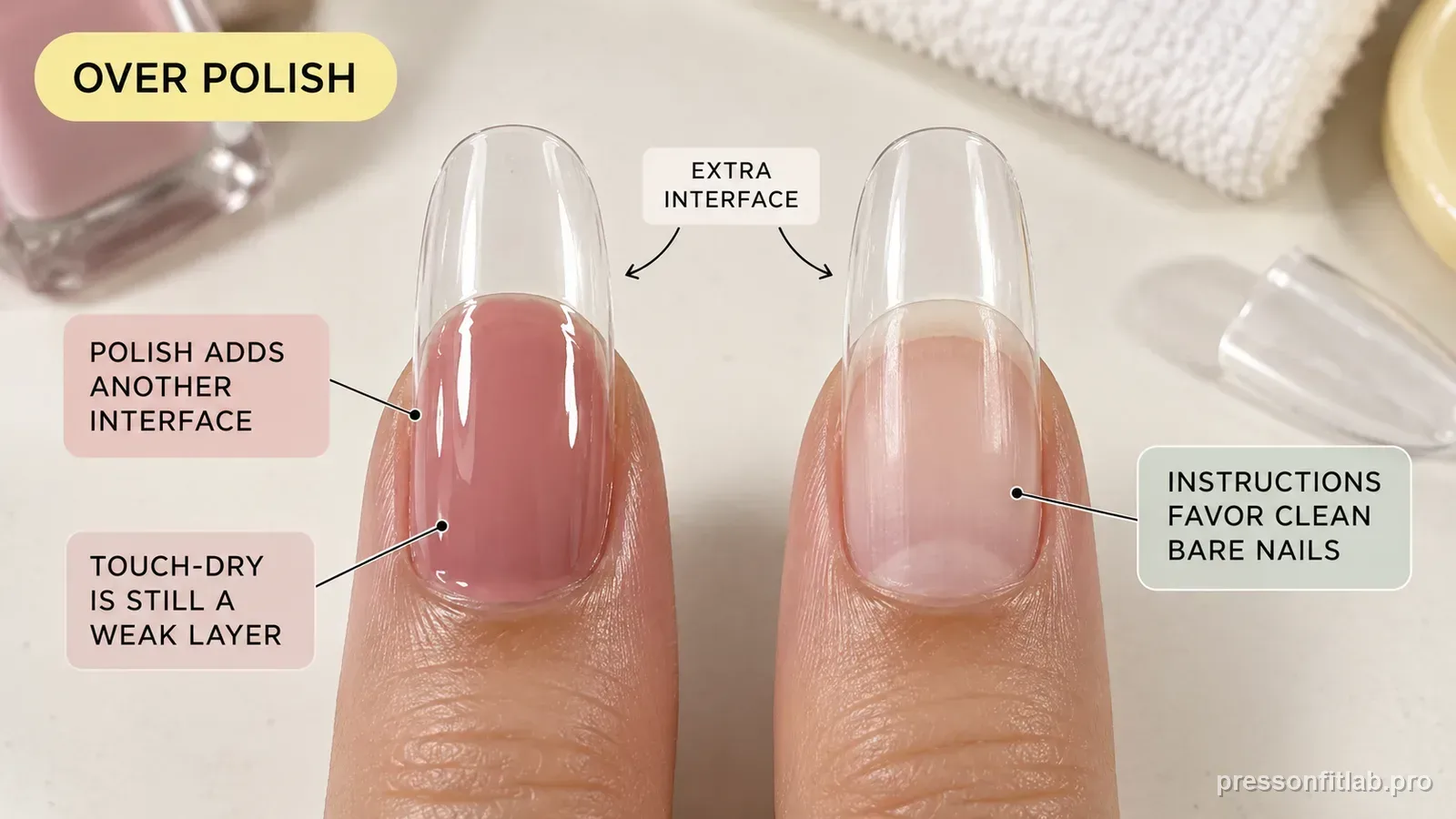
Fresh polish adds an extra layer between press-on glue and natural nail, and major press-on instructions generally call for polish-free prepared nails. Even if glue bonds strongly to the color coat, the whole assembly can release when the polish film lets go from the natural nail. For dependable long wear, bare properly prepared nail is the more predictable substrate.
Check these first
- ✓ Is the polish truly hardened rather than still soft or dentable?
- ✓ Does the press-on brand instruct you to remove polish first?
- ✓ Did a failed shell carry a sheet of color with it?
- ✓ Is the polished surface glossy or recently oiled?
- ✓ Is preserving the manicure underneath more important than maximum press-on hold?
Polish creates another interface
The stack becomes natural nail to polish layers, polish to top coat, top coat to press-on glue, and glue to shell. Every added interface is another possible separation plane.
Think of the polish film as a removable coating, not as the natural nail. KISS instructs users to clean nails with polish remover before glue-on application, and Glamnetic similarly says nails should be free of polish or residue. Those directions remove an entire potential failure plane before bonding begins.
Press-on instructions favor clean polish-free nails
Both Glamnetic and KISS instruct users to clean/remove polish or residue before application. That is the best baseline when long wear and diagnostic predictability matter.
Fresh polish introduces two uncertainties: adhesion of the color system to the natural nail and the maturity of the coating itself. A manicure can be dry enough not to smudge yet still be more susceptible to pressure or solvent interaction than a fully aged film. That makes same-day long-wear glue tests particularly hard to interpret.
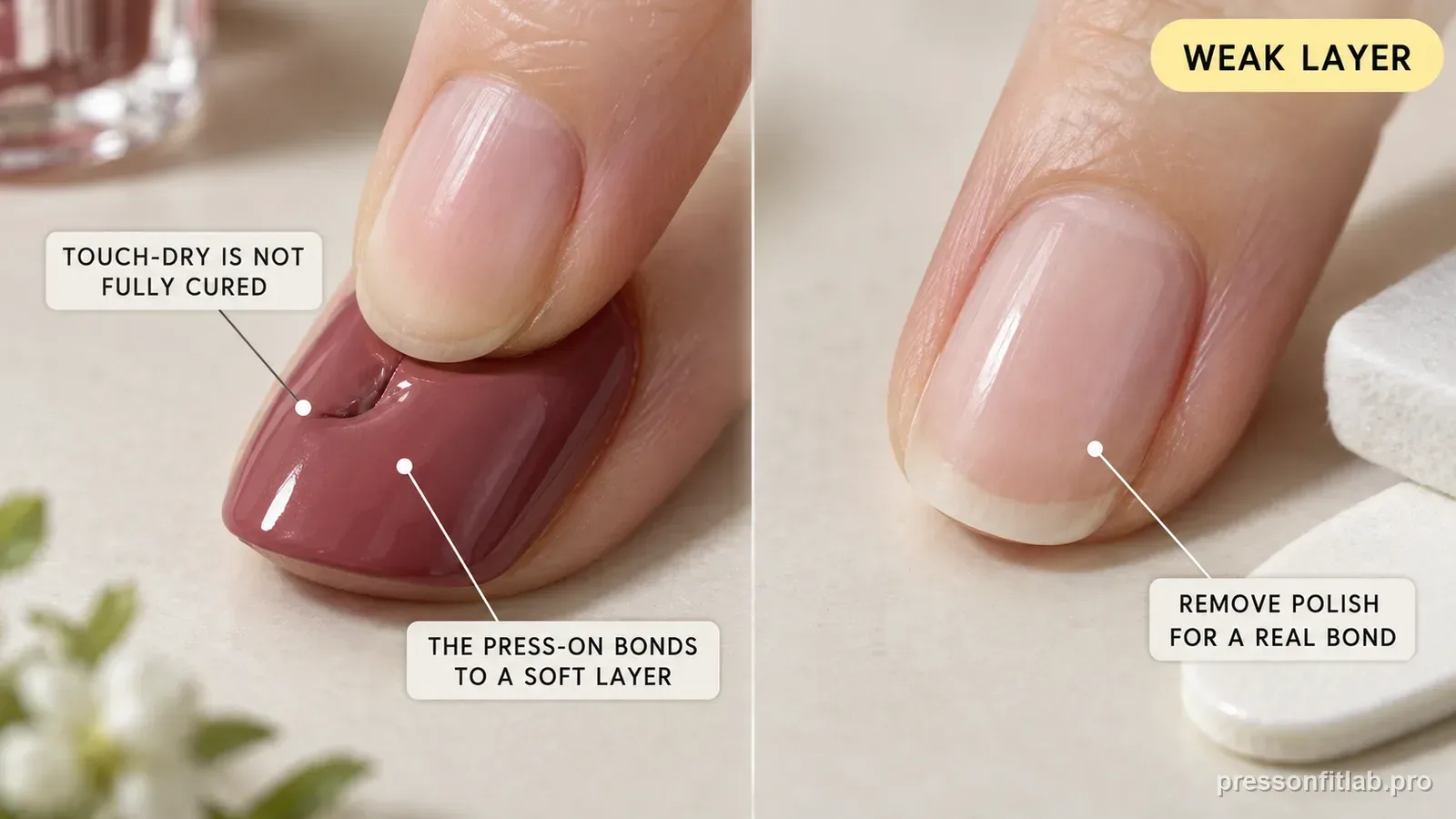
Touch-dry polish may still be a weak layer
A surface can feel dry while deeper layers remain vulnerable to pressure. A strong glue-to-polish bond can then peel the color film from the natural nail instead of holding the full stack in place.
Failure debris can tell a precise story. If the underside of the press-on carries an intact sheet of colored polish, the nail glue did not necessarily fail at all; the polish-to-nail interface did. If the polish remains perfect on the nail while glue releases cleanly from its glossy top coat, the upper interface is the weak link.
Gloss and oil complicate the upper interface
A smooth top coat and cuticle oil are different from the prepared nail surface specified by press-on instructions. Do not deeply file through a fresh manicure just to force an improvised bond.
Trying to roughen fresh polish creates a contradictory goal: you wanted to preserve the manicure, but now you are abrading its finish to make another adhesive stick. If long wear matters more, remove the polish and use the press-on system's normal prep. If preserving color matters more, accept a shorter-wear strategy rather than pretending both goals are identical.
Short decorative wear is a different objective
Someone may intentionally accept less predictable hold to preserve polish beneath a temporary look. In that case, choose an adhesive method designed for the intended short wear rather than expecting long-glue performance from a layered surface.
Oil added after polishing can migrate over the top coat and cuticle margin. Even if the polish film itself is sound, that contamination can make reapplication inconsistent. Do not confuse ‘polished’ with ‘clean’; the relevant surface for adhesion is whatever is physically on top at the moment of bonding.
The failed layers tell you what happened
Inspect before cleaning. If color is attached to the press-on, the polish-to-nail interface likely failed. If the polish remains perfect but glue releases from its glossy surface, the upper interface was weaker.
Avoid interpreting a successful one-night wear as proof that polish is equivalent to bare nail for two-week wear. Those are different performance goals. State the expected uncertainty clearly and choose the substrate according to whether reversibility or durability is more important for that application.
Diagnostic table
| What you see | What it suggests | Next check |
|---|---|---|
| Press-on comes off carrying color film | Polish separated from natural nail | Use bare-nail prep for stronger wear |
| Glue releases from intact glossy polish | Glue-to-polish interface weak | Remove polish and use specified prep |
| Polish dents under shell | Coating not fully hardened | Do not glue over soft manicure |
| Tabs work briefly but glue wear fails | Layered surface limits durability | Choose method around wear goal |
| Recently oiled nails fail | Surface contamination possible | Clean/prepare according to manufacturer |
A controlled test plan
- 1
Decide whether preserving polish or maximizing press-on wear is the priority.
- 2
For maximum wear, remove polish and use the brand’s bare-nail prep.
- 3
If a layered test fails, preserve the shell and polish long enough to inspect which layer separated.
- 4
Do not change glue strength until the failure plane is identified.
- 5
Use the observed layer failure to choose the next surface preparation.
What not to do
- Calling touch-dry fresh polish an ideal substrate
- Applying over peeling or chipped polish
- Deeply filing through polish into natural nail
- Adding more glue when the color film itself releases
- Ignoring manufacturer instructions that specify polish removal
Worked troubleshooting example
Olivia applied press-ons the morning after painting her nails. Two came off that evening with intact pink color stuck underneath.
The evidence showed that the glue had bonded to the polish while the polish released from the natural nail. For the next long-wear set she removed the polish and followed bare-nail preparation.
The early release stopped without changing glue, confirming that the added polish layer—not a sizing problem—had limited the previous stack.
Field notes
A press-on can fail while the glue itself is performing very well. A shell carrying an intact sheet of polish is strong evidence that the weak interface was underneath the glue.
Layer-by-layer inspection is especially useful for reusable shells because it tells you whether the next change belongs on the shell side or the nail side.
Frequently asked questions
Will nail glue stick to polish?
It may stick to the polish surface, but the complete assembly is only as strong as the polish’s attachment to the natural nail.
Can I use adhesive tabs over polish?
Possibly for a short-wear goal if the product allows it, but the polish still remains part of the bond stack.
Why do brands tell me to remove polish?
It eliminates an extra failure interface and gives the adhesive the prepared surface their instructions were designed around.
Sources checked
Sources below are page-specific. We prioritize manufacturer directions for product-specific steps and use medical or dermatology guidance when a safety question requires it. Always follow the instructions for the exact adhesive or set you own.