Best Press-On Nail Length for Typing: Find Your Personal Maximum
Choose a press-on length for typing by testing key travel, finger-pad contact, error rate, and leverage instead of using a universal short-versus-long rule.
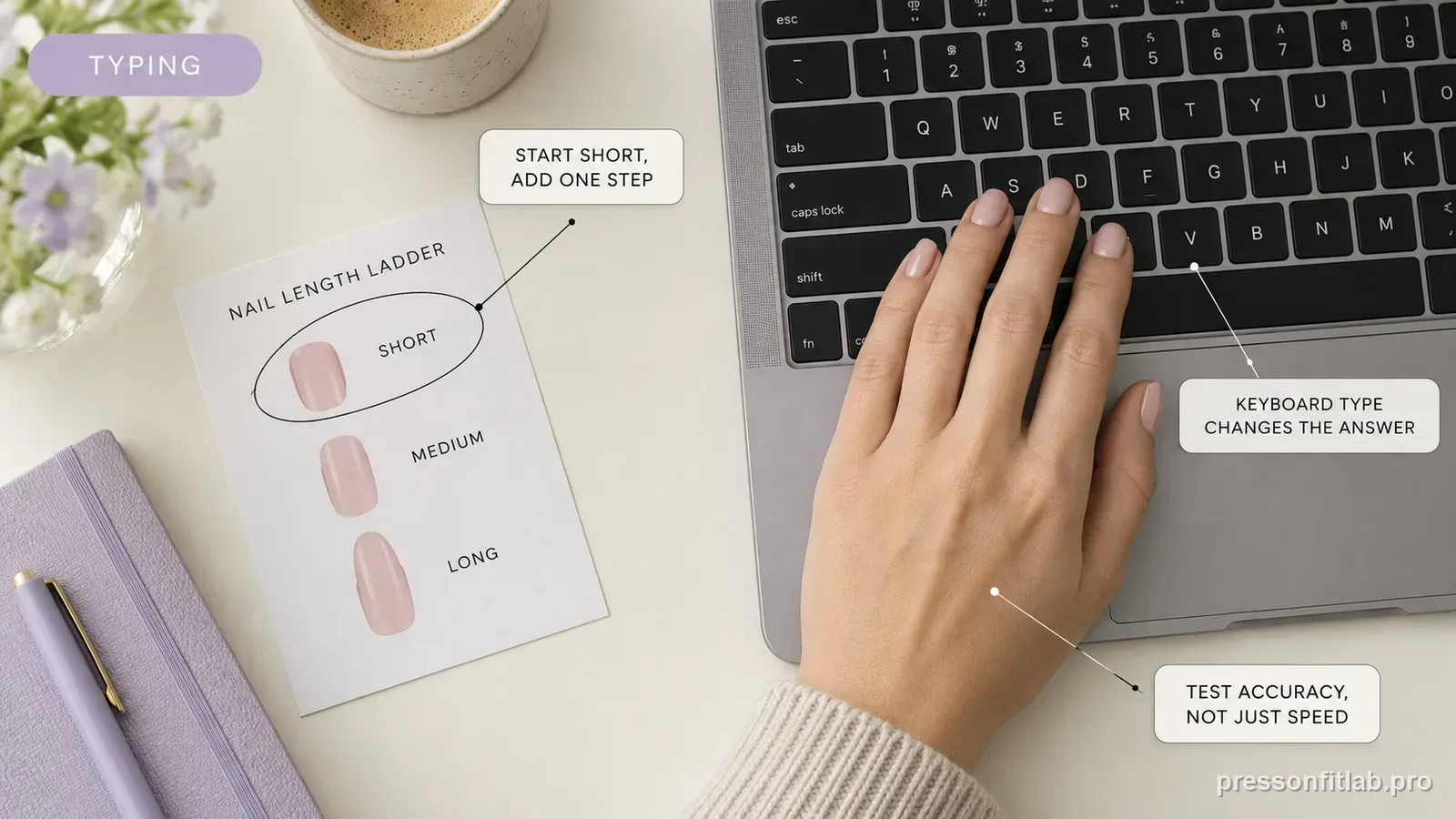
For most heavy typists, shorter press-ons are the easiest starting point because they let the finger pads reach keys with less hand-position change. But the “best” length depends on keyboard height, key spacing, nail shape, and your typing technique. Test short and medium lengths on your real keyboard and stop increasing length when accuracy, comfort, or nail stability clearly worsens.
Check these first
- ✓ Are you typing on a low-profile laptop, raised desktop keys, or both?
- ✓ Can your finger pads contact keys without the nail tip hitting first?
- ✓ Does one finger—often index, middle, or thumb—need a shorter tip?
- ✓ Are typing errors increasing because of length or because the nail is loose/rocking?
Keyboard geometry changes the answer
A laptop keyboard with very low-profile keys gives long nails less vertical space than a desktop or mechanical keyboard with taller keycaps. That is why two people wearing the same nail length can report very different experiences. The right test environment is the keyboard you actually use for hours.
Do not choose length from a product photo alone. Dry-fit the tip to judge fit, then use a securely applied set for real typing. Before adhesive, you can place your hand over the keyboard and simulate key reach without striking keys with loose tips. If the chosen nail length collides before the finger pad can land comfortably once applied, it starts with a mechanical disadvantage.
Start short, then increase one step
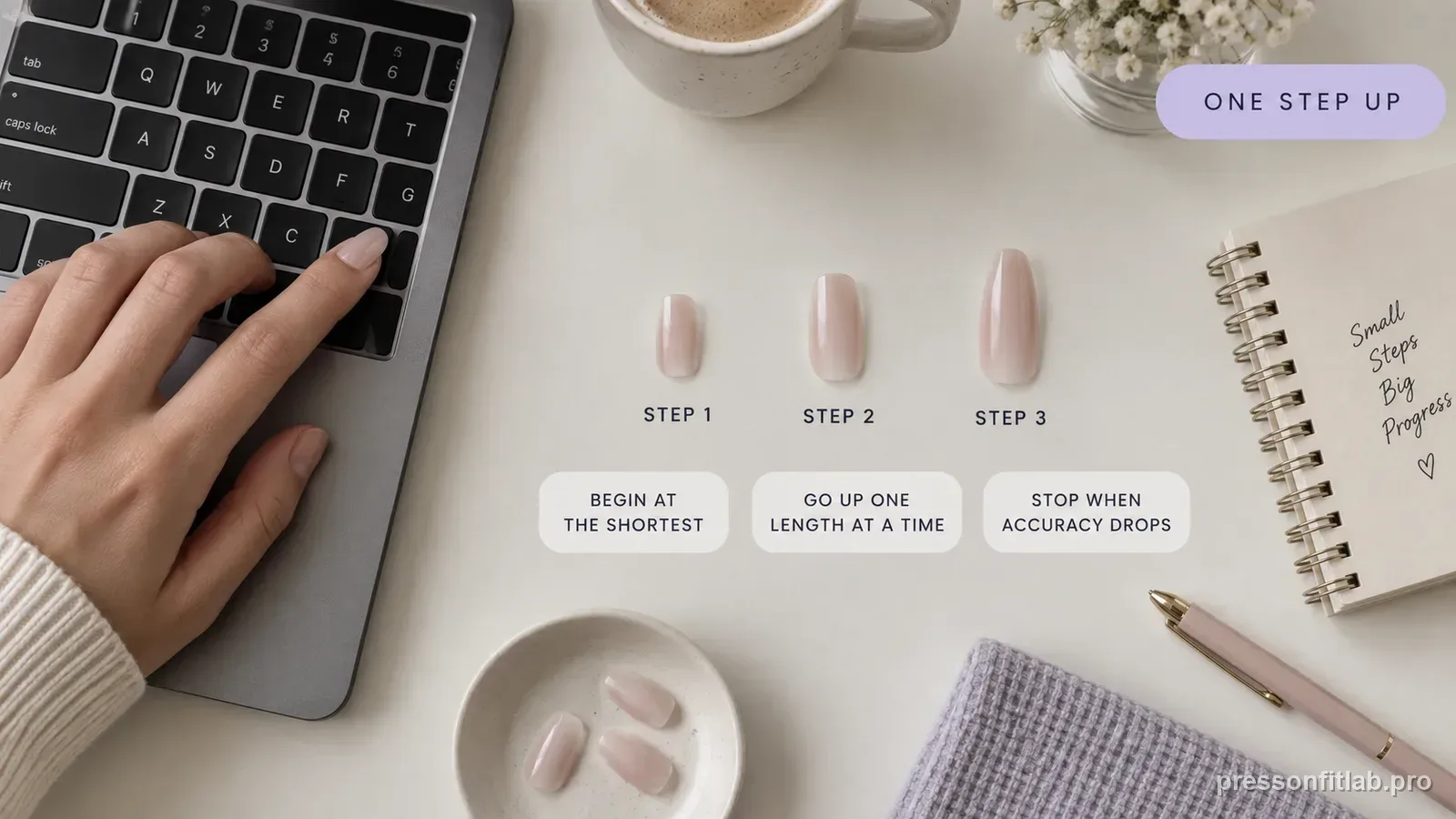
If typing is central to your day, use a short set as the baseline even if you eventually want medium or long nails. Record your comfort and error rate for a few work sessions. On the next set, increase length only one step so you can tell whether the change itself is responsible for slower typing or more catches.
This controlled progression is more useful than forcing yourself to adapt to an extra-long set immediately. Some people do adjust their technique; others remain more accurate with shorter nails. The goal is not to prove you can type with a certain length—it is to find a repeatable daily setup.
Finger-pad technique can reduce tip collisions
Some long-nail wearers adapt by changing hand angle and using more of the finger pad rather than approaching every key from directly above. Anecdotal user discussions also suggest keyboard type can matter, with raised keys feeling easier than thin laptop boards for some people; treat that as a use-case clue, not a universal rule.
Technique should not require pain or extreme wrist posture. If a nail length makes you hold your hands unnaturally for hours, shorten the set rather than protecting the manicure at the expense of comfort.
Different fingers can have different practical lengths
You do not have to treat all ten nails identically. A long thumbnail may interfere with spacebar use, while a long pinky may rarely touch a key. If a particular finger repeatedly catches or loosens, use a shorter spare in the same design and keep the others unchanged.
This finger-specific approach follows a cleaner troubleshooting principle: change one variable where the failure occurs instead of redesigning the entire set.
Measure typing success with more than speed
Words per minute is useful, but also track errors, hand tension, nail collisions, and whether a tip starts lifting after a long session. A length that preserves speed but repeatedly levers the index nail off is not a successful typing setup.
After several representative work sessions, you should be able to describe the longest comfortable daily length on each keyboard. Save that note with your nail widths so future sets are chosen for both fit and function.
Diagnostic table
| What you see | What it suggests | Next check |
|---|---|---|
| Nail tips hit keys before finger pads | Length too high for keyboard geometry | Try one shorter length |
| Typing slows but improves over days | Technique adaptation | Keep if comfortable and nails stay stable |
| Only index nails loosen | Finger-specific leverage | Shorten/refit those fingers |
| Laptop is hard, desktop keyboard is fine | Key height/spacing difference | Use different length strategy by device |
| Hands or wrists hurt | Technique/length is not sustainable | Reduce length and return to comfortable posture |
A controlled test plan
- 1
Use your normal keyboard and record a short baseline with your natural nails or current short set.
- 2
Dry-fit a short press-on and confirm finger-pad access to the most-used keys.
- 3
Wear short nails for several work sessions and log speed, errors, collisions, and lifting.
- 4
On the next set, increase to medium only if the short length was easy.
- 5
Stop at the first length that causes persistent comfort or stability problems and save that as your daily maximum.
What not to do
- Choosing extra-long nails because a social clip shows someone typing quickly with them.
- Tilting wrists into an uncomfortable position to avoid nail contact.
- Ignoring a loose nail and continuing to hammer it against keys.
- Assuming every keyboard will feel the same with the same set.
Worked troubleshooting example
Example: a medium almond set works on your mechanical keyboard but causes constant tip collisions on a low-profile work laptop. The nails fit correctly and do not rock, so the issue is not sizing.
You keep the same widths and curve but switch the index and middle fingers to the short version. Laptop errors drop and the nails stop hitting the key above the one you intend to press.
Your final profile says “medium on desktop; short index/middle for laptop-heavy weeks.” That is a personal maximum based on function rather than appearance.
Field notes
Typing is one of the best reasons to keep a per-finger nail profile. Heavy typists often discover that a single index, thumb, or middle finger is the real limitation while the rest of the set can stay longer.
If you frequently switch between a laptop and a desktop keyboard, test both. Your “best typing length” may be device-specific, which is more actionable than a universal short/medium label.
Frequently asked questions
Are short press-on nails better for typing?
They are usually the easiest starting point because they create less key collision and leverage, but keyboard design and technique can make medium lengths workable for some people.
Can I type with medium press-on nails?
Often yes. Test your real keyboard, keep comfortable wrist posture, and shorten any finger that repeatedly catches or loosens.
Do I need the same nail length on every finger?
No. A slightly shorter index, middle, or thumb can improve typing while preserving the overall look of the set.
Sources checked
Sources below are page-specific. We prioritize manufacturer directions for product-specific steps and use medical or dermatology guidance when a safety question requires it. Always follow the instructions for the exact adhesive or set you own.